Last Updated on March 5, 2026 by Maged kamel
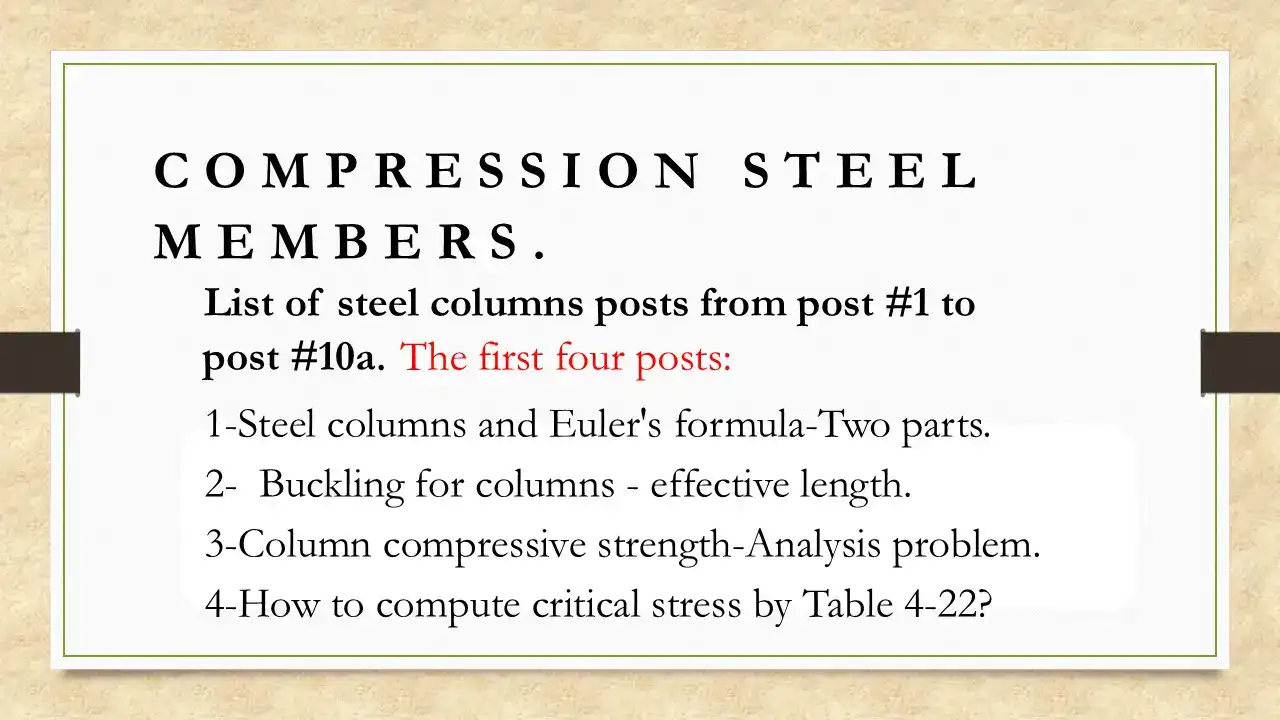
- List of compression Member Posts-part 1.
- Steel columns and Euler's formula- Two parts.
- Buckling for columns – effective length factors.
- Column compressive strength- Analysis problem.
- How to compute critical stress by Table 4-22?
- A Solved Problem 4-9 For available compressive strength.
- Alignment charts for columns.
- Solved problem 7-1 for the alignment chart for columns.
- Solved Problem 13-28 For Compression Members.
- Solved Problems for column analysis.
- 10- Introduction to Local Buckling.
List of compression Member Posts-part 1.
Steel columns and Euler’s formula- Two parts.
The first post of the Compression Member’s Posts includes four points. The first point is, what is the definition of compression members?
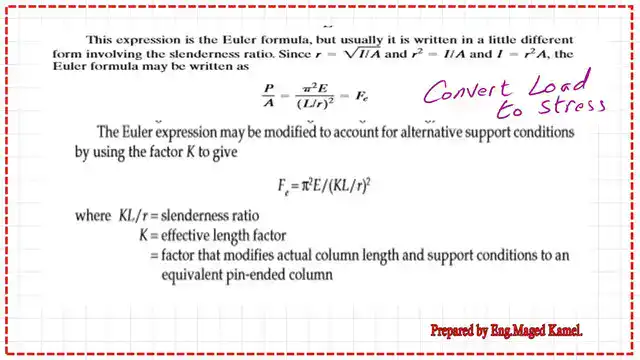
The second point will be Euler’s equation, including its derivation. The third point is what buckling is. The fourth point is how to estimate the critical load. The next image shows the Euler equation for stresses.
This is a link to the first post.
This is a link to the second post-1a.
Buckling for columns – effective length factors.
This is the third post in the Compression Member Posts-part 1 series, which discusses column buckling. If we apply an axial force to a straight column and gradually increase it, the load will eventually reach a value known as Pcr, at which the column will buckle.
As previously stated, the Pcr is the critical buckling load. Buckling occurs when a straight column is acted upon by a compressive force. It will be converted into another form that has a bending moment, as shown in Figure 1b earlier. Later, it was plumb to a deformed shape. There is a solved problem given, as shown.
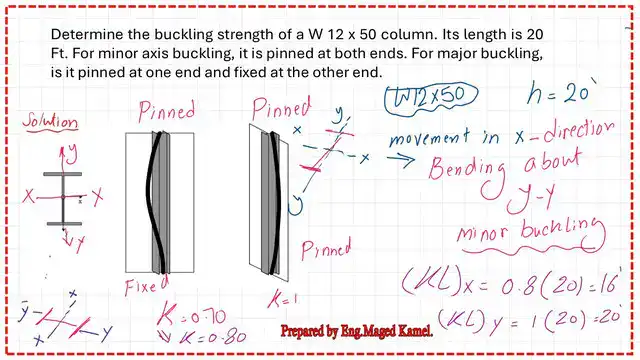
Buckling is identified as a failure limit state, the shape of failure for that column.
The link to post 2: Buckling for columns – effective length factors.
Column compressive strength- Analysis problem.
This is the fourth post in the compression member Posts-part 1, which includes solved problem 4.2 from Prof. William T. Segui’s handbook. solved problem 4.2 (estimate design compressive strength).

This is the link to post 3: Column compressive strength– Analysis problem.
This is the link to post 3a: Solved problem 4-2-how to find design compressive strength?
How to compute critical stress by Table 4-22?
This is the 7th post in the compression member Posts-part 1, which covers our subject: estimating compressive strength using tables.
The controlling factor that distinguishes short columns from long columns is the criterion Kl/r. We evaluate the maximum value in either the x- or y-direction.
The maximum kL/r value will yield the minimum compressive strength.
The link to post 4: How to compute critical stress by Table 4-22? The following post image explains the LRFD value estimation by using Table 4-22.

A Solved Problem 4-9 For available compressive strength.
This is the 8th post of the compression member Posts-part 1, which includes the solved problem, 4-9.
A solved problem example From Prof. William T Segui’s handbook solved problem 4.9 A W12×58, 24 feet long, is pinned at both ends and braced in the weak direction at the third point, as shown in Figure 4.11. A992 steel is used.
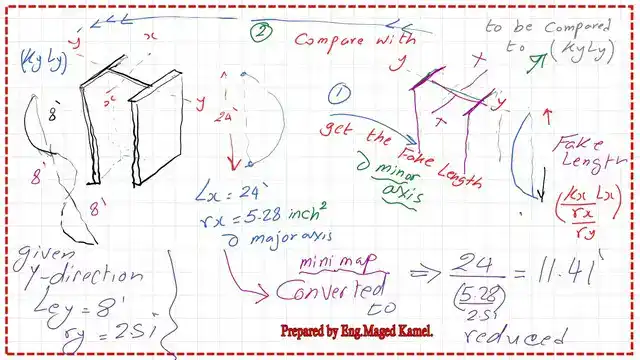
Determine the available compressive strength.
The link to post 5: A Solved Problem 4-9 For available compressive strength.
Alignment charts for columns.
This is the 9th of the compression member Posts-part 1, which includes a new subject: the use of the alignment chart for columns when attached to frames, whether braced or not. This graph was done by Anderson and Woodward, or Nomograph, or Anderson and Woodward.
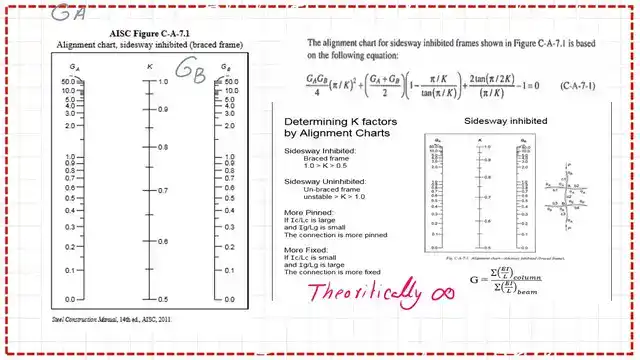
However, this method is based on certain assumptions: that the column and beam are elastic if those conditions are met, and that the adjusted factor should be used if the column is inelastic.
The link to post 6: Alignment charts for columns.
Solved problem 7-1 for the alignment chart for columns.
This is the 10th post of the compression member Posts-part 1, which includes a solved problem 7.1 from Prof. McCormack’s book. Determine the effective length factor for each of the frame’s columns shown in Fig.7.4.
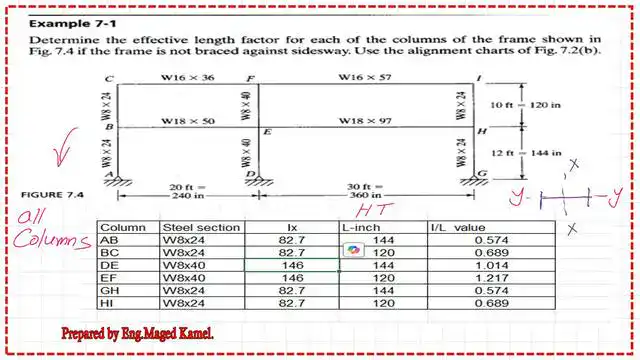
If the frame is not braced against the side-sway. Use the alignment charts in Fig. 7.2(b).
The link to post 7: Solved problem 7-1 for the alignment chart for columns.
Solved Problem 13-28 For Compression Members.
This is the 11th post in the Compression Member Posts series, which includes solved problem 13.28. The example from M.Iqbal. A W12 x 50 is used as a column, as shown. Fy = 50 ksi. The support is fixed at the bottom and has a guide roller at the top. It is required to estimate the available axial compression strength in kips.
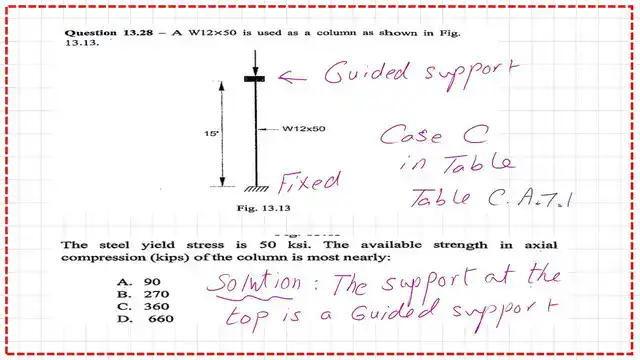
Select the correct answer from the following options 1) 90 kips, 2)270 kips 3)360 kips 4)660 kips. The link to post 8: Solved Problem 13-28 For Compression Members.
Solved Problems for column analysis.
This is the 12th post in the Compression Member Posts series, which includes two solved problems: 13.28A from M. Iqbal. It is used as a column, as shown. Fy = 50 ksi; the support is fixed at the bottom, and with a guide roller at the top, it is required to estimate the available axial compression strength in kips.
Select the correct answer from the following options 1) 500 kips, 2) 460 kips 3)580 kips 4) 600 kips.
The second solved example 13-28a.
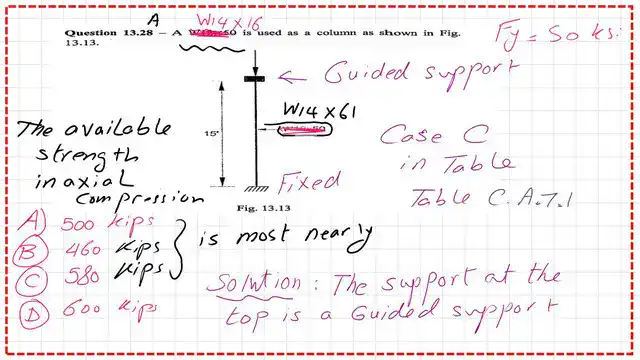
This is post 9: Solved Problems for column analysis.
10- Introduction to Local Buckling.
This is the 13th post in the Compression Member Posts series, which includes: We have discussed local buckling for beams, the local buckling coefficient for both flange and web beams, and the general Condition. There are three types: compact, noncompact, and slender sections.
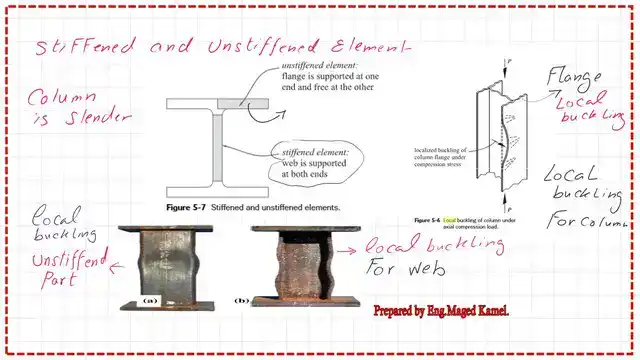
This is post 10: Introduction to Local Buckling. This is part 1.
This is a link to post 10a, which is the second part.
List of compression Member Posts-part 2.
List of compression Member Posts part -3.
For a good A Beginner’s Guide to the Steel Construction Manual, 14th ed. Chapter 7 – Concentrically Loaded Compression Members.
For a good A Beginner’s Guide to the Steel Construction Manual, 15th ed. Chapter 7 – Concentrically Loaded Compression Members.
For a good A Beginner’s Guide to the Steel Construction Manual, 16th ed. Chapter 7 – Concentrically Loaded Compression Members.