
Last Updated on September 17, 2026 by Maged kamel
Two Solved Problems For Column Analysis-FE Exam.
This is a brief description of the Post content.
Two solved problems for steel column analysis.
Two solved problems for column analysis. The first problem is similar to problem 13.28, which we addressed in the previous Post. However, this Time I changed the dimensions from W12x50 to W14x61.

Solved problem 13- 28: Use Provision E-1 from AISC-360-16.
The column is fixed at one end and has a guide roller at the other end, located at the top. This Table shows different k values based on column end conditions.
This problem is from the M. Iqbal Book for the FE exam review. We will continue with the previously solved problem 13-28, which we will refer to as 13-28a. However, after modifying solved problem 13-28a, the column is selected as W14x61, with Fy = 50 ksi.
What is the available axial compression Strength in kips? Which Value of the four alternatives is listed from option A to option D?
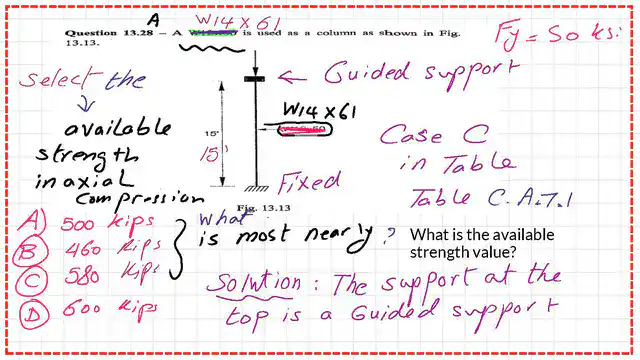
Table C-A-7-1 lists six support condition cases and the corresponding recommended effective K values. We will choose the appropriate K Value based on the data from problem 13-28A. We will select column C.
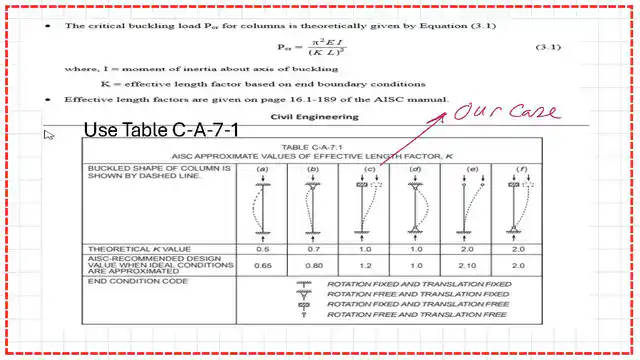
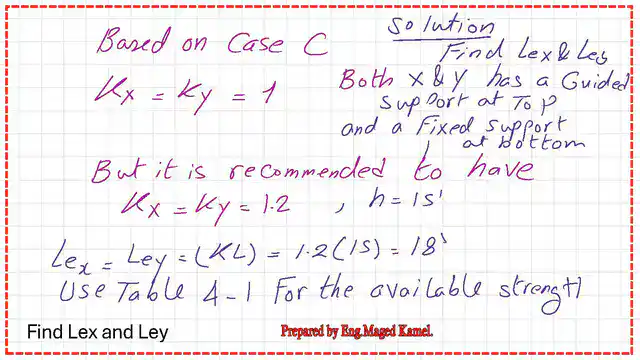
What is the selected K Value?
The support case of a column is case C, where the support is fixed at the bottom and guided at the top. Our kx = ky = 1.2, as recommended. The Lex=Ley=1.2*15=18 feet.
Use Table 1-1 to get the Area and radii of Inertia values for 13.28a.
We will use Table 1-1 to get the Area and the values of rx and ry (the radii of Inertia). This Table, quoted from the FE Reference Handbook, lists W sections and provides the Area, depth, Flange width & thickness, and inertias about the x and y axes for E = 29000 ksi and a yield stress of 50 ksi.
The following slide image shows the first part of Table 1-1.
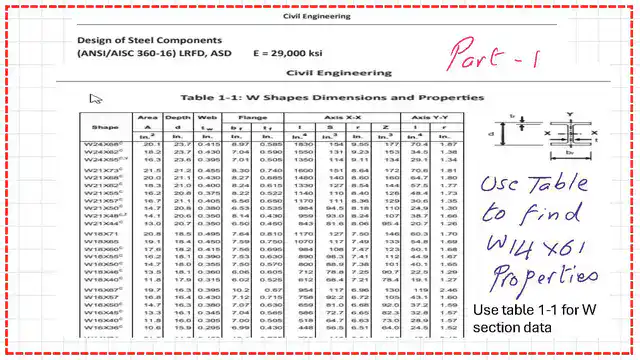
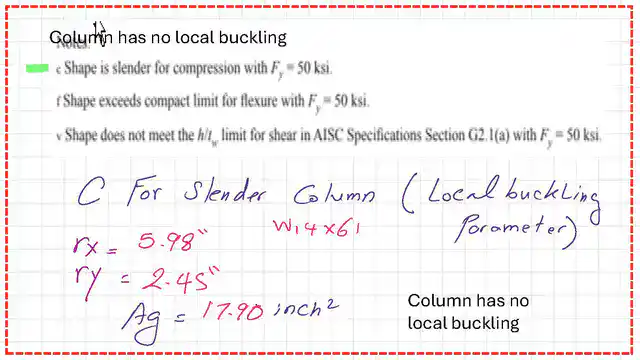
For W14x61, the Area is 17.90 in², the radius of Gyration about the major axis is rx = 5.98 in, and the radius of Gyration about the minor axis is ry = 2.45 in.

We will proceed directly to Table 4.1, FE Exam Ref book 10.40. We have our KyL = 1.2 x 15 = 18 feet; mark the Value. The yield stress Fy is 50 ksi.
What is the requirement of Table 4-1?
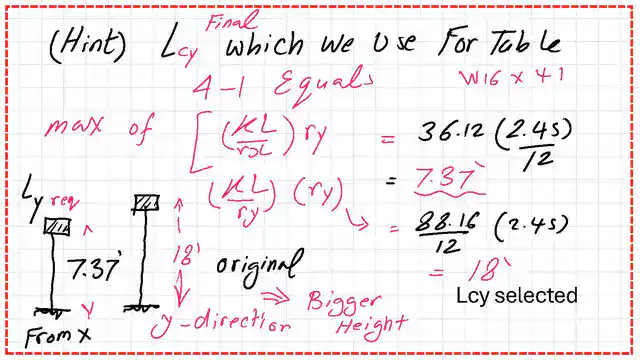
Table 4-1 requires that the tabulated effective length for ry be the maximum of the ly required from the x-direction (ly modified, Lcx*(ry/rx)) and the ly Value from the y-direction. The required ly Value equals 7.37 feet; please refer to the following slide image.
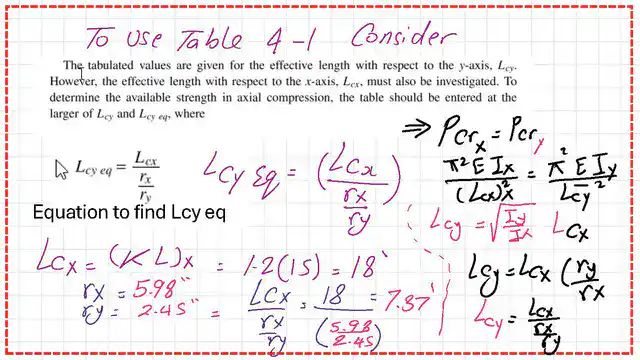
The ly Value equals 18 feet; the selected effective length is the maximum Value of 7.37, and 18 feet will be 18 feet.

What is the available Strength from Table 4-1?
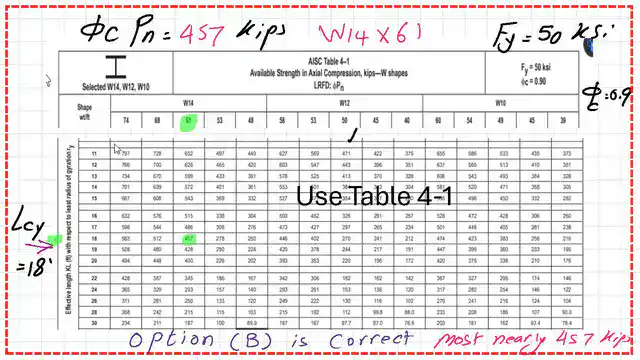
We use Ly = 18 feet, move horizontally, and drop a line from the top W14x61 section; the intersection gives an available Strength of 457 kips, which matches option b).
We will proceed to Table 4-1 to obtain the available Strength, or LRFD Value. One remark is that the Table is assigned only when the yield stress Fy =50 ksi, at the intersection of the horizontal line of 18′ and the vertical line for W14x61.
The available Strength Value equals 457 kips, which is nearly equal to option B. Please refer to the following slide image for more details.
We could achieve the same result by using the E-1 provision of AISC-360-16, determining whether the given column is short or long, and then selecting the appropriate Fcr equation.
The curve we discussed, at KL/r = 4.71*sqrt(E/Fy), distinguishes between short and long columns.
If Le/r = KL/r > 4.71*sqrt (E/Fy), then the column is considered a Long column, and hence the Euler Elastic stress. The division of pi^2 EI/ (kl)^2 over the Area gives the stress as (pi^2 E/ (le/r)^2) for the traditional way of calculation.
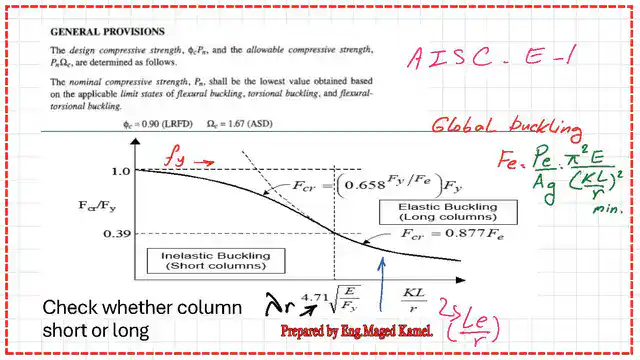
We will estimate whether the column is long or short by using the formula for the Value of (k*l/r), which will give ( 4.71sqrt(E/Fy)), and will give 4.71*sqrt (50000/50)= 113.43.
The same procedure for our Ky*ly/ry from the previous calculation is smaller than the 4.71*sqrt(E/fy); the column is short.
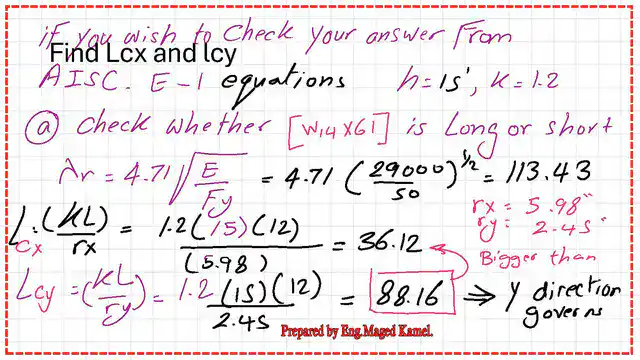
In the next slide, there is a hint: what is Lcye from the column in the x direction compared to Lcy in the y direction?
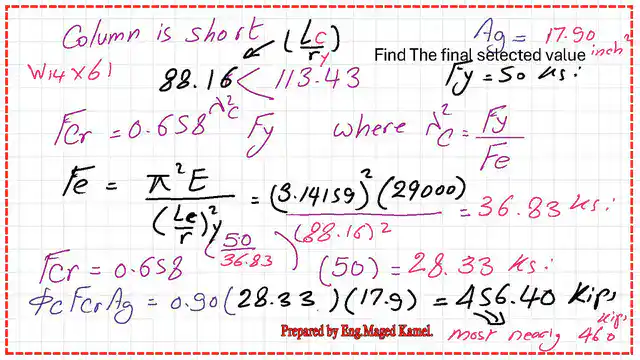
We will apply the Fcr equation for the short column; the critical stress equals 0.658^lambda2 * Fyy, where lambda^2 = Fy/Fe.
The Euler stress equals 28.33 ksi; Fcr = 28.33 ksi, multiplied by phi and the Area to get the LRFD Value of the available Strength, which equals 456.40, very close to option B.
Another solved problem is 13.30 for column analysis.
Another solved problem is 13-30 for column analysis from M. Iqbal’s book. The given column is W10x49, carrying a dead service Load of 0;0, its slenderness is 120, and its yield stress is 50 ksi. Please select the Value closest to the service live Load from the four options provided.
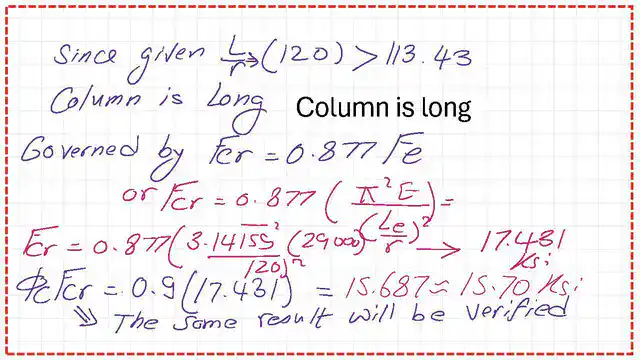
The controlling slenderness ratio for Fy = 50 ksi is 113.43, and the slenderness ratio for the given section is 120, which is larger than 113.43, so the column is long.
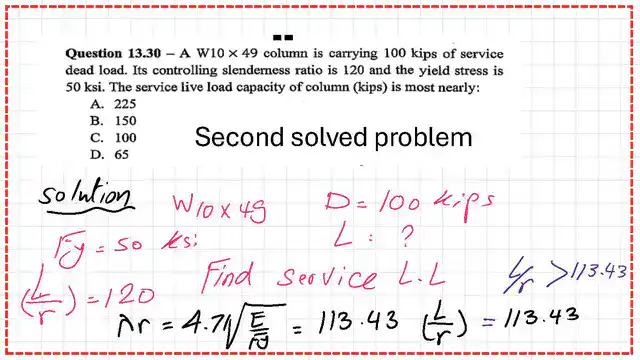
Since the column is long, we use the equation fcr = 0.877Fe, where Fe is the Euler stress. The following slide shows the details of the Fcr Value and the factored Fcr. Later, we will recheck using Table 4-14.
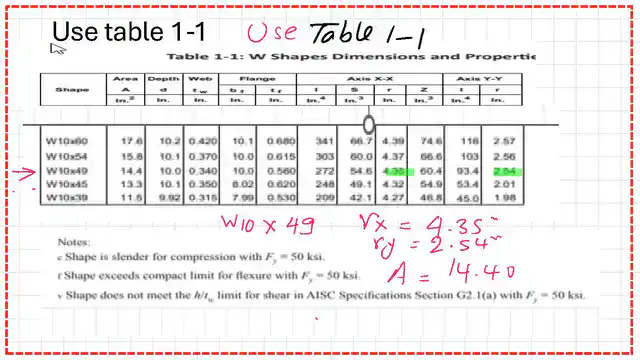
Use Table 1-1 to get the Area and radii of Inertia values for 13.30.
Use Table 1-1 to obtain the Area and radii of Inertia for W10x49; refer to the following slide.
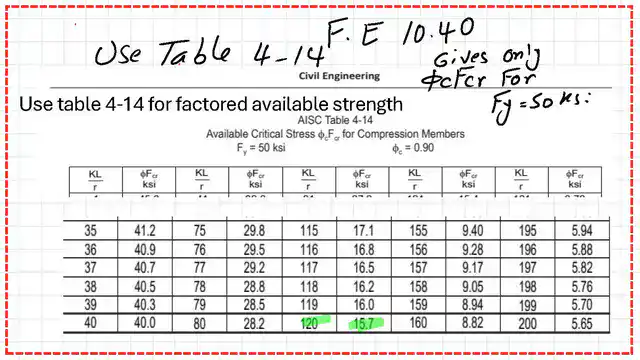
Use Table 4-14 to get the factored critical Load.
We use Table 4-14 to obtain the factored critical stress for a slenderness Value of 120; it equals 15.70 ksi.
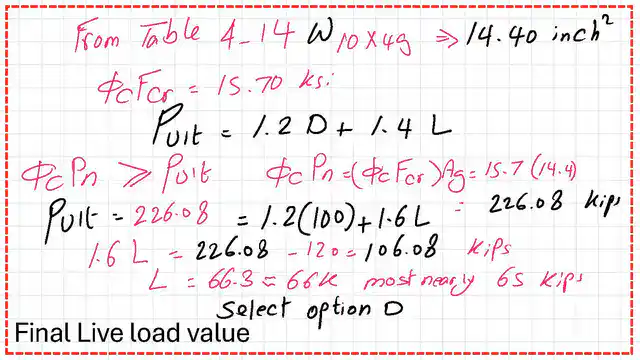
What is the final factored live Load Value?
We equate the ultimate Load to the factored Nominal Load based on a dead Load of 100 kips. The final Live Load is 66 kips, which is most nearly Equivalent to option D; please refer to the next slide for more details.


#1. According to AISC Table C-A-7-1, what is the recommended design effective length factor (K) for a column that is fixed at the base, but rotationally fixed and translationally free at the top (Case c)?
You can view and download the PDF for this Post from the following Link.
The next Post, Post 10, is an Introduction to Local Buckling.
For a good beginner’s guide to the Steel Construction Manual, 14th ed. Chapter 7 – Concentrically Loaded Compression Members.
For a good A Beginner’s Guide to the Steel Construction Manual, 15th ed. Chapter 7 – Concentrically Loaded Compression Members.
For a good A Beginner’s Guide to the Steel Construction Manual, 16th ed. Chapter 7 – Concentrically Loaded Compression Members.