Last Updated on March 5, 2026 by Maged kamel
- List of compression Member Posts-part 2.
- 11- Local Buckling stiffened and unstiffened.
- 12- Solved problem 5-2 for local buckling.
- 13- A solved problem 5-3 for local buckling.
- 14- Solved problem 6-8 for local buckling.
- 15- A solved problem 6-19-4 for local buckling.
- 16-A solved problem 5-10 for local buckling.
- 17-Alignment chart part 2.
- 18-A Review of portal frames.
- 19-Modification to the alignment chart of the unbraced frame.
- 20-Solved problem 4-16 for k factor.
List of compression Member Posts-part 2.
11- Local Buckling stiffened and unstiffened.
This is the first post in the Compression Member Posts-part 2, which includes the local buckling classification of sections. Local buckling sections are classified as non-slender or slender.
For non-slender elements, we have two factors: one for the flange and one for the web. If the b flange / t flange < a certain ratio λr. The section is non-slender. The ratio, which we have already discussed via tables, is also essential. h web/ t web < λr.
For a particular factor, the section is non-slender; if it is bigger than λr shown in the table, then the section is slender, and the coefficient is reduced.
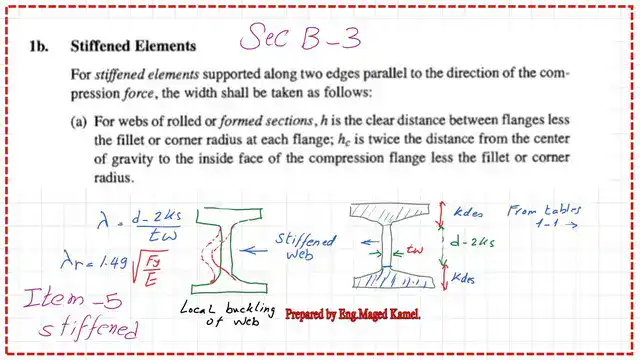
There are two coefficients: Qs and Qa. Qs is for the flange; if λ>, the ratio is given, while Qa is for the effective area/ A gross. Non-slender not exceeding λr, from table B4.1a,
This is the link to post 11: Local Buckling stiffened and unstiffened.
12- Solved problem 5-2 for local buckling.
This is the 2nd post in the Compression Member Posts-part 2, which includes solved problem-5-2, quoted from Prof. Jack McCormac’s handbook. The given W section is W#12×72, a non-slender section.
a) Using the column critical stress values in Table 4-22 of the Manual, determine the LRFD design strength and the ASD allowable strength for the column shown in Fig. 5.8.
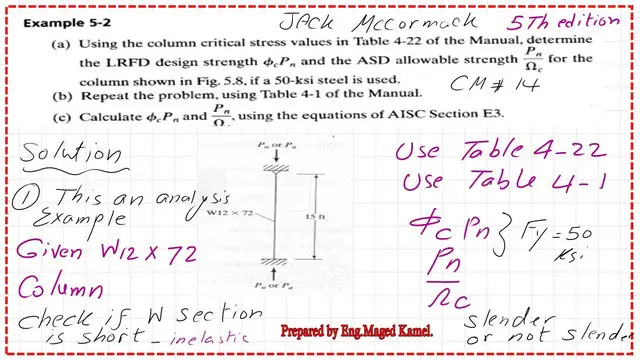
If 50-KSI steel is used. (b) Repeat the problem, using Table 4-1 of the Manual. (c) Calculate and, using the equations of AISC Section E3,
This is the link to post 12: Solved problem 5-2 for local buckling.
13- A solved problem 5-3 for local buckling.
This is the 3rd post in the Compression Member Posts-part 2 series, which includes Example 5-3 from Prof. Jack McCormac’s handbook. A square HSS section measuring 18 x 15 x 1/2 inches is used for an 18-ft-long column with simple end supports. The column section is non-slender.
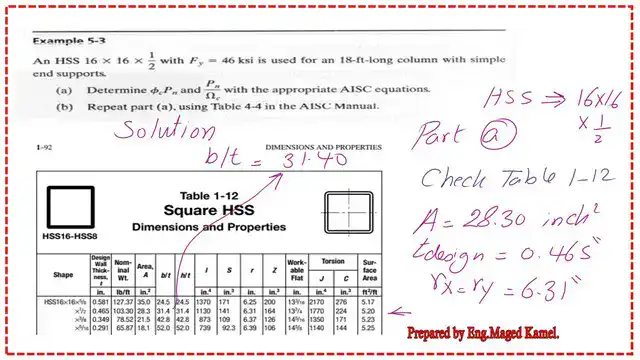
(a) Determine Φc*Pn and Pn/Ωc with the appropriate AISC equations.
(b) Repeat part (a) using Table 4-4 in the AISC Manual. A step-by-step guide is provided.
This link to post 13: A solved problem 5-3 for local buckling.
14- Solved problem 6-8 for local buckling.
This is the 4rth post of the compression Member Posts-part 2, which includes solved problem-6-8 from Prof. Jack McCormac’s handbook. Determine the axial compressive design strength and the allowable design strength of a 24-ft HSS column section.
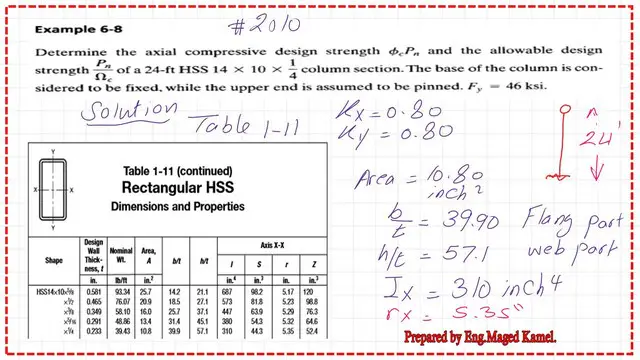
The base of the column is considered to be fixed, while the upper end is assumed to be pinned.
This is the link to post 14: Solved problem 6-8 on local buckling.
This is the link to post 14a: Problem-6-8 for local buckling-CM#15 For HSS section.
15- A solved problem 6-19-4 for local buckling.
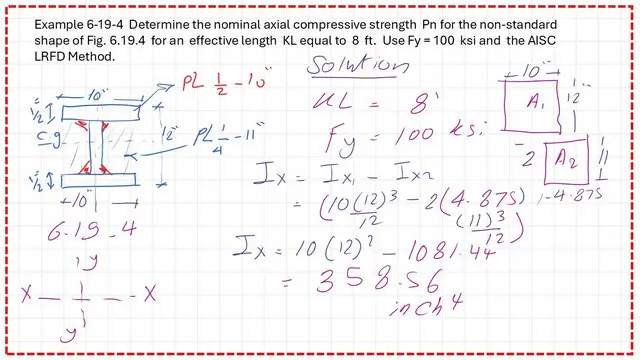
This is the 6th post of the Compression Member Posts-part 2, which includes a solved problem -16-19-4 from Charles G. Salmon’s handbook. Example 6-19-4 Determine the nominal axial compressive strength φc*Pn for the nonstandard shape of Fig. 6.19.4 for an effective length KL equal to 8 ft. Use Fy = 100 ksi and the AISC LRFD Method.
This is the link to post 15: A solved problem 6-19-4 for local buckling.
16-A solved problem 5-10 for local buckling.
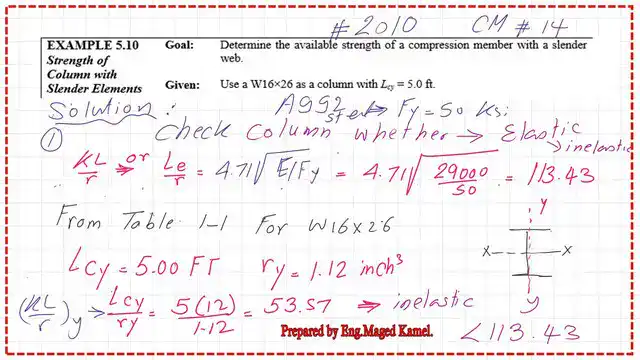
This is the 7th post of the Compression Member Posts-part 2, which includes a new example 5-10 from the unified design of steel structures by Louis F. Geshwendener.
In solved problem 5-10. It is required to determine the available strength of a slender-web compression member, with a section W16x26, acting as a column, with lcy = 5.0 ft.
This link to post 16: A solved problem 5-10 for local buckling. Two more posts have been added.
Post 16a- Solved Problem 5-10 with more iterations-Fcr value. This is the same solved problem 5-10 from the Unified Design of Steel Structures by Prof. Louis F. Geshwendener. It is required to determine the available strength of a slender-web compression member. The steel section is W16x26 as a column with a length of 5.0 ft. The solution is based on Cm#14.
Post 6b-Available Strength for slender W section-CM#15. In solved problem 5-10. It is required to determine the available strength of a slender-web compression member, with a section W16x26, acting as a column, with lcy = 5.0 ft. The solution is based on CM#15, AISC-360-16. I have chosen a height of 6 feet to check our estimate with Table 6-2.
17-Alignment chart part 2.
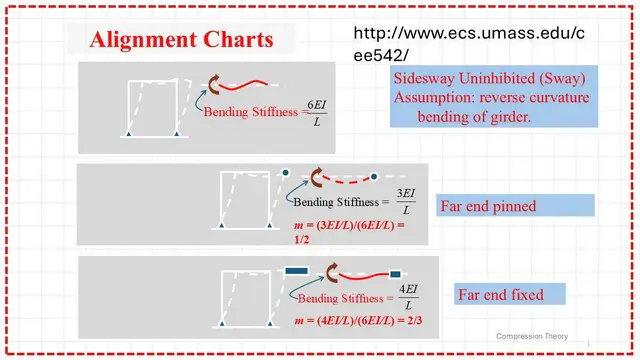
This is the 10th post in the Compression Member Posts-part 2 series, which includes the alignment chart and conditions for anti-symmetrical curvature of the unbraced frame.
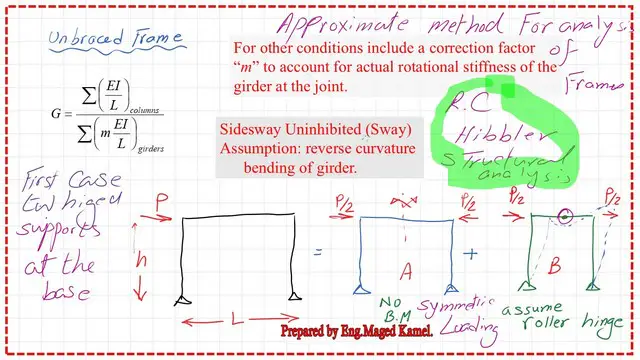
The Nomograph was based on the assumption of double curvature. We have a bending moment at one end, but at the other end, there is another moment, equal in magnitude, that will cause anti-symmetrical curvature.
This is the link to post 17: Alignment chart, part 2.
18-A Review of portal frames.
This is the 11th post of the Compression Member Posts-part 2, which includes how to make a structural analysis. We give an example: a frame with two hinged supports is subjected to a force on the left side.
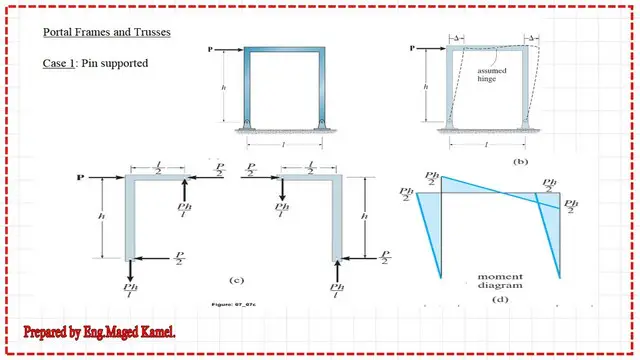
The frame can be analyzed by dividing it into two parts: the first has antisymmetric loading, and the second has symmetric loading. Due to that loading, the elastic curvature.
This is the link to post 18: A Review of Portal Frames.
The second post is Post 18a-Analysis of portal frame-fixed supports at base.
19-Modification to the alignment chart of the unbraced frame.
This is the 13th post in the Compression Member Posts-part 2 series, which discusses adjustments to the G equation because the end condition for the girder does not meet the requirement.
This is the link to post 19: Modification to the alignment chart for the unbraced frame.
20-Solved problem 4-16 for k factor.
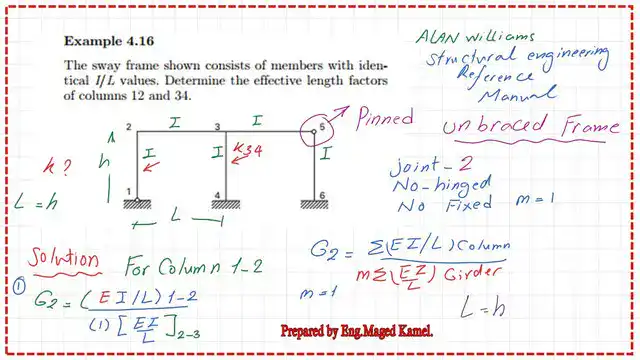
This is the 14th post of the Compression Member Posts, Part 2, which includes our example, 4-16, from Prof. Alan Williams’s book, Structural Engineering Reference Manual. A sway frame is an Unbraced or Unstiffened frame. The sway frame shown consists of members with identical I/L values.
Determine the effective length factor for columns. 12 and 34, he has not included any values for the length of girders or the height of columns. We can assume that h and L are the same; we need the K value for the two columns, 12 and 34.
This link to post 20: Solved problem 4-16 for k factor. The verification of the K values by using the French equation is done in post 21 in the list of compression posts, Part 3.
Here is the List of compression member posts in part-1.
The following list of compression member posts is part 3.
For a good A Beginner’s Guide to the Steel Construction Manual, 14th ed. Chapter 7 – Concentrically Loaded Compression Members.
For a good A Beginner’s Guide to the Steel Construction Manual, 15th ed. Chapter 7 – Concentrically Loaded Compression Members.
For a good A Beginner’s Guide to the Steel Construction Manual, 16th ed. Chapter 7 – Concentrically Loaded Compression Members.