
Last Updated on September 19, 2026 by Maged kamel
Solved problem 4-16 for the K Value for a portal frame.
Full description of the content.
We have solved problem 4-16 from Prof. Alan Williams’s book, Structural Engineering Reference Manual.
We need the effective length factors for two columns. Please refer to the next image. The two columns are NOS 12 and 34.
The sway-inhibited frame means an unbraced or Unstiffened frame, and the sway frame shown consists of members with identical I/L values.
We need to determine the effective length factor for two columns without given girders or column heights; we can assume h = L.
First, we notice that the joint at 1 has a hinged support—that was the first remark. Joint 3, which we consider the far end of girder 23, has no hinged or fixed joints. This is the normal condition, so m=1.
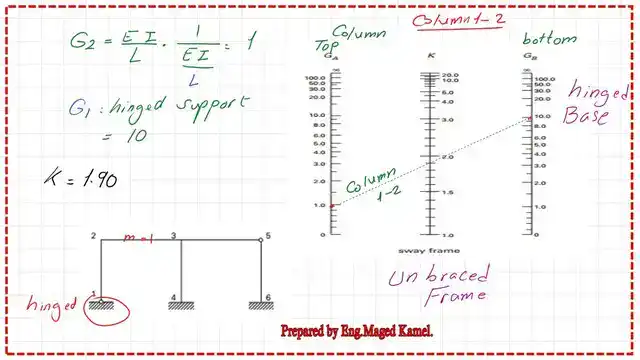
We begin evaluating G values from the Nomograph for joint 2 for column 12. We have only one column; there is no added column at joint 2, then ∑EI/L for columns/∑EI/L for girders, ∑EI/L for girders, *(m).

Our L=h; our condition for column 12, G2=∑EI/L/∑EI/L, then G2 = 1. Joint 2 has only one girder, 23.
We get G at 2 = EI/L/(EI/L)G, so at 2 = 1, while for joint 1, we have G = 10 since it has a hinged support. We use the Nomograph.

K Value for Column 12.
If we consider 12, then 1 is the top G. We consider column 21. To get the k Value for that column, I considered joint 2 as the top (G=1) and joint 1 as the bottom (G=10). Draw the line in the Nomograph for the Nomographced frame.
Starting from G=1 on the left and ending at G=10 on the right, the intersection with the middle line yields k=1.90. Please refer to the next image for an illustration.
If we consider joint 1 with G=10 as the top point, and joint 2 as the bottom, k will be the same Value. K=1.0. We have completed column 12. For column 34, at joint 3, we have two girders, 32-35. Girder 35 ended with a hinged support. This is case no. 2, where m = 1/2.
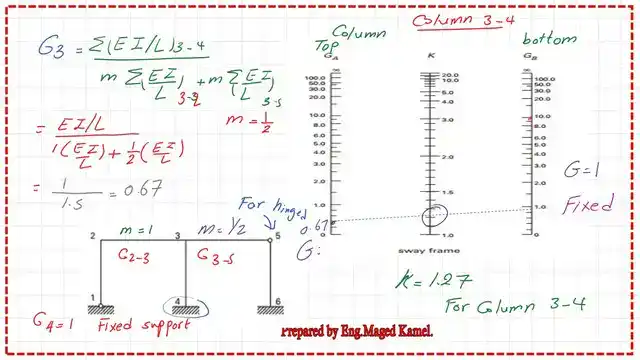
Let us proceed at joint 3, in the Solved problem 4-16, we have only one column, then G3=∑EI/L for one column- 34 / ∑m*EI/L for two girders, ∑m*EI/L for two girders, which=m1*EI/L for girder 32 +m2*EI/L for girder 35 m for member 32=1, m1=1, no external support attached to that joint, while for girder 35 m2=1/2, since at the far end, there is a hinge the for denominator=3/2*EI/L, G3 =1/1.5=2/3.
K Value for Column 34.
For the K Value for column 3-4, in the solved problem 4-16, one side is G=1, and for the other side G=2/3; joining the two points on the Nomograph for the Nomographced frame, we get the K for column 3-4= 1.27.
For more details, see the next image. For support 4, which is fixed, the code in the commentary lets G = 1. We proceed to the Nomograph: on the G3 Nomograph, plot the left point and the lower point, with G = 1. The intersection gives k = 1.27, which was for member 34.
Next Time, we will discuss the French equation and how to use it to get an approximate k Value, not the exact Value. I’ve included the solution from Prof. Alan Williams’s book for review; next, we’ll cover the French equation for the unbraced frame.
The solution from Prof. Alan Williams’s book has been included for review; the next subject will be the French equation for the unbraced frame.

The PDF for this Post is available for viewing and download in the document below.
This is the next Post, 21, which links to Solved Problem 4-16 using the French Equation.
For a good A Beginner’s Guide to the Steel Construction Manual, 14th ed. Chapter 7 – Concentrically Loaded Compression Members.
For a good A Beginner’s Guide to the Steel Construction Manual, 15th ed. Chapter 7 – Concentrically Loaded Compression Members.
For a good A Beginner’s Guide to the Steel Construction Manual, 16th ed. Chapter 7 – Concentrically Loaded Compression Members.