Last Updated on February 14, 2026 by Maged kamel
List of Tension Member’s Posts-part 1A.
The tension Member’s Posts-part 1A list will start with post 2 and end at post 6.
Solved problems for net area estimation.
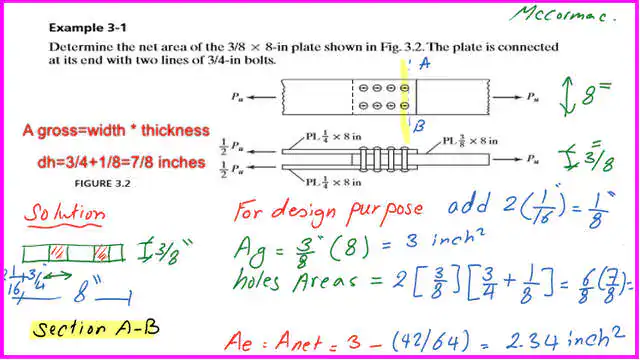
In the first solved problem 3-1, we have a plate 3/8 inch thick and 8 inches wide.
Determine the net area of the 3/8-inch x 8-inch plate, which is connected at its end with two lines of 3/4-inch bolts. The two lines of bolts are not staggered. Please refer to the following slide image for more details.
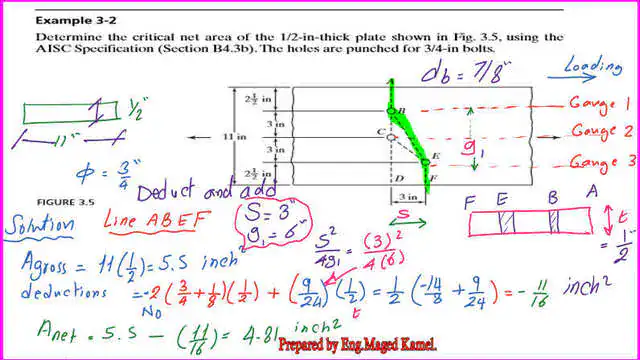
This is the second post in the Tension Member’s Posts series, which includes Solved Problem 3.2.from Prof. McCormack’s book. Determine the net area of the plate shown in Fig.3.2.
The plate is connected at its end with three lines of 3/4-in bolts. The third line is attached to the first and second lines. How can we estimate the required minimum area?
This link for post 2: Solved problems for net area estimation, for more details about the detailed estimate for the two problems.
Solved problem 3-1 for the nominal strength.
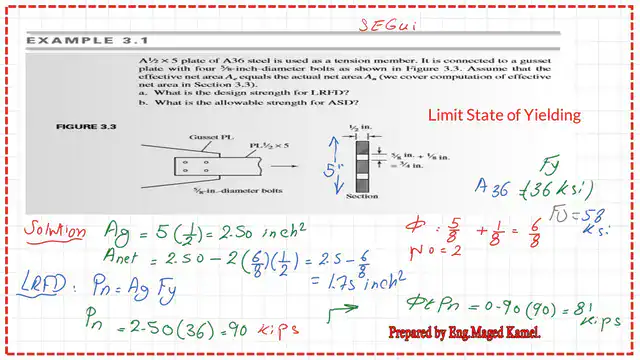
This is the third post in the Tension Member’s Posts series, which includes an example from Prof. William T. Segui’s handbook. 3.1. A1⁄2 × 5 plate of A36 steel is used as a tension member. It is connected to a gusset plate with four 5⁄8-inch-diameter bolts, as shown in Figure 3.3.
Please assume that the effective net area Ae equals the actual net area An (we cover the computation of effective net area in Section 3.3). a. What is the design strength of LRFD? b. What is the allowable strength for ASD? The detailed estimate shows that the two limit states are covered in more detail.
This link for post 3: Solved problem 3-1 for the nominal strength.
Simple illustration for workable Gauge Lines.
This is the fourth post in the Tension Member’s Posts series, which includes estimating the net area. Later, we will discuss two problems. The main idea is to assess the net area of an angle bolted in different gauge lines.
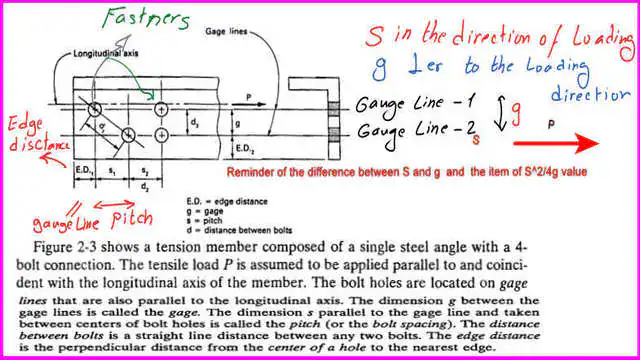
This is a link for post 4: Simple illustration for workable Gauge Lines.
Two solved problems for the net area estimation.
This is the fifth post in the Tension Member’s Posts series, which includes two solved problems. The first solved problem is from Prof. Charles G. Salmon’s handbook, 3.4-2. Determine the area net A net area of the angle given in 3.4.2 if 15/169 in Fig 3.4.4 inch-dia holes are used.
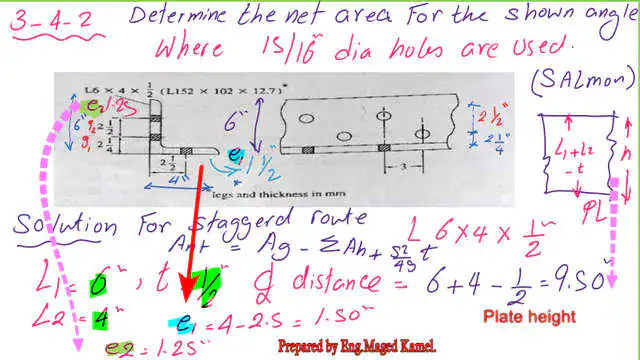
The second problem, 3.5, is from Prof. McCormack’s book. Determine the net area along route ABCDEF shown in Fig.3.8. Holes are for-in bolts. The details of converting the given angle to a plate is included in the post.
This link is for post 5: Solved problems for the net area estimation.
Definition of the effective area for tension members.
This is the 6th post in the Tension Member’s Posts series, which introduces a new topic: How can the effective area be estimated? The effective area will be considered if a structural steel element is subjected to a tensile force. A comparison between D3.1 for CM#14 and CM#15.
An example -4-1 U-Value for a bolted connection of an equal angle. For the bolted tension member shown in Figure 4-6, determine the shear lag factor, U; the net area, An; and the effective area, Ae.
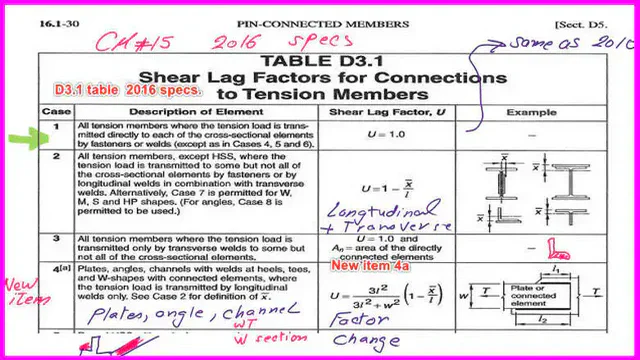
The link to post 6 defines the effective area for tension members.
This is a link to the list of tension members’ posts in part 2.
An external source for tension members from Prof. T. Bartlett Quimby’s site, which is the Tension Member Overview