
Last Updated on September 20, 2026 by Maged kamel
Solved problem 7-2-frame K Value 3/3.
This is a reminder of the modification factors based on the conditions, whether the far end is connected as a hinge or as a fixed support for the braced frame. In our example, we have two braced frames.
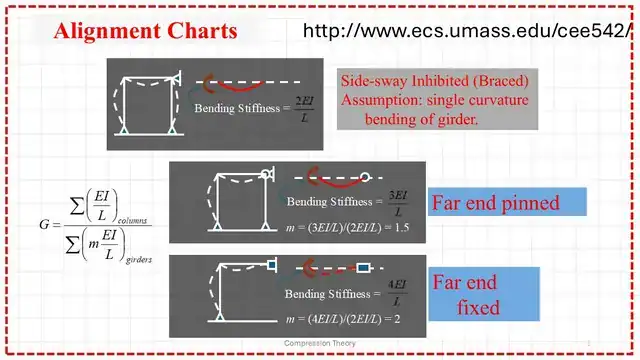
Solved problem 7-2: frame K Value 3/3, the unbraced portion of the frame column
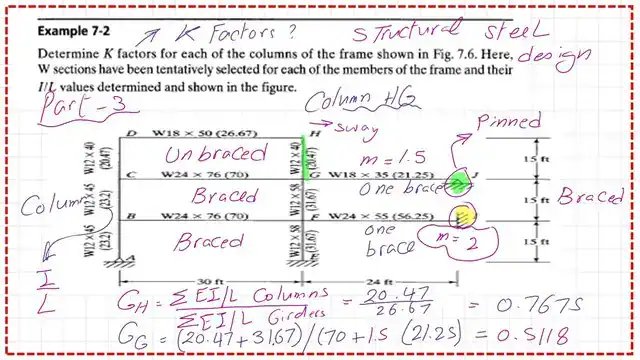
We will continue discussing our solved problem 7-2 for frames, by God’s will. Last Time we stopped at the hatched yellow column GH; the column was unbraced, starting at joint H and continuing through the other joints.
At joint H no upper column, G=sum of (EI/L) which is=20.47/ sum(EI/L) for girder Gh =26.67, Gh=(20.47/26.67)=0.675.
For Gg at joint G, we have two columns: GH, GF, and Gc: (20.47 + 31.67)/sum of (m*EI/L) for girders CG and GJ. m value=1 at GC and m=1.5. For girder GJ, because of the hinge at the far joint, the denominator = (1*70 + 1.5*21.25); Gg = 0.5118. We used the French equation for the unbraced frame, with Gh = 0.675 and Gg = 0.5118.
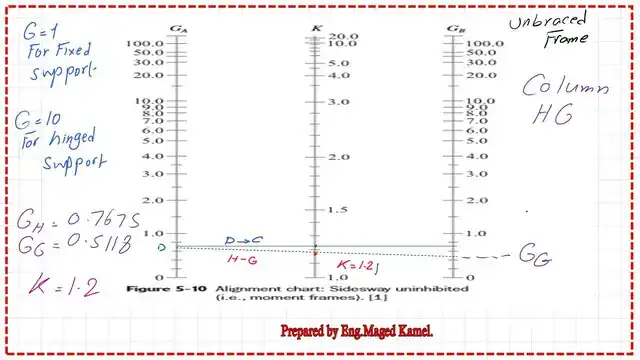
Using a nomograph for the unbraced frame to determine the K Value for column HG, we have Gleft = 0.6753 and Gright = 0.5118.
The K Value will be between 1.1 and 1.20, very close to 1.20.
The DC column for the unbraced frame is also drawn on the nomograph for a side-sway, uninhibited frame.
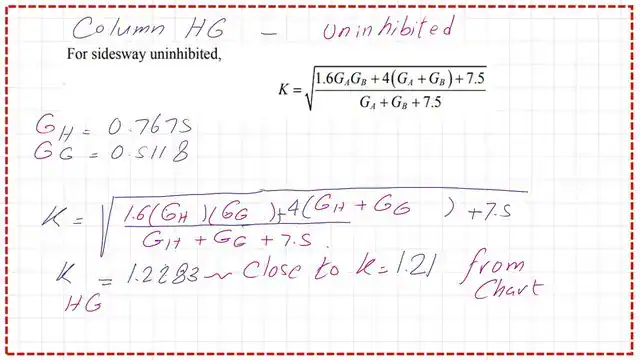
Solved problem 7-2 for frames-part 3, column GF.
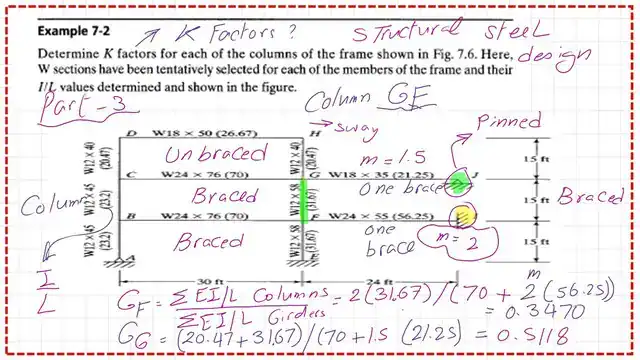
We continue to estimate G for the new column GF, hatched in green. For joint G, the joint G Value is Gg = 0.5118.
For joint F, the G Value is expressed as GF = sum(EI/L) for columns/sum(m*EI/L) for the girder. Gf = ((331.67 + 31.677)/denominator), where m = 1 for Girder FB; for Girder FI, m = 2 because the far end is fixed; the Value of 2 is for the braced frame.
The denominator=(70+2*56.25) Gf=0.3471.
The Joint G has a girder ending with a pinned support, for which m = 1.50. Substituting gives GG = 0.5118.
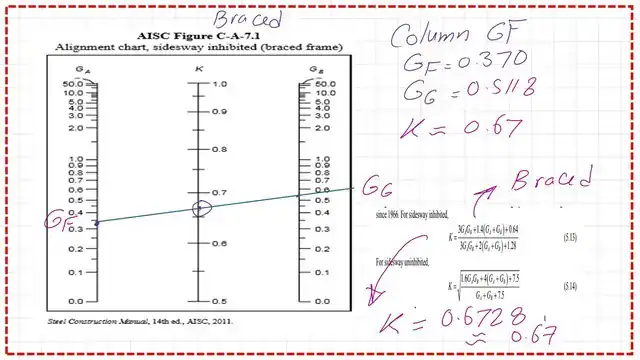
Using the alignment chart for the braced frame, our column is GF. The point on the left is Gf =0.5118, while Gc = 0.3471.
The K-value from the French equation for the braced frame is k = 0.672, while using the Nomograph method, the k-value is 0.66. The k-value from the French equation is quite close.
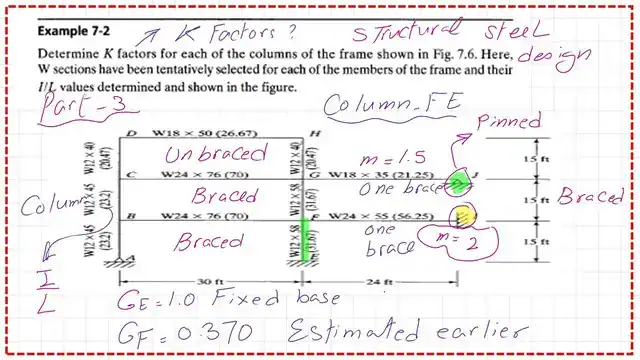
Solved problem 7-2-frame K Value 3/3-column FE.
Let us continue with a new column. The last column, FE, is braced with Gf = 0.3471. For point F, we have used m = 2 since it is connected to a fixed support in a side-sway-inhibited frame. Joint E is fixed at the support, with a G Value of 1.
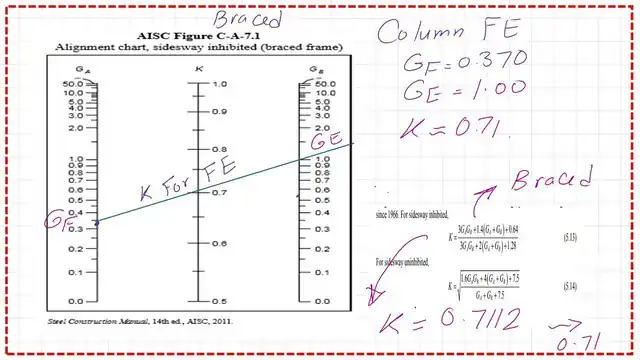
This frame is braced. Nomograph of the braced frame, with Gf = 0.3471 and Ge = 1; as shown, the marked point k will be above 0.70.
We consider k=0.71. Using the French equation for the braced column k Value, k = ((3GA*Gb + 1.4 (GA + Gb) + 0.64)/(3GA*Gb + 2 (GA + Gb) + 1.28)), substitute Ge = 1 and Gf = 0.3471 for Ga and Gb. k=3(0.3471*1+1.4(0.3471+1)+0.64)/(3(0.3471*1)+2(0.3471+1+1.28)=0.7112.
From the French equation, K = 0.7112 is close to 0.71, as indicated on the Nomograph chart. Thus, we have completed the evaluation of the k values for all columns in the solved problem 7-2, part 2.
Solved problem 7-2-frame K Value 3/3–Author’s solution
I have included the author’s solution to problem 7-2, as shown in the slides, as a reference. This is the Table at the end, where the k-value figures are closed.
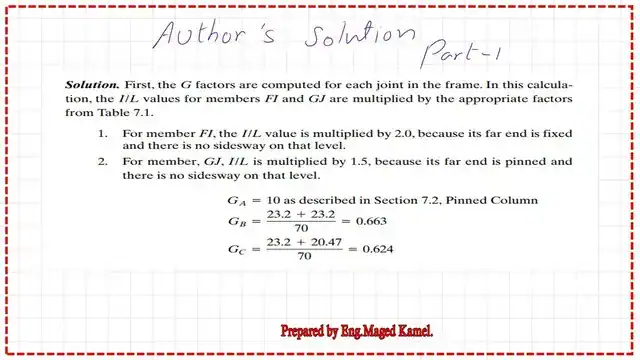
This is a full detail of the Value estimated by the author.
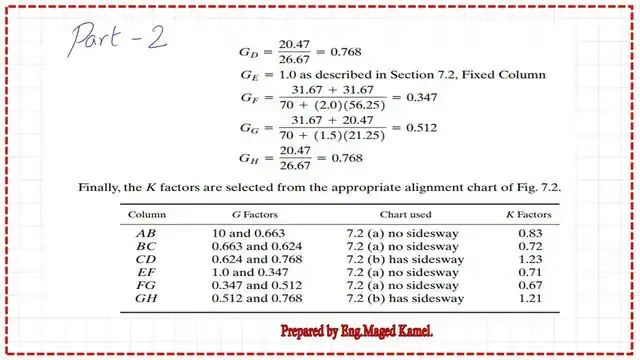
The PDF file used to illustrate this Post is available for viewing or download below.
For more data on the previous calculations, please refer to the Link to the previous Post to check parts 1 and 2 in posts 23 and 23a of the same example.
This is the next Post: Stress Reduction Factor for Inelastic Columns.
For a good A Beginner’s Guide to the Steel Construction Manual, 14th ed. Chapter 7 – Concentrically Loaded Compression Members.
For a good A Beginner’s Guide to the Steel Construction Manual, 15th ed. Chapter 7 – Concentrically Loaded Compression Members.
For a good A Beginner’s Guide to the Steel Construction Manual, 16th ed. Chapter 7 – Concentrically Loaded Compression Members.