Last Updated on September 7, 2026 by Maged kamel
The similarity between Cash flows and forces.
Introduction to Cash Flow and Equivalence.
There is a similarity between Cash flows and forces. The economic Equivalence can be viewed as a relation between two forces acting on the free body diagram; the sum of the moments due to those two forces can be set equal to zero.
As mechanical and civil engineers, we are familiar with bending moments and shear forces, and with how to determine the bending Moment for a given beam.
The Moment due to Cash flows is simply the product of Cash flow and the distance to the point on the Timeline. Whether the Cash flow is an inflow or an outflow, when drawn on a Timeline, the horizontal line starts at Time t=0 and ends at Time t=n.
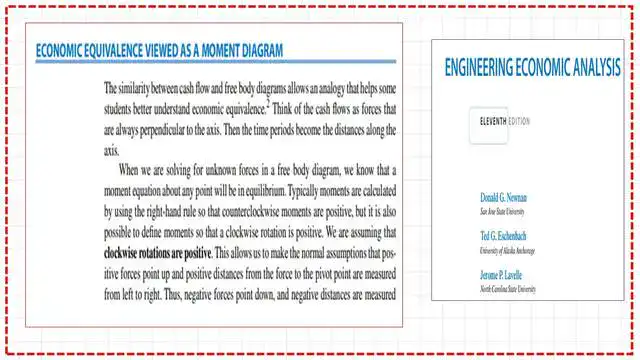
Cash flow can be represented as an upward arrow when you have income, from the borrower’s point of view. While expenses are drawn as downward-pointing arrows, the present value P is shown. For instance, we need to find the future value F. The picture is quoted from the book Engineering Economic Analysis, 11th edition. The author is Donald G Newman. The chapter is titled ECONOMIC Equivalence VIEWED AS A Moment DIAGRAM.
Another payment, shown as F, is needed to repay the loan; the directions of both P and F will be opposite.
The present value, while paying, is represented by a downward arrow, or (-) P. When we have income at present. An upward arrow represents P, or (+P). Similarly, for future values, income increases, while pay decreases.
If you consider Cash flow as a group of forces that are always perpendicular to the axis, then the periods correspond to the distance along the axis.
We need the distance between the forces along the Timeline, now that the Timeline is in equilibrium at any point on the Moment diagram; this holds in all directions.
As we know, in the bending Moment diagram for a beam, at a point we will have both clockwise and anticlockwise moments.
The summation principle yields a zero Moment. I quote that we assume clockwise rotations are positive. This principle allows us to assume that the positive forces point up and that positive distances are measured from left to right. How does this technique work?
The different cases of forces, Cash flows, and the pivot point.
We will discuss the different cases of forces and the moments they produce, whether positive or negative.
If they are greater than 0 and point upward, they can be represented by the (+) sign. A Moment due to a positive force at a point on the right side of that force is a positive clockwise Moment.
We have four cases. The first case is an upward force, and the point is on the right. In the second case, the force acts upwards, but the Moment about a point on the left side of the force is about a point to the left of the force, so the product of (+)*(-) = (-) is considered negative, indicating anticlockwise rotation.
The third case, where the force is pointing down, is considered as (-) value, and the point we are getting the Moment at lies at the right side, the Moment as a product of (-)*(+) =(-) is negative as being anticlockwise.
In the fourth case, where the force points downward (considered negative) and the point about which the mMomentis taken lies on the left, the Moment, as the product of (-)*(-), is positive and clockwise.
The written data concludes the four previous cases we just explained. The slide image shows the four force cases and the distances to the pivot points.

Cash flow moments and moments due to forces.
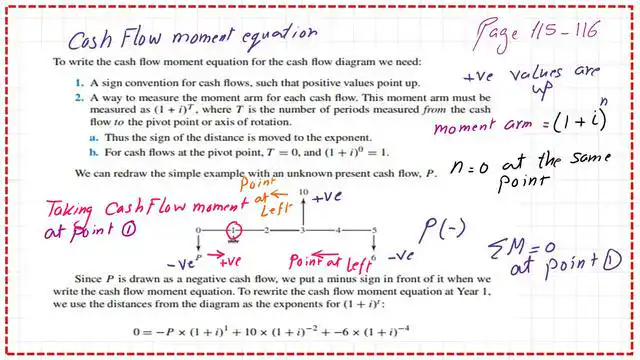
A similarity between Cash flow moments and moments due to forces. We consider the following points: 1) a sign convention for Cash flows, with positive values pointing up. For instance, inflows are represented as (+); from the bank’s point of view, the sign is (+), while the Moment arm is at a pivot point.
To measure the Moment arm as (1+i)^T, where i is the interest rate, whether yearly or monthly, based on the given case.
While T is the number of periods, that is, the distance measured from the Cash flow to the pivot point or axis of rotation at the stated point.
Thus, the sign of the distance is moved to the exponent, with its sign being either (+) or (-).
For Cash flow at the pivot point, T=0 and (1+i)^0=1, and in that case, the Moment value will be the exact value of the force. For the given example, P acts at a pivot point with an unknown present Cash flow where T=0.
P is considered downward(-P). Money was paid, and it is expected to receive +10 in the third year and at the end.
For instance, you will pay (6) at Time t=5, which is represented by the downward -6. We have +10 acting upward, while P is the present value (-P) and -6. Let us consider the bending Moment at a pivot point at t=1.
The sum of the moments at the pivot point (t=1) will be equal to 0. Start with (-P), which creates a Moment at t=0. The point is on the right, with T = 1.
The Moment arm will be (1 + i)^1. Now consider the (+10) that acts at t=3. Since the pivot point is on the left side of the (+10), the difference between T=3 and T=1 is the (+10).
The Moment due to +10 will be=(1+i)^(-)(3-1) or (1+i)^(-2). Considering the Moment at T=6, the force acts downward; therefore, it is -6. The arm of the Moment is (1+i)^-(5-1) = (1+i)^-4. The sum of the moments is zero.
Now let us review the written Expression,-P*(1+i)^1+10*(1+i)^(-2)+(-6)*(1+i)^-4=0. By rearranging the terms, we can obtain an Expression for the P-value. The slide image describes the Moment arm and the acting forces.
The PDF files for this post and the next can be viewed or downloaded using the following button.
Please refer to post 2, Introduction to Economic Equivalence, to review the subject of Equivalence.
The next post: Derive the P and F relation as a casmomentnt.
This is a good link: Engineering Economy. A good reference