
Last Updated on September 10, 2026 by Maged kamel
3 Solved Quizzes for rounding numbers.
Rounding numbers is a fundamental math skill used in various real-life situations. Understanding how to round can help estimate values, simplify calculations, and make data easier to interpret. In this blog post, we will explore three solved quizzes covering different aspects of rounding numbers, with insights and examples to strengthen your understanding.
We can provide step-by-step instructions by breaking down the rounding process. This method can be applied to various types of numbers, making it easier for learners to grasp the concept. Providing additional examples can also help students recognize patterns in rounding.
The first quiz.
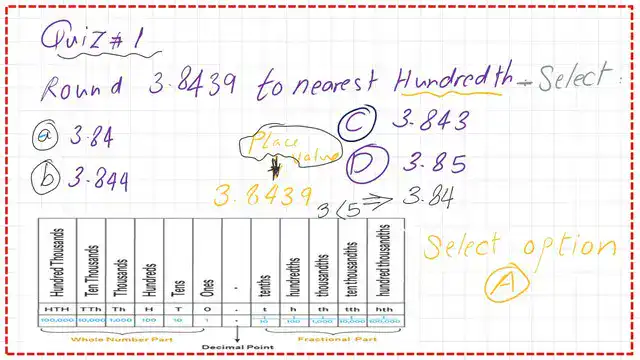
This is Quiz 1, a multiple-choice quiz. To answer Quiz -1, round 3.8439 to the nearest hundredth.
Beyond practical applications, these quizzes show how rounding is used in various fields, making the lessons more relevant.
Understanding rounding is crucial not just in mathematics but in daily life. For instance, rounding can help you make quick estimations of your total costs when calculating expenses. This practical application of rounding is often overlooked but is very valuable.
In Quiz 2, we explore rounding to three decimal places. This is particularly useful in scientific calculations where precision is key. The skills learned in this quiz can also be beneficial in fields such as finance and engineering.
As we analyze the options in this quiz, we not only find the correct answer but also discuss why each incorrect option does not meet the criteria for rounding correctly. This critical-thinking aspect supports deeper understanding.
As was explained earlier, we will take two numbers. The different options are given as follows: option a) 3.84, option b) 3.844, option c) 3.843, or option d) 3.85 to the nearest hundredth; draw a line that separates the first two numbers to the right of the decimal from the others.
Using quizzes in the learning process can build confidence in handling rounding problems.
We can also introduce more complex numbers for practice, allowing students to challenge themselves further. Consider rounding 12.6789 to three decimal places and discuss the reasoning behind this approach.
In addition, we can incorporate exercises that require students to round multiple numbers in a single question. This technique tests their understanding and ability to work through a series of rounding problems in one go.
Since the number 3 is less than 5, we will keep 84 unchanged. Then, 3.8439 will be rounded to the hundredths place, which is 3.84, the correct answer (option A). Select this because two decimal places, or the nearest hundredth, are required.
Quizzes can also improve retention of rounding techniques over Time.
In Quiz 3, we emphasize the importance of significant figures. Rounding to significant digits is a slightly different process that is crucial in certain fields such as physics and engineering.
Ultimately, quizzes help solidify the understanding of rounding numbers and their practical applications.
Significant figures can often confuse students, so it’s vital to provide examples that delineate how to identify significant digits in different scenarios. For instance, in the number 0.00456, all nonzeros digits are significant, while leading zeros are not.
Moreover, the discussion should extend to contexts where rounding applies. For example, in statistics, rounding can significantly impact results and interpretations. Highlighting these implications can enhance studentstudents’iation of rounding.
Finally, we can summarise the quizzes by outlining the students’ understanding. This recap can help reinforce learning and encourage students to revisit sections for better understanding.
Please refer to the image on the next slide for more details.
The second quiz.
In conclusion, mastering rounding numbers is essential for both academic success and practical day-to-day applications. Students can become proficient through practice, improving their math skills.
For Quiz-2, round 12.6257 to three decimal places.
The four different options are given: option a) 12.6, option b) 12.63, option c) 12.626, and option d) 12.62.
Let us count 1, 2, 3. The place value is in the 5th place, and we check to the right. We have 7, which is greater than 5. So, we upgrade the 5 to 6, and the final value is 12.626. Options a), b), or c) are incorrect.
The correct answer is option d). Our last quiz is quiz 3, which returns to the set and asks you to subset the main item. Since the data are included in the set of subjects, it was an opportunity to review whole numbers, natural numbers, rational numbers, and irrational numbers.
Please refer to the image on the next slide for more details.

The third quiz.
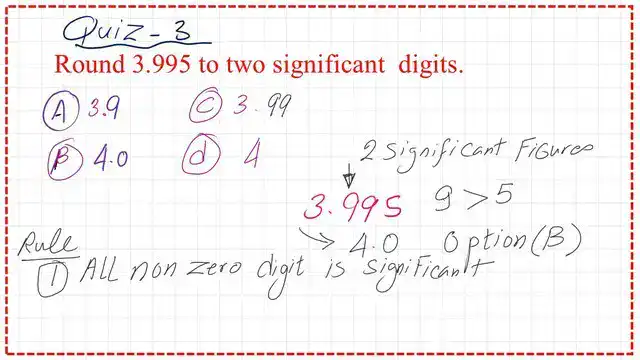
In quiz 3, round 3.995 to two significant digits. There are four options: Option a) 3.9, Option b) 4.0, Option c) 3.99, and Option d) 4. For two significant digits, start from left to right in case no zero entry exists.
The number 3.995 has four digits. Start counting from the left; the place value is in the 9th position. Check the number on the right. Since 9 is >5, this will make 39 to 40, but consider that we have 4.0, not 4.
The final answer, 3.995 to two significant figures, becomes 4.0, which is option a). The question is why it is not 4, as in option d)? In the quiz, you must use two Significant digits. If you need only one significant digit, you get the same result as in option d).
Please refer to the image on the next slide for more details.
The PDF data for this post can be viewed or downloaded via the following doc: “ment.
For an external link, it’s fun: Venn diagrams.
The following post: 6- What is an easy approach to roster notation for sets?
You can use a calculator from Calculator Soup to find the corresponding rounding for any number you wish.