
Last Updated on September 8, 2026 by Maged kamel
Moment of Inertia Iy for Parallelogram.
Divide into areas and estimate the Inertia of each Area about the y-axis.
The post includes how to estimate the Moment of Inertia Iy for a parallelogram. The y-axis passes through the left corner of the Parallelogram and intersects the base at point A.
A parallelogram is a skewed rectangle with an angle θ between the base and the left side; when θ = 90, the shape becomes a rectangle.
The Area of the Parallelogram is b*a, where b is the base, a is the side length, and h = a*sinθ is the height. To find Iy, we divide the Parallelogram into two triangles and a rectangle.

We will use the previously obtained data on the Moment of Inertia about the y-axis for the right-angled triangle and rectangle.
Iy for right-angle case-1, Iy for right-angle triangle case-2, and Iy for the rectangle. The sum of the Inertia for the two triangles will be deducted from the Inertia of the big triangle.
The Inertia of the left triangle about the y-axis.
The left triangle has an upper base of (a* cos θ) and height h; the Inertia about the y-axis will be estimated about an axis passing through the left corner of the Parallelogram. It can be considered as the sum of Iy about the CG plus the Inertia value from the Product of(A* x bar^2).

The Expression for the Inertia Iy for the left triangle can be simplified as shown in the next slide image.

The Inertia of the right triangle about the y-axis.
As for the right triangle, it has a bottom base of (a* cos θ) and a height of h; the Inertia about the y-axis will be estimated about an axis passing through the CG point, then add the Product of the area*x cg^2, where xcg is the distance from the CG to the external Y-axis. Iy2 is the sum value shown in the next slide image.

The next slide image shows a simplified Expression for Iy2. The next slide image shows the detailed calculations for Iy for a parallelogram.

We will add the Inertia of the two triangles to get their sum, which we will later subtract from the Inertia Iy of the big triangle.

The steps for Inertia Iy for the Parallelogram.
The Inertia of the big rectangle can be considered as height*base^3/3; the left side of that rectangle coincides with the Y-axis.

The final value of the Inertia Iy for the Parallelogram is to be obtained by deducting the iInertiaof the two triangles from the Iy of the rectangle. The estimation steps are shown in the following slide images. The common items can be cleared.

The final Expression for Inertia Iy for a parallelogram is shown in a similar form to the Expression shown in the NCEES Handbook. For a rectangle, Iy is 90 degrees.
When substituted into the equation for the Inertia Iy of a parallelogram, we get the same Expression for the Inertia of a rectangle about the y-axis.

The value of the radius of Gyration at the external corner for the Pparallelogramcan be ffound bydividing Iy at the left edge by the Area of the pparallelogramor r^2y for the pparallelogram is Parallelogram extslide image.

Steps for Inertia Iy for a Parallelogram at the Cg.
The Inertia Iy for the Parallelogram at the Cg is calculated by subtracting the Product of the Parallelogram’s Area and the horizontal distance from the Parallelogram’s Cg to the Y-axis from the Inertia Iy for the Parallelogram’s items.

The next slide shows the steps for calculating the Inertia Iy for the Parallelogram in detail.

The final Expression for the Moment of Inertia for the Parallelogram about the Y-axis.

The value of the radius of Gyration about the external Y-axis for the PParallelogramcan be obtained by dividing the Area of the Parallelogram—theeexpression for the pParallelogramis shown in the next slide.

The value of the radius of Gyration at the CG for the Pparallelogram canbe obtained by dividing the CG by the Area of the Parallelogram. The next slide shows the formula for rg^2 for a Parallelogram.
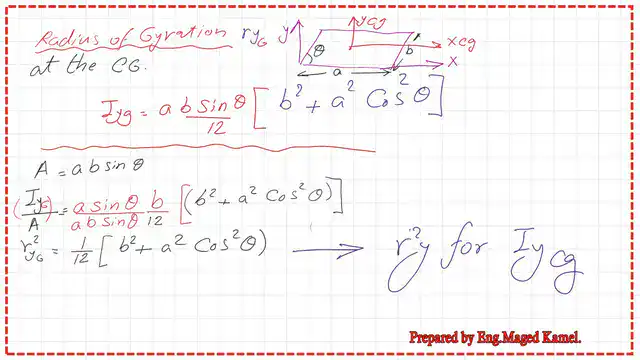
The slide image shows the Moment of Inertia, Iy, for the Parallelogram about the y-axis, and matches the previous calculation shown in this post.

This concludes our post on the Moment of Inertia Iy for the Parallelogram
You can download and review the Parallelogram from this post through the following PDF file.
Next is the post on Iy for the Trapezium.
To use a calculator for various shapes, please see the Moments of Inertia – Reference Table.