
Last Updated on September 8, 2026 by Maged kamel
Moment of Inertia Ix for parallelogram.
Divide the Area into subareas and estimate the Moment of Inertia of each subarea about the x-axis.
The post includes how to estimate the Moment of Inertia Ix for a parallelogram. The x-axis is located at the base of the parallelogram. A parallelogram is a skewed rectangle with an angle=θ between the base and the left side. When θ = 90, the shape becomes a rectangle.
The Area of the parallelogram is b*a, whereas the side length and the height are h and h = a*sinθ.
To find Ix, we divide the parallelogram into two triangles and a rectangle, and use the previously obtained moments of Inertia about the x-axis for the right-angle triangle and the rectangle.
Here are the relevant data for Ix for right-angle case 1, right-angle case 2, and the rectangle.
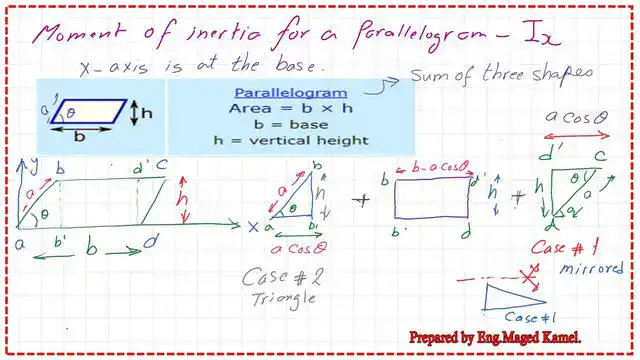
The left triangle has a base of (a* cos θ) and height h; the Inertia about the x-axis is estimated about an axis passing through the left corner point of the base of the parallelogram. Ix for that triangle=base*height^3/12, or (a* cos θ)*(h^3/12).
As for the rectangle about the x-axis, Ix=base*height^3/3=(b-(a* cos θ)*(h^3/3).
For the last triangle Inertia, Ix will be deducted; it is case 1 of the right-angle triangle, but this angle is inverted. We will get Ix about the Cg and add the multiplication of Area by ycg^2, which is ((2/3)h)^2 = (4/9)h^2.
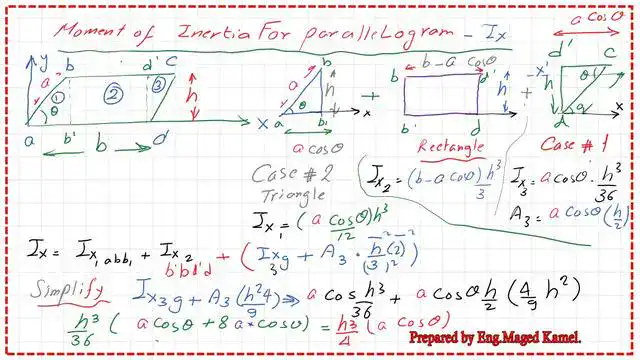
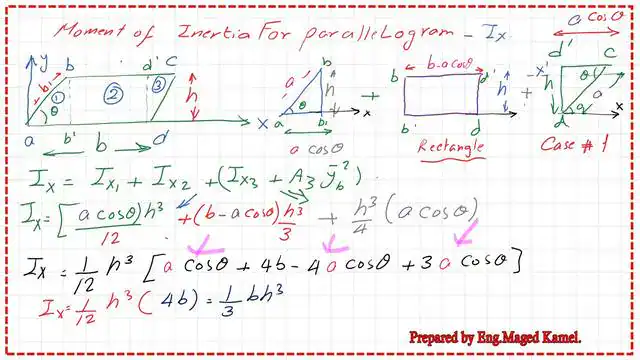
Group and adjust the matching items. The final Expression for the Inertia Ix of a parallelogram can be estimated as Ix = (1/3)bh^3. To get an Expression in terms of a, the value of Inertia Ix for a parallelogram will be=ba^3(sin θ)^3(1/3).
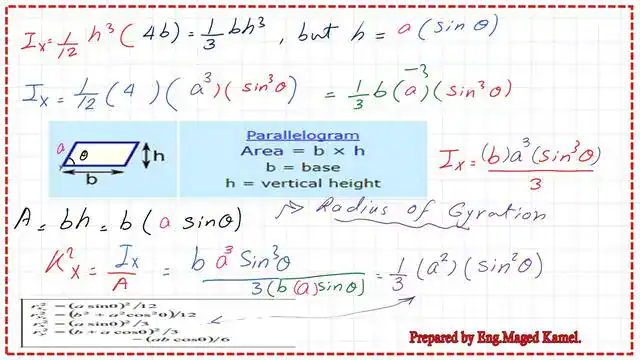
The square of the radius of Gyration (rx)^2 for the parallelogram about the x-axis.
Since rx^2 = Ix/Area, we divide the Inertia Ix for a parallelogram by the Area; the final Expression is shown in the next slide image and compared with the value obtained from the FE Reference Handbook.
The square of the radius of Gyration (rx)^2 for the parallelogram about CG.
The Expression for the Moment of Inertia about CG can be derived by using the parallel Axes theorem. We consider Ix for a parallelogram about the X-axis and subtract the Product of the area*ycg^2 from the Ix value.
We have the cg distance ycg = 1/2 (a*sin θ) from the X-axis that passes through the base; Area = b*h. The final value and the relevant calculation can be derived from the image on the next slide.
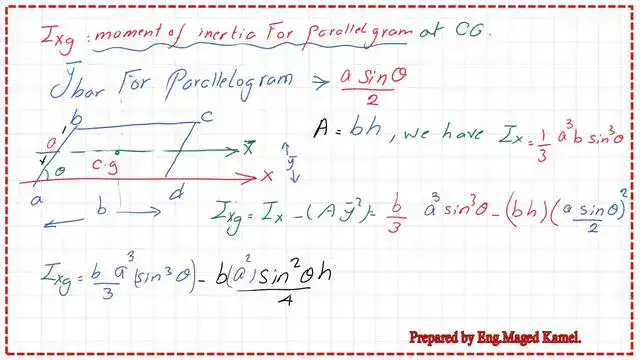
A modification of similar terms is to be conducted; the h value is to be replaced by the equation h = a sin θ. The final term of Ix cg=(1/12)ba^3*(sin^3 θ).
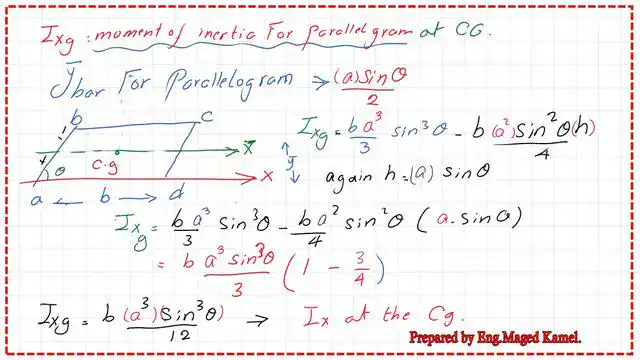
The square value of the radius of Gyration for thParallelogramam about the Cg in the x-direction can be estimated by dividing the Inertia Ix for thParallelogramam at the CG over the Area, Ixg/A, we have Ixg=(1/12)*b*a^3*(sin^3 θ), while the Area of the parallelogram=b*h, rg^2=(1/12)*b*a^3*(sin^3 θ)/(b*h).
The square value of the radius of Gyration about the Cg in the x-direction can be found to be =(1/12)*a^2*(sin^2 θ).
The rectangle Inertia Ix is similar to the Inertia Ix for a parallelogram, for which the angle θ=90 degrees. Then, the square of the radius of Gyration about the Cg in the x-direction for the rectangle is I_x/(m*a^2) = (1/12) a^2; a is the height h. Finally, I_x = (1/12) h^2. Please refer to the next slide image for more details.
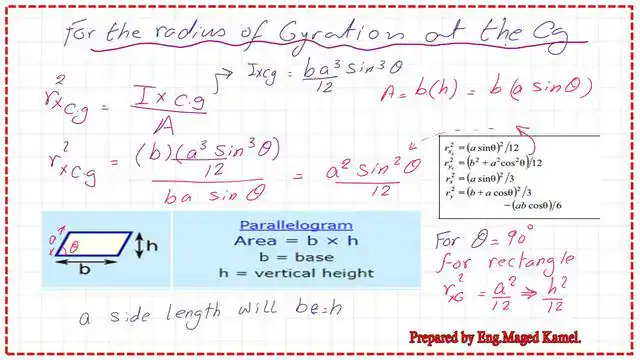
The slide image shows the Moment of Inertia for the parallelogram and its radius of Gyration, matching the previous calculation shown in this post.
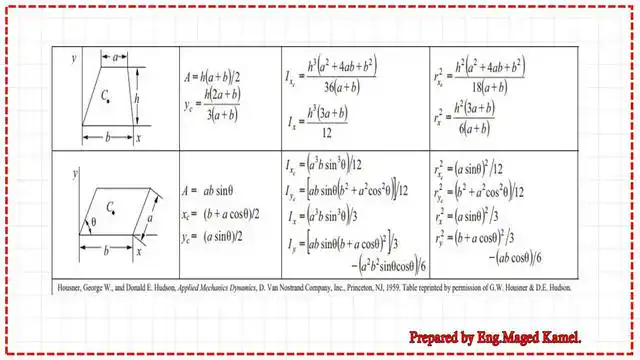
You can download and review the content of this post through the following PDF file.
For a link to a calculator for various shapes, please find the Moments of Inertia – Reference Table.
This is the following post: Moment of Inertia Iy for Parallelogram.