
Last Updated on September 17, 2026 by Maged kamel
Solved Problem 4-2: How do we find design compressive strength?
Summary of the Post content.
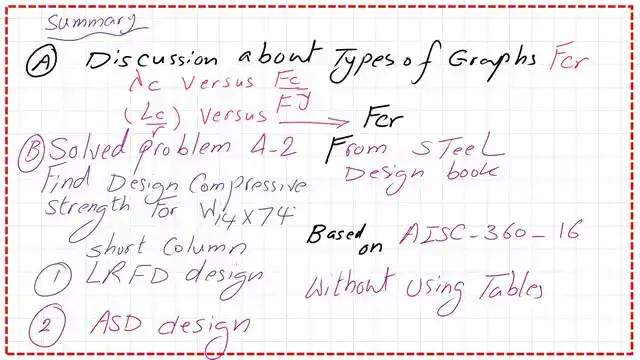
The following slide summarises the content of the current Post; we will discuss the various types of Graphs. The first graph plots λc against Fcr/Fy, where λc is the ratio of Fy/Fe between the yield stress and the critical stress of a column.
The second graph shows the relationship between lc/r (slenderness ratio) and critical stress Fcr. We will use Solved Problem 4.2 to apply the two graphs and determine the required critical stress, thereby calculating the available strength for the column without relying on tables.
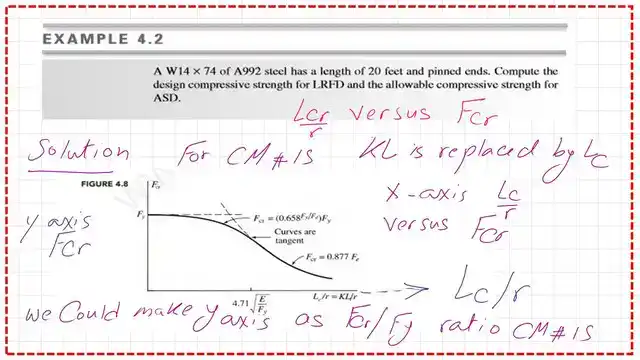
This is the known graph, which shows the relationship between L/r (the slenderness ratio) on the x-axis and Fcr on the y-axis; we could add another y-axis for Fcr/Fy, where Fy is the column’s yield stress.
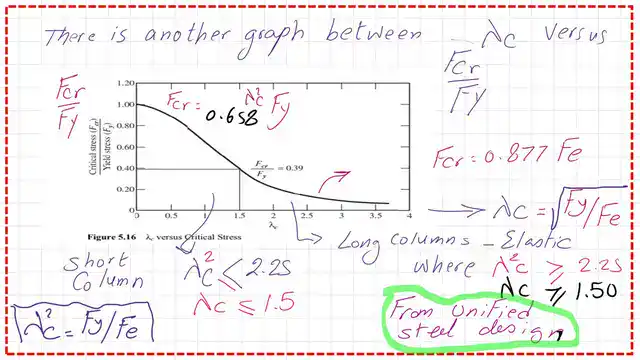
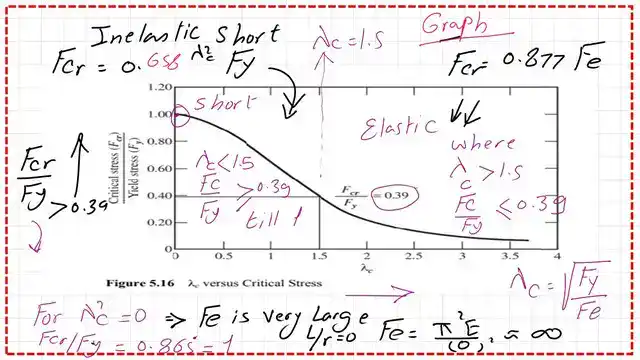
An illustration of the graph between λc and Fcr/Fy.
Another graph we will focus on is the one between λc and Fcr/Fy, where λc is the ratio of Fy/Fe between the yield stress and the critical stress of a column.
The source is the Unified Steel Design Handbook. We can use λc to determine whether the column under study is short (inelastic) or long (elastic) by comparing λc to 1.50, as shown in the following slide image.
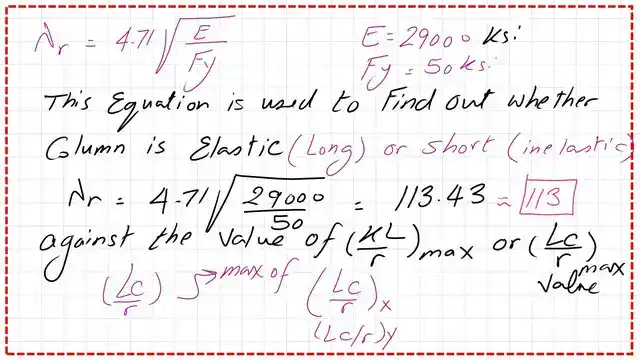
There is λr that is used to find out whether any given column is short or long. It is a given relation based on the yield stress, Fy, and the Modulus of elasticity.
Compare the maximum slenderness ratio (Lcx/rx and Lcy/ry) with λr. If the maximum slenderness ratio is less than λr, the column is short; otherwise, the column is long.
The Value of λr for Fy = 50 ksi is 113.43.
What is the ratio λc^2?
What is the ratio λc^2? The ratio λc^2 equals Fy/Fe, where Fe is the Euler stress Value given by π^2*E/(L/r)^2. We will begin studying a long column where λr = 113.48.
We use tπ^2*E/(L/r)^2 as the denominator, and obtain ac^2 e=1.7469 × 10^-1 * (Lc/r) after substituting the values of Π, Fy, and E. Please refer to the image on the next slide for an illustration.
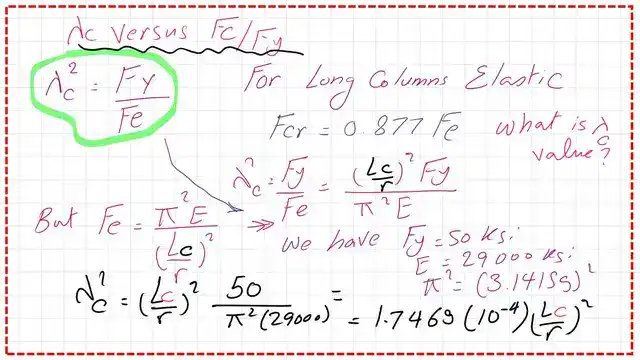
What is the Value of λc^2 when λr = 113.43 for an elastic column?
If we use Lc/r = 113.43 and substitute it into the equation for λc^2, we get 2.25. The square root of λ^2 is λ, which equals 1.50; for a long column, λc is equal to or greater than 1.50. The ratio of Fcr/Fy=0.39.

What is the Value of Fcr/Fy for a short column when λr = 113.43?
We will check the Value of Fcr/Fy for a short column using 0.658^λ multiplied by Fy/Fy for λ^2 = 2.25, resulting in Fcr/Fy = 0.3939.
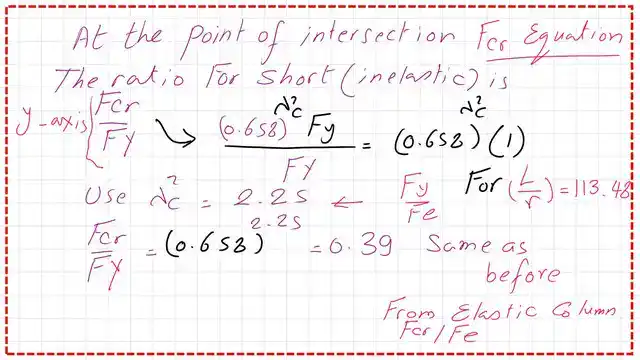
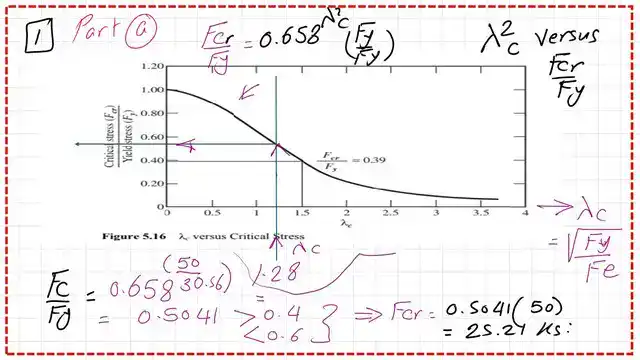
I have included all necessary data for the graph of λc versus Fcr/Fy. The vertical line at λc separates the graph into two parts; the right side shows Fcr/Fy for an elastic column.
Meanwhile, the left side of the line represents the graph of FCr/Fy for an inelastic column. For λc = 0, the slenderness ratio is 0, and Fe = infinity; the Fcr equation (0.658^0* Fy) gives Fcr = Fy, as shown in the graph.
A solved problem 4-2: How do we find design compressive strength?
Now, for problem 4-2 from Prof. Sequi’s book: for a 14x74W14x74 section of A992, the column is 20 ft long and pinned at both ends. Compute the design compressive strength for LRFD and ASD. This solved problem is included in the fifth and sixth versions of the book.
This is an analysis for a given column of A992 W14x74 of A992, L = 20 ‘.
The following slide image shows the difference between the major and Minor directions for the column.

Table 1-1 provides all necessary information for the W14x74 section, including Ix, rx, Area, Iy, ry, and the Area used to calculate the slenderness ratio and Euler strength. We will estimate Lcx and Lcy in inches. The effective length factor K equals 1 for both the X and Y directions.
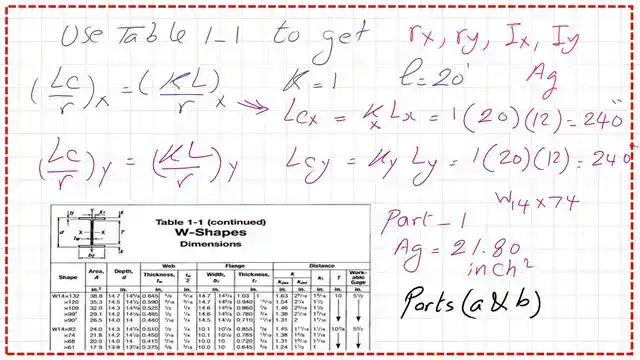
After obtaining the necessary information from part 2 of Table 1-1, estimate the slenderness ratios Lcx/rx and Lcy/ry and determine the larger Value, Lcy/Lry.
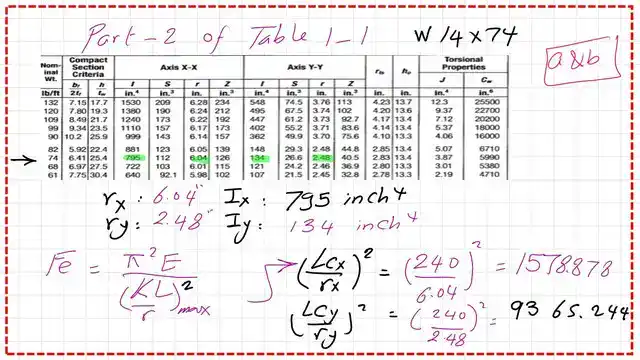
Check the Value of Euler stress.
The following steps are to be performed.
A- Find the Value of the Euler stress by plugging in lc/ry = 240/2.48 and substituting the values of Pi and E. The Fe Value equals 30.56 ksi.
B-check whether the column is short or long by determining the Value of λc, which equals the square root of Fy/FE=1.28; if this Value is smaller than 1.50, the column is short.
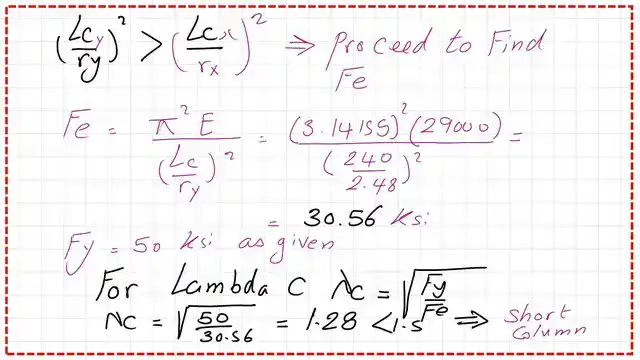
Find the Value of Fcr using the λc versus Fcr/Fy graph.
C- estimate the Value of Fcr/Fy; since the column is short, use Fcr=0.658^(50/30.56)=0.5041, which is bigger than 0.40 and less than 0.60; multiply by Fy; get a Value of 25.51 Ksi.
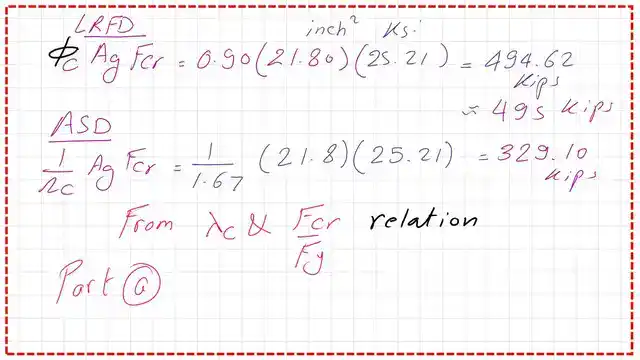
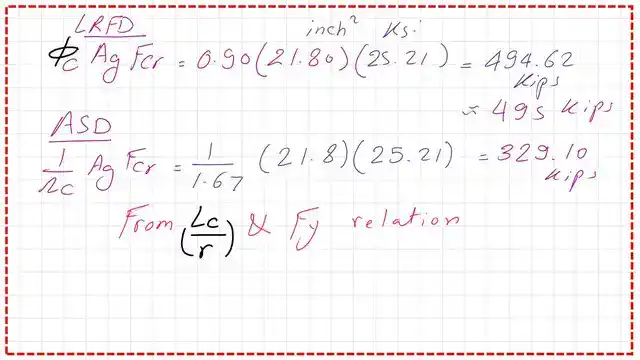
For LRFD, use Φ = 0.9; for ASD, use Ω = 1.67. The column’s LRFD design strength is 495 kips; compare this to the larger of (1.4d or 1.2d + 1.6L), where D is the dead Load and L is the Live Load.
The allowable design strength of ASD is 329 kips, which can be compared with D+L. The detailed calculations are shown in the slide image; the estimate was done by using λc versus Fcr/Fy.
Find the Value of Fcr using the lc/r versus Fcr graph.
Using the lc/r versus Fcr graph, we plug in the Value of Lcy/ry as equal to 96.774 and draw a vertical line. Since L/r is smaller than 113.43, the column is short. Use the equation Fcr = 0.658^ (50/30.56)*Fy=25.21 ksi, the same Value that we have obtained using the previous estimate.

The column’s LRFD design strength is 495 kips, and the ASD Value is equal to 329 kips, the same as we estimated earlier. Thanks a lot.
You can view and download the PDF for this Post from the next document.
The following Post on how to compute critical stress- Table 4-22?
For a good A Beginner’s Guide to the Steel Construction Manual, 14th ed. Chapter 7 – Concentrically Loaded Compression Members.
For a good A Beginner’s Guide to the Steel Construction Manual, 15th ed. Chapter 7 – Concentrically Loaded Compression Members.
For a good A Beginner’s Guide to the Steel Construction Manual, 16th ed. Chapter 7 – Concentrically Loaded Compression Members.