
Last Updated on September 10, 2026 by Maged kamel
Area and CG for a circle.
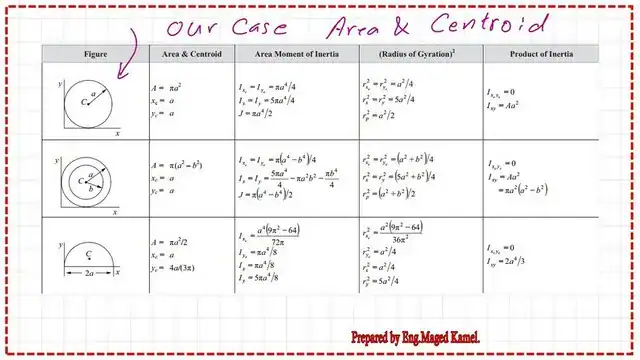
Reference handbook: 10.00 value for the Area and CG for a circle.
A list of common round shapes, their areas, and CG values. Our first case is a circle.
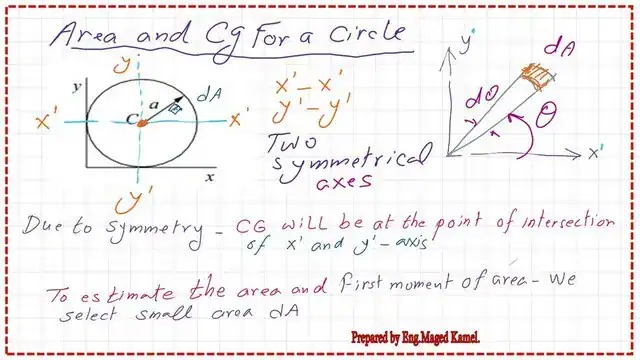
Area and CG for a circle- select an Area dA.
We have a circle with radius a, and we need to find its Area and CG. We can find two axes, X’ and Y’, that divide the circle into four similar parts. Because of that symmetry, we expect the center of gravity (CG) to be at the intersection of these two axes.
We have two axes, X and Y, that are tangent to the circle and are separated from the X-axis by a distance of a, the circle’s radius. We will select a small Area dA that has a radius of ρ from the intersection of the two axes X’ and Y’.
Area and Cg for a circle- first Moment of Area about the x’-axis.
The first Moment of Area for the small Area dA about the X’-axis is the Product of that Area by the vertical distance to the X’- axis. The vertical distance is y, which is equal to ρ*sin θ. The Moment dMx=dA*(y)=(ρ*dρ*d θ)*(ρ*sin θ). It will be simplified to (ρ^2*dρ*sin θ*dθ).

For the first Moment of Area of the whole circle, we will use double integration, since we have to integrate ρ from ρ=0 to ρ=a. The second integration is over the angle dθ, from θ = 0 toθ = 2π (360 degrees). dA*y=∬(ρ^2*dρ*sin θ*dθ).
The value of the first integration will be ∫ρ^2*dρ from 0 to a = 1/3*ρ^3. After substitution, this yields 1/3*(a^3-0) = a^3/3. While for the second integration, ∫, (sin θ*dθ)=-cos(θ), after substituting from zero to 2*π.
The value will be (- (cos(2*π)- cos(0))=zero.
But the circlAreaea can be found from the integration of dA= ∬(ρ*dρ*dθ) from ρ=0 to ρ=a and for dθ from =0θ=0 to dθ=2*π;; the final eExpressionfor the Area is dA=ρ^2*0.5*(θ), substitute to get A=0.50*(a^2-0)*(2*π-0)=π*a^2.
Dividing A*y/A to get Y bar will lead to ybar=0/π*a^2=0. This implies that the Cg lies on the X’ -axis.

Area and Cg for a t circle- first Moment of Area about the Y’-axis.
The first Moment of Area dA about the y’-axis is dMy=dA*(x)=(ρ*dρ*d θ)*(ρ*cos θ). This simplifies to (ρ^2*dρ*cos θ*dθ).
For the first Moment of Area of the whole circle, we will use double integration, since we have to integrate ρ from ρ=0 to ρ=a. The second integration is over the angle dθ, from θ = 0 toθ = 2π (360 degrees). dA*y=∬(ρ^2*dρ*cos θ*dθ).
∫ρ^2*dρ from zero to a=1/3*ρ^3 after substitution will lead to 1/3*(a^3-0)=a^3/3, while the ∫(cos θ*dθ)=-cos(θ), after substitute from zero to 2*π. The value will be (+ (sin(2*π)-sin(0))=zero.
We have estimated the Area of the circle to be π*a^2. x bar is equal to A*X/A= zero/π*a^2 =0. This implies that the Cg lies on the Y’- axis.


We have completed the subject of the Area and Cg for a circle.
You can view or download the PDF of this post’s content from the following document.
The next post will be on how to estimate the Area and CG for a circular shaft.
This is a link to a very useful site: Engineering statics, open and interactive.