
Last Updated on October 19, 2026 by Maged kamel
First solved Problem for a 3×3 Matrix by Crout’s LU (option 2).
We have two solved problems for the 3×3 Matrix using Crout’s LU (option 2). For these, we will apply the same technique used to derive the elements of the lower and upper matrices. Option 2 is finding the upper Matrix first.
The video covers the content of this Post.
The video timestamps are shown.
- 00:00 Introduction to the first solved Problem.
- 01:10 Verify that Matrix A is invertible.
- 01:58 Express Matrix A as an L × U Product.
- 03:04 Find the values for the elements of the first column in Matrix L.
- 03:52 What are the elements to find their values?
- 05:05 Find L22 and L32 elements.
- 06:37 How can we find the U23 Value?
- 08:03 How can we find the L33 Value?
- 09:44 What are the elements of the U Matrix?
- 11:08 Verify that L times U will give Matrix A.
- 11:51 Develop the values for elementary matrices.
- 14:22 Find the values for the E2 Matrix.
- 15:19 Find the values for the E3 Matrix.
- 17:28 The Formula for the inverse of the L Matrix.
- 18:56 The elements of the inverse of the L Matrix.
- 20:04 Verify L by L inverse equals I.
We will start with the first solved Problem.
The following slide shows the first solved Problem: how to find the L and U matrices using option 2, and how to use elementary matrices to find L and U.

The first solved Problem is a 3×3 Matrix using Crout’s LU decomposition (Option 2).
The first Problem for the 3×3 Matrix is Crout’s LU decomposition. It is required to find both the Lower and upper Matrix decomposition, LU, by using Crout’s method through a given Matrix A. The given Matrix is 3×3.
Step 1: Convert Matrix A to an upper Matrix (Option 2).
First, Matrix A is (1, 1, 1; 4, 3, -1; 3, 5, 3). We estimate the determinant of Matrix A as +10. Since the determinant is not zero, the Matrix is invertible, and we can proceed to find the L and U matrices using Crout’s method. The details for estimating the determinant are shown on the next slide.

The first-column elements of the A Matrix, 1, 4, and 3, are set as L11, L21, and L31. L11=1, L21=4, L31=3.

We can find U12 and U13 by comparing the first Row of Matrix A with the element-wise Product of L and U. U12 = +1 and U13 = +1.

The following slide shows the elements we need to find: L22, L32, L33, and U23.

Minus 4 times 1, plus 3, gives us minus 1. Again, minus 4 times 1 plus minus 1 gives us minus 5. Regarding the third Row, we have minus 3. Adding two and three gives us zero. Minus three added to five gives us plus two. Minus 3 times 1 is minus 3; adding 3 gives us 0.
The second Row will be minus 4 multiplied by 1. The detailed procedures are shown in the slide image.
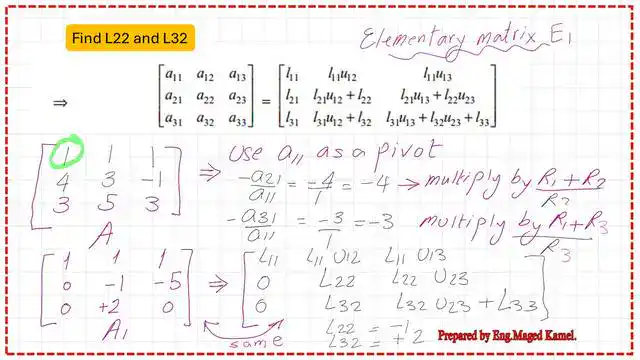
Step-2:Find values of L22, L32, option-2.
We will use a11 as a pivot to eliminate a21 and a31 elements. The multipliers are -a21/a11 = -4, multiplied by R1 and added to R2. The second multiplier is -a31/a11 = -3, to be multiplied by R1 and added to R3. These are the two operations: the Matrix becomes (1, 1, 1, 0, -1, -5, 0, 2, 0). Compared with the Matrix shown on the next slide, we find that L22 = -1 and L32 = +2.
Step 3: Find the Value of U23 (Option 2))
We use a22 as the pivot to eliminate a32; the multiplier is +2, which we multiply by R2 and add to R3. The Matrix elements will be (1 1 1,0 1 5, 0 0 1). Compared with the Matrix shown on the next slide, we find that U23 = +5.

Step 4: Derive the Value for L33.
To obtain the final L and U matrices, we use a22 as the pivot and divide -a32 by a22, which is +2. We multiply this multiplier by R2 and add it to R3. We compare the two matrices; we find that L33 =-10:
The first Row is (1, 1, 1). The second Row is (0, -1, -5). The third Row is (0, 0, -10).

Step 5: Find the elements of a 3×3 U Matrix.
On the next slide, to obtain the elements of the U Matrix, we will divide the first Row (R1) by 1, the second Row (R2) by -1, and the third Row by -10 to set the diagonals of the U Matrix to 1.

We can write both the lower and upper matrices and check whether multiplying the lower by the upper yields the final A Matrix. Using row-by-column multiplication, we can see that L*U equals A.
The following slide shows that the Product of L and U gives the elements of Matrix A.

You can view or download the PDF data for the first part from the next button.
Elementary matrices to do Row operations- first solved Problem.
We can perform the same steps using elementary matrices; the elementary Matrix E1 to the right of Matrix A will eliminate the a12 and a13 elements. The elementary Matrix E2 will eliminate the a23 element and be placed to the right of the A*E1 Matrix; we finally obtain a Lower Matrix. Please refer to the slide image below.

We can get the Value of the E2 Matrix; please refer to the following slide.

We can verify the U Matrix by multiplying E3*E2*E1*A from left to right.

How can we get the inverse of the L Matrix?

The Product of E3, E2, and E1 will give the inverse of L.

Check that L, when multiplied by its inverse, gives the identity Matrix.

You can view and download the PDF for the first solved Problem from this Link.
This is a Link to the following Post: 12-Second Solved Problem for a 3×3 Matrix by Crout’s LU -Option 2.
This is the Omni calculator for estimating various linear algebra items: LU Decomposition Calculator.
Link to the the Omni calculator:: LU Decomposition Calculator.
Another calculator to use is the Calculator for matrices.