Last Updated on September 10, 2026 by Maged kamel
Area and Cg of a Trapezium.
Reference handbook 10.00 value for Area and Cg in the x-direction.
To find the Area and CG of a Trapezium, we divide it into a Rectangle and two triangles, and take the first Moment of Area about a vertical axis y passing through the external edge point, using the external axes. This will give the x-bar of the Trapezium.
For the y-bar, we do the same process, but we take the first Moment of Area about an external axis passing through the base, which is then called the x-axis.
This is a list of the first Moment of Area for typical plain shapes. The Trapezium data for Area and Cg are shown in the fifth shape.
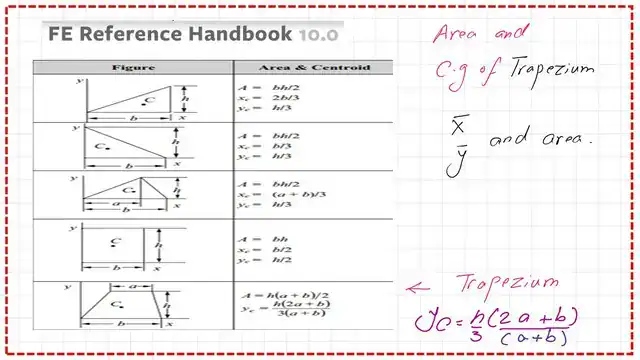
We need to obtain the same data as in the FE reference handbook, as shown in the image on the next slide, for case #No. 5.
Area and CG of a Trapezium in the x-direction.
The Trapezium with base b, upper side a, and height h is divided into the following shapes:
1-A Rectangle of base b and a height of h;; its Area A1=b*h;; its CG is apart from the y-axis by a distance x1= (b1+0.50*a).
2-A left triangle of base b1 and a height of h, its area A2=1/2*b1*h, its CG is apart from the y-axis by a distance x2=(2/3*b1).
3-A right triangle of base b2 and a height of h, its area A3=1/2*b2*h, its CG is apart from the y-axis by a distance x3=(b1+1/3*b1).
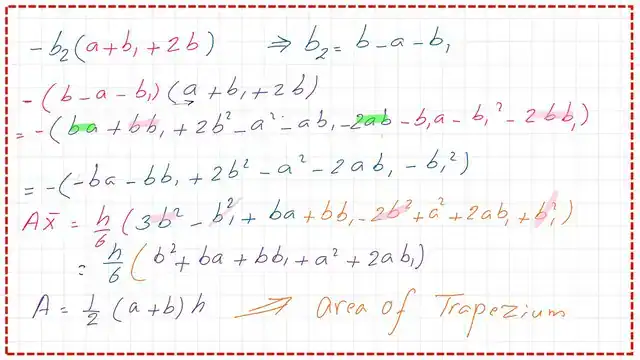
The Area of the Trapezium equals the Area of the Rectangle minus the Area of the left triangle and the area of the right triangle. The details of these shapes are shown in the next slide images.

The first Moment of Area for these three shapes equals the first Moment of Area for the Trapezium.

We will proceed with our estimation by equating the first Moment of Area for the Trapezium about the y-axis to the Equivalent moments of Area for areas A1, A2, and A3; the (-) sign is introduced because we are subtracting areas A2 and A3 from A1.

The next two slide images give the full details of the estimation.
Area and Cg of a Trapezium in the x-direction.
We will have the final Expression for the distance of the Cg of the Trapezium about the y-axis, which is the X-bar.
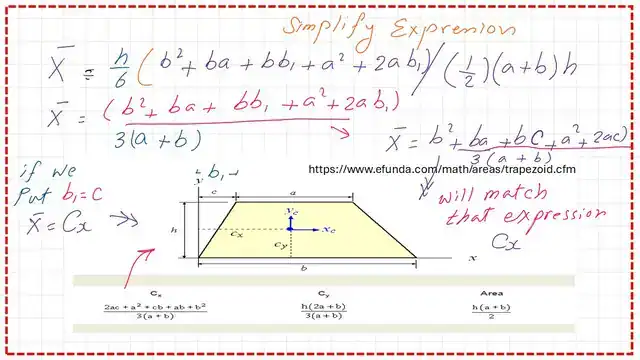
The next link shows the same Expression, but considers it as Cx. I used b1 in lieu of C. When Cx equals 1/2*(b-a), where a is the upper side and b is the lower side, the Cg distance equals b/2.
Area and Cg of a Trapezium in the y-direction.
The Trapezium with base b, upper side a, nd height h is divided into the following shapes:
1-A rRectangleof base b and a height of h; its Area is A1 = b*h; its CG is a distance y1= (1/2*h) from the x-axis.
2-A left triangle of base b1 and a height of h; its Area A2=1/2*b1*h, it is CG is apart from the y-axis by a distance y2=(2/3*h).

3-A right triangle of base b2 and a height of h;; its Area A3=1/2*b2*h, it is CG is apart from the x-axis by a distance y3=(2/3*h) from the x-axis from the x-axis.

The next slide image shows the Expression for the first Moment of Area about the x-axis, which is A*Ybar.
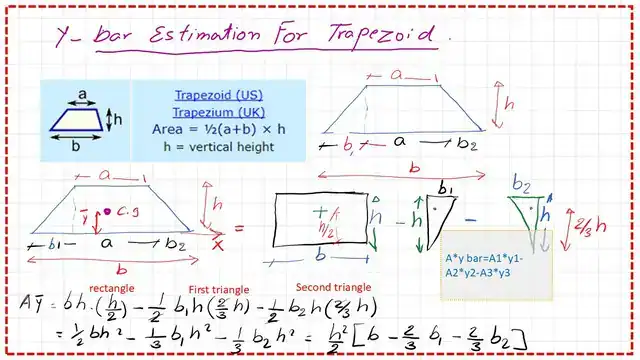
We divide by the Area, then Y-bar = = (1/3)*(2a+b)/(a+b). This result matches the result obtained from the FE reference handbook table of areas and CG.
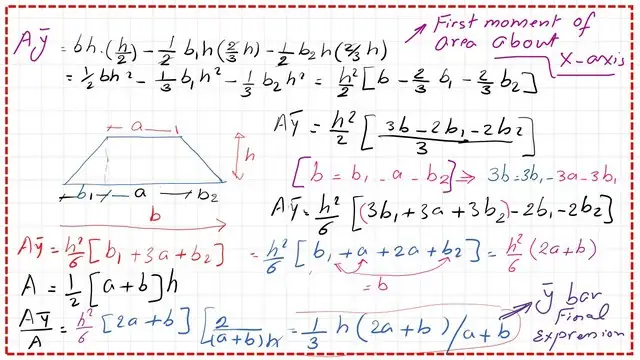
The final Expression of the first Moment of Area about the x-axis is A*y-bar, which can be obtained as (h^2/6)*(2a1+b).
You can view or download the PDF for this post via the Area and CG for a Trapezium document.
This is a different Moments of Inertia and their CG: a useful link for areas and CG.
You can find the second Moment of Area, or Moment of Inertia, for a Parallelogram in post 19.
This links to the next post on the Area and CG of a Parallelogram.