
Last Updated on September 13, 2026 by Maged kamel
Elastic and plastic section moduli for any shape
Video describing the content of two posts, 3a and 3b. The part of the video that covers this post starts from 10:42 to the end.
Timestamps for the video.
- 00:00 Elastic section Modulus Sx definition.
- 02:59 Plastic section modulus Zx.
- 06:27 What is the shape factor?
- 06:53 Derive an Expression for y-bar for a rectangular section
- 09:15 Effect of symmetry on the elastic neutral axis.
- 10:24 Elastic neutral axis for stem and unequal angle.
- 10:53 Elastic neutral axis for any shape.
- 11:49 Plastic neutral axis for any shape.
This continues the previous post, “Elastic and plastic section moduli for a Rectangle.” We will proceed to estimate the section modulus Sx and plastic section modulus Zx for any shape.
What will be the steps to find the neutral axis if we have an unsymmetrical shape? We will indicate this in the next slide.
Section modulus Sx for any shape.
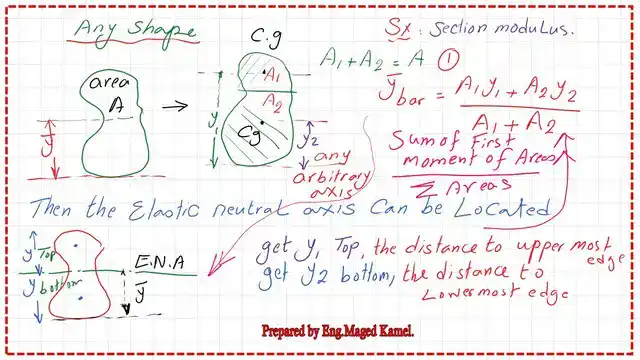
For shapes where the E.N. axis does not pass through the center, follow these steps.
Create a datum line, for instance, passing through the bottom of the shape. Use any arbitrary axis; this axis will divide Area A into A1 and A2, estimate A1 and A2, and find the total Area that is equal to A.
Estimate the distances y1, y2, or the Cg distance for A1 and the Cg of the second Area, A2.
Estimate the E.N. axis distance from the bottom datum by dividing the sum of A*y over the Area.
The elastic neutral axis can be located at a distance from the bottom datum equal to (A1*y1+A2*y2)/(A1+A2)
We will use the same procedure we used for the rectangular shape.
1-We estimate the value of Y-bar for any Area by estimating the Y-bar for the section, by summing the first Moment of areas, considering the datum line is at the bottom: the Product of A1*y1 + A2*y2 = At*y-bar. Since the total Area is known, we can get Y-bar.
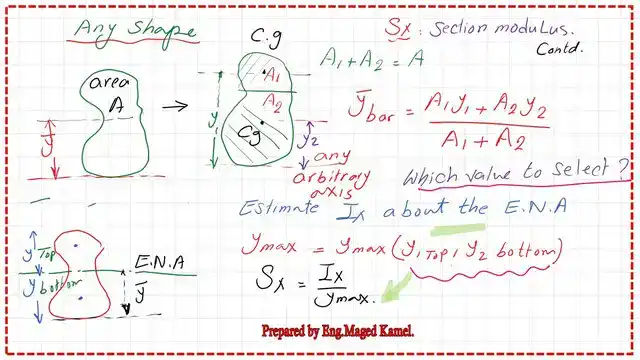
2- We estimate the Inertia about the neutral axis, which we have just evaluated at a distance y-bar from the datum.
3- We estimate the y-max value, which will be the maximum value of (y1,y2).
4- Estimate Sx, which is Ix/ymax.
How do you evaluate Zx, the Plastic section modulus, for any shape?
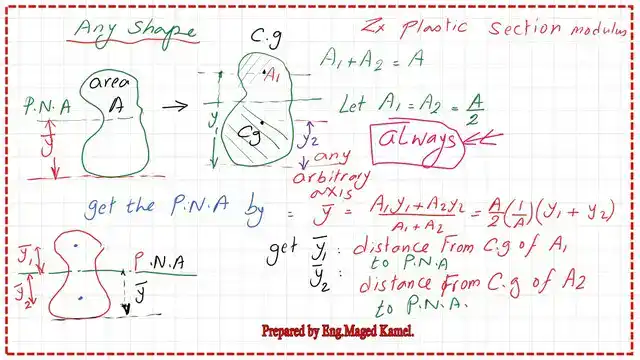
For the plastic section modulus Zx. Create a datum line, for instance, passing by the bottom of the shape.
Use any arbitrary axis; this axis will divide Area A into two equal areas, each equal to A/2. Estimate the distances y1, y2, or the Cg distance for A1 and the Cg of the second A2 about the external datum.
Estimate the P.N. axis distance from the bottom datum by dividing the Moment of Area by the Area, and get the Expression y bar equals 1/2(y1+y2), where y bar is the P.N. axis distance from the external datum.
Estimate y1 bar and Y2 bar about the P.N. axis.
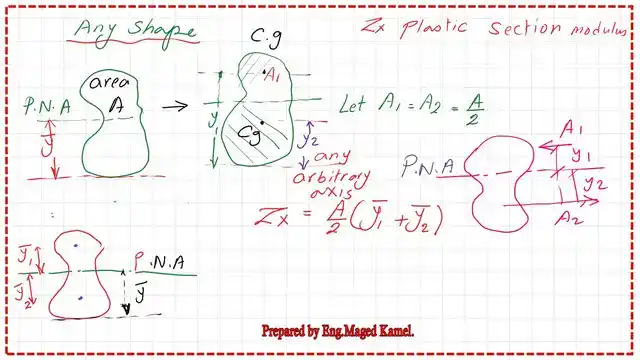
To estimate the plastic section modulus Zx. Use the expression: e = A/2*(y1 bar + y2 bar).
For the plastic section modulus Zx of a rectangular shape.
In step -1. Let a datum line pass by the lower base, and consider another axis located at a distance of kd from the lower datum line. This axis will have a distance from the upper fiber equal to (d-kd).
Step 2: Estimate the Area A1. Let A1 be the Area enclosed by the upper datum axis and the top side of the Rectangle. We can estimate A1 as equal to (b)*(d-kd)=bd(1-k).
The third step is to estimate the second Area, or A2; it will equal (b)*(kd). Equate A1 and A2.
bd (1-k)=b*k so thato we cansolve2bd=1/2:.
Thus, the P.N. axis is located at a distance of kd, which is d/2. Let y1 cg be the distance between the P..N axis and Cg of A1; it will be equal to d/4. Similarly, y2cg equals d/4.
Zx can be equal to bd^2/4.

The PDF containing this post’s content is from the following Link.
Here is the Link to Chapter 8, “Bending Members.” A Beginner’s Guide to the Steel Construction Manual, 14th ed.
Here is the Link to Chapter 8, “Bending Members.” A Beginner’s Guide to the Steel Construction Manual, 15th ed.
Here is the Link to Chapter 8, “Bending Members.” A Beginner’s Guide to the Steel Construction Manual, 16th ed.
For more details, please refer to the first part via post 3a.
The next post Link: 4-Solved problem 4-3 for the elastic and plastic sections.