
Last Updated on September 6, 2026 by Maged kamel
The difference between simple and compound interest.
When someone borrows Money from the bank and has to repay it after some time, in the case of simple interest, what will be the value if the loan is to be repaid at a compound interest rate?
The difference between simple interest and compound interest is shown. For a simple interest: the final value equals principal(1+% interest)* the number of years.
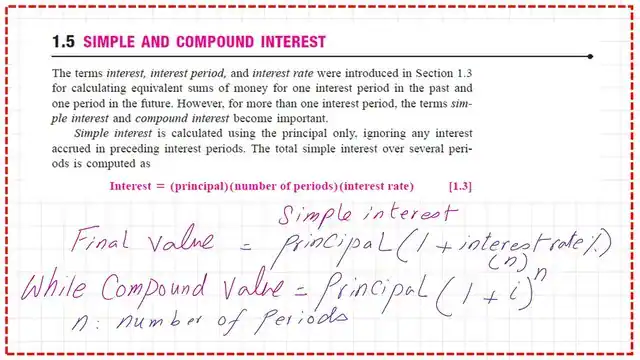
For compound interest, the final value will be equal to principal*(1+%interest)^(number of years), where the number of years is considered as a power factor.
Example 1.4: How to determine the loan value?
Example 1.4 – HP borrowed Money to conduct rapid prototyping of a new ruggedized computer. That targets desert oil field conditions. The loan is $1 million for 3 years at 5% simple interest per year. How much Money will HP repay at the end of 3 years?
Solution for Example 1.4. The example is a direct application of simple interest.
HP borrowed $1.0 million for 3 years at 5% interest, simple interest. How much Money will the company repay at the end of the 3 years? The solution is shown in tabular form on the next slide.
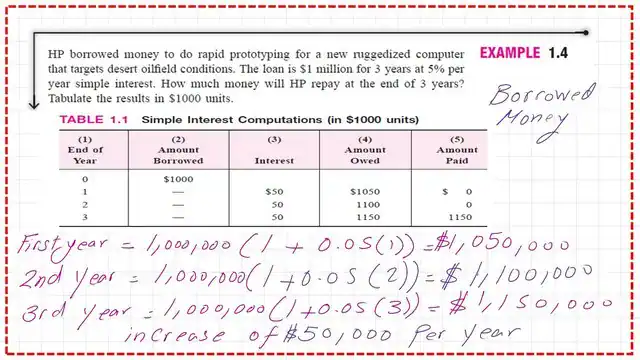
Steps to calculate the simple interest value.
1- The borrowed Money is $1.00 million.
2-At the end of the first year, simple interest at 5% of the Money after one year=$1.0(1+0.05*1.00)=$1.05 million.
3-At the end of the second year, simple interest at 5% of the Money after two years =$1.0(1+0.052) = $ 1.10 million.
4-At the end of the third year, simple interest at 5% of the Money after three years =$1.0(1+0.053) = $ 1.15 million.
Money is due at the end of the first year+interest = 1.05+0.052.00=$1.15 million.
Using Excel to calculate simple interest, example 1.4.
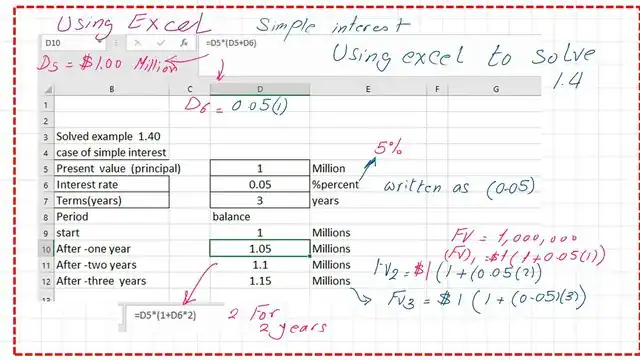
For practical purposes, Excel can be used to estimate the future value of deposits, loans, or debts by specifying the interest rate, time, and the principal (or present value) at time 0. There is no function for the case of simple interest, but we can create relations between cells.
For our solved example 1.4, the present value is $1.00 million, the simple interest rate is 5%, and the period is 3 years. The future values after 11 years, 22 years, 5 years, and 1010 years were estimated using the formula we used earlier.
Solved problem 1.5 based on compound interest.
Example 1.5 is a direct application of compound interest. HP borrowed $1.0 million for 3 years at 5% interest, compounded annually.
How much Money will the company repay at the end of the 3 years?
The solution is shown in tabular form on the next slide.
Using Excel for compound interest value, for example, 1.5.
For practical purposes, Excel can be used to estimate the future value of a deposit, whether for loans or debts, by specifying the interest rate and time, and the principal or the present value at time (0). There is a function in Excel called FV, which stands for future value.
For our solved example 1.5, the present value is $1.00 million, the compound interest rate is 5%, and the period is 3 years. We can put this data in an Excel sheet, as shown in the image on the next slide.

TheThe interest cell is D6,, and multiply by 1) to express the future value after one year,, or 2 for the case of two years, etc.
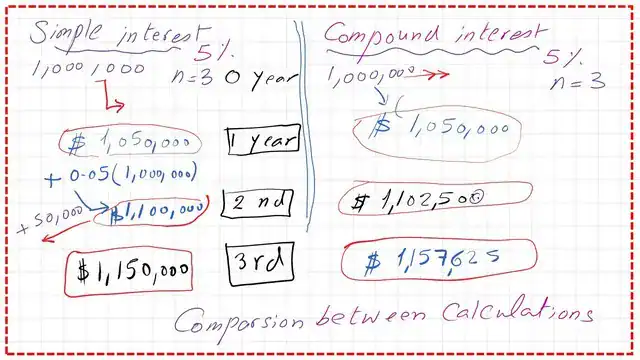
This is a comparison between the values estimated by using simple interest and the
values estimated by using compound interest.
The FV function requires the interest rate, n per, the number of periods (in our case, 3 periods), and the rate expressed as a yearly rate. It also requires the present value, which is included but with a negative sign.
This is the Excel sheet used to estimate compound interest values using the FV function.
As we can see, after the one-year value is =D5 which is the principal value, placed at cell D5, open bracket, inside1+, then another bracket (interest several years))
The PDF used to illustrate this post can be downloaded from the following document.
The next post title is Compound Interest Part 2.
Engineering Economy: Applying Theory to Practice is A good reference.