
Last Updated on September 23, 2026 by Maged kamel
False position method.
The false position method is another numerical method for root finding. The same Solved problem will be used to find the root of f(x), but this Time using another method called false position, or regula falsi, which can be done by substituting the formula shown here.
Xr is the horizontal distance to the root, where x1 and x2 are the distances from point (0.0) to the left-bracket point and the right-bracket point, respectively.
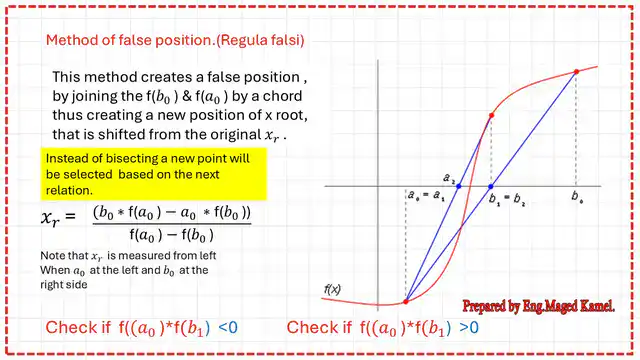
b1 and b2 represent the function values at the left-bracket point and the right-bracket point, respectively.
A solved problem for the false position method.
We have used previously the function for which f(x)=x^3 -6x^2 +11x-6. Find the zeros of the function by the False position method, considering a0= 2.50 and b = 4, as before. xr numerator is (x right*yleft-x left*y right), while the denominator =(yleft- y right).
The steps are as follows:
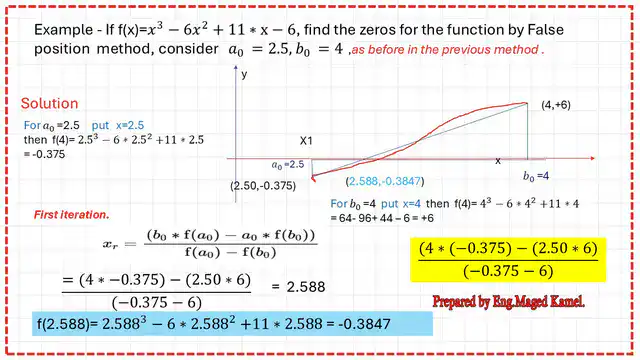
1-The solution we have before a0 as =2.50 will give us an f(a0) =-0.375, and we have b. =4 that is giving f(b)= f(4)=+6.0.
2- If we assume that this is a sketch of the graph. Suppose this is a sketch of the graph. The graph intersects the x-axis at a certain point, and we want to find x1 and, accordingly, f(x1).
3- We apply in the equation of xr=((b0)*f(a0)- a0*f(b0))/(f(a0)-f(b0) The b0=4.0. and a0=2.50.
4-The function of f(b0) is 6, and the function of (a0)= f(a0)=-0.375 hen xr=((4-*0.375)-(2.50*6)/(-0.375-6) =2.588.
5- Our next step is trying to find the function Value at x1=2.588. So we plug in the function. by putting f(x)= f(2.588).We substitute the result as -0.3847.
This point is considered a new left bracket point.
6-We can make a left bracket here, and we have the bracket for the positive Value again, the function of x at x = 4, or b=4; it is a right bracket point.
We join this point with the other point that has a positive Value, of +6.
Our false position again moves from a = 2.50 to x = 2.588. This is very close to the required x Value that gives zero.
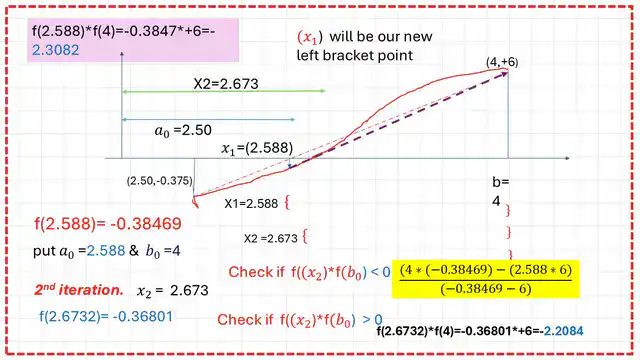
7- We apply in the equation of xr=((b0)*f(a0)- a0*f(b0))/(f(a0)-f(b0) The b0=4.0. and a0=2.588. f(a0)=-0.36801, b0=4, f(b0)=+6.
Our new value of xr=(4*(-0.38469)-(2.588)*(6))/(-0.38469-6)=2.673.
8- We will substitute into the function; we get f(2.673), which=-0.36801, and it will give (-), which means it is the new left bracket. We can check that f(2.673) and f(4) aregative, that is, (-0.384696 =-2.2085).
9- We apply in the equation of xr=((b0)*f(a0)- a0*f(b0))/(f(a0)-f(b0) The b0=4.0. and a0=2.673. f(a0)=-0.368019,b0=4, f(b0)=+6. Our new value of xr=(4*(-0.368019)-(2.588)*(6))/(-0.36801-6)=2.7499.
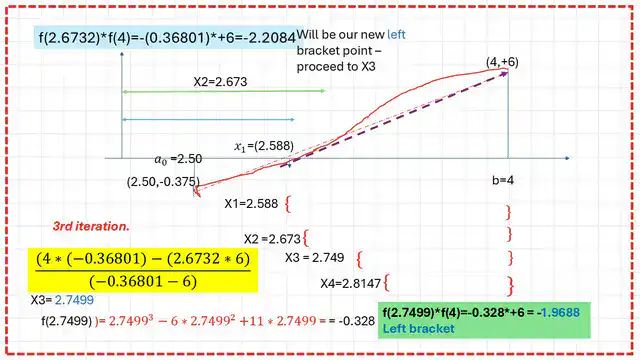
10-We substitute into the function and get f(2.749), which = -0.328. Since it is negative, it is the new left bracket. We can check that f(2.749)*f(4) is negative, that is, (-0.328*6) = -1.9688.
11- We apply in the equation of xr=((b0)*f(a0)- a0*f(b0))/(f(a0)-f(b0) The b0=4.0. and a0=2.7499. f(a0)=-0.328, b0=4, f(b0)=+6.
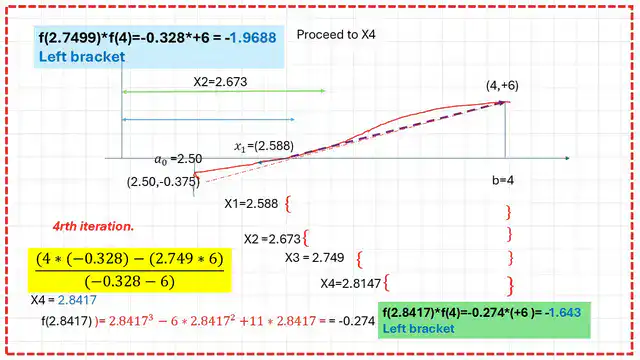
Our new value of xr=(4*(-0.328)-(2.7499)*(6))/(-0.328-6)=2.8147.- We apply in the equation of xr=((b0)*f(a0)- a0*f(b0))/(f(a0)-f(b0) The b0=4.0. and a0=2.673. f(a0)=-0.368019,b0=4, f(b0)=+6. Our new value of xr=(4*(-0.368019)-(2.588)*(6))/(-0.36801-6)=2.7499.
We substitute into the function and get f(2.8147) = -0.2741. This gives (-), which means it is the new left bracket. We can check that f(2.8147)*f(4) is negative, that is, (-0.2741*6 =- 1.643).
We have reached x5, as shown in the next slides: x5 = 2.866, with a negative Value, and it is again the new left bracket, moving closer to b = 4. The next image shows the calculation details.
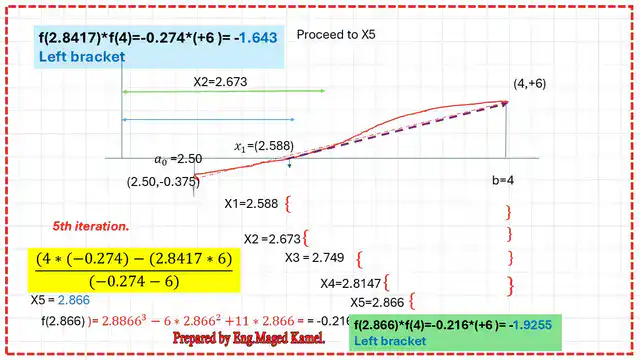
We plug in x=2.866 as a0. While f(2.866)=f(a0)=-0.216, we can get a new point of x=2.905. THIS POINT is a left bracket point.

Table of the number of iterations.
This Table shows 20 iterations at x20; the Value is 3.00. f(x=3)=0; the calculations are performed using an Excel sheet as shown in the next slide image.
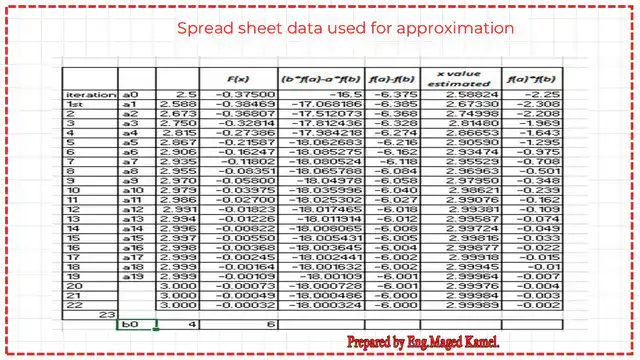
You can download the PDF data for this Post from the following document.
The next Post will be Fixed-point iteration and how to use it.
A very interesting source is Holistic Numerical Methods.