
Last Updated on September 21, 2026 by Maged kamel
We will introduce two practice problems for Ixy for a Trapezium, 8.43 and 8.49. These problems are quoted from Bedford and Fuks’s Engineering Mechanics: Statics.
Two Practice problems for Ixy for a Trapezium.
Two practice problems: the first illustrates how to estimate the Product of Inertia about external axes, and the second describes how to find Ixy at the CG.
The first practice problem on Inertia is No. 8.43. Find Ixy for a given Trapezium.
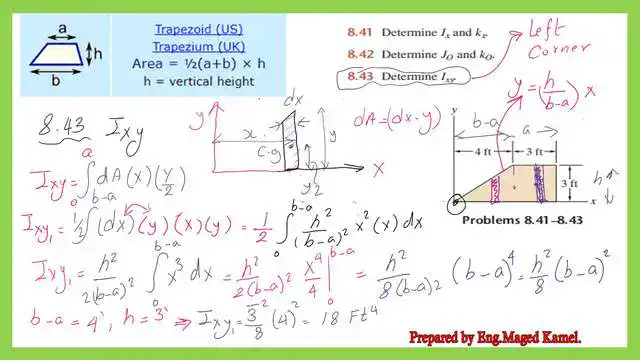
For the first of the two Practice problems for the Product of Inertia Ixy for a Trapezium, we have a Trapezium with a base length of 7 feet (b), an upper part length of 3 feet, and a height of 3 feet. We need to determine the Product of Inertia Ixy about the two external axes at the left edge.
The first part is Ixy1, the Product of Inertia for the triangular portion about the intersection of the X and Y axes. For a small strip dA, the Value of this Area is dx*y. The Area dA creates dIxy about the point of intersection of the axes X and Y.
The Product of Inertia dIxy1=(dA*x*y/2)=(x*y^2*1/2*dx), but y has a relation of x as y=(h/(b-a)*x ,so the dIxy1can be rewritten as (h^2/(2*(b-a)^2)*(x^3*dx). We will integrate from 0 to (b-a) for the triangular portion.
finally the Expression for Ixy1 can be written as (h^2*(b-a)^2/8). We can substitute h = 3 ft, a = 3 ft, and b = 7 ft. We can substitute these values into the Ixy1 Expression. The Ixy1 Value equals 18 Ft4. Please refer to the next slide image for more details.
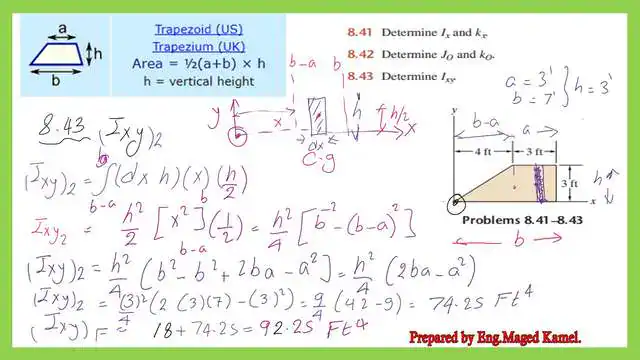
Ixy2: Product of Inertia for a given Trapezium by integration using a vertical strip.
Next, we calculate the Ixy2 Value for the rectangular portion. dIxy2 = (dx*h^2*x/2); we integrate from b-a to b, and the final Value of Ixy2 is 74.25 Ft4. The final Product of Inertia Ixy for the given Trapezium will be equal to 92.25 Ft4.
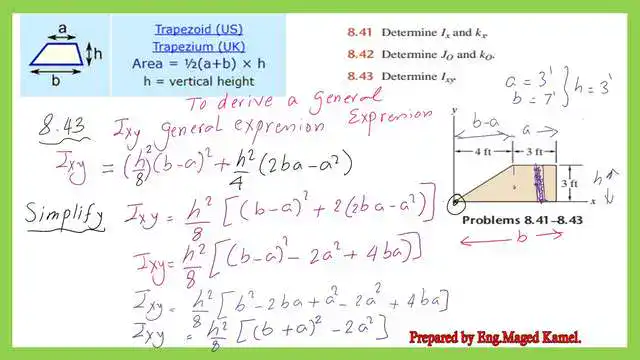
Derive a general Expression for Ixy for a Trapezium.
To derive an Expression for Ixy for a Trapezium, we add Ixy1 and Ixy2 and simplify the standard terms. For a more detailed illustration, see the next slide, which shows the final Ixy Expression.
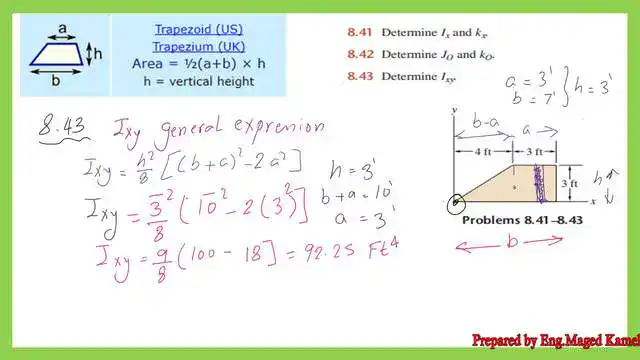
We can substitute the values of a, b, and h to obtain Ixy = 92.25 ft^4, which matches the Value we obtained earlier. For more details, see the image on the next slide.
The second practice problem for Inertia is 8.48. Find Ixy for a given Trapezium about the Cg.
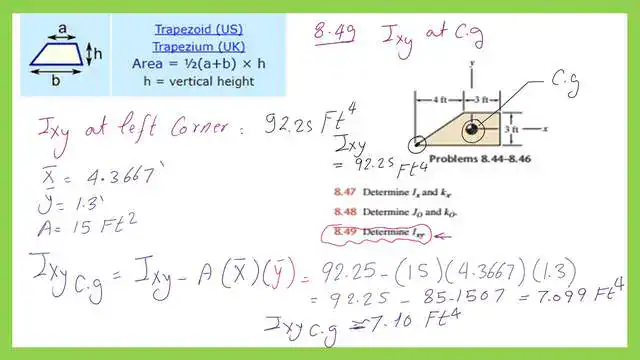
For the second of the two practice problems for Ixy for a Trapezium, 8.48, it is required to find the Ixy Value for the Trapezium at the Cg.
We obtained the Cg distance values from the external axes, x̄ and ȳ, in the previous posts, and the Trapezium has an Area of 15 ft². The Product of Inertia about the Cg is equal to Ixy minus the Product of Area by (x̄*ȳ). The final Value of Ixy at the Cg is 7.10 ft4.
You can download and review this Post’s content in the following PDF file.
We ended after solving the two Practice problems for Ixy for a Trapezium.
Thank you very much, and I look forward to seeing you in the next Post.
Please refer to Post 19 for more information about Ix for a Trapezium.
Please refer to Post 22 for more information about Iy for a Trapezium.
The previous Post was Post 26-Two: Practice Problems for the Polar Inertia of a Trapezium.
Engineering Statics Open and Interactive provides a helpful Link for areas to view the CG.
Next, we will cover a new topic: the maximum and minimum Moment of Inertia. Please refer to Post 1: Easy illustration of the theory of pure bending.