
Last Updated on September 8, 2026 by Maged kamel
In the second option for Ix of the Trapezium, instead of dividing the Trapezium into one rectangle and two triangles to determine the Moment of Inertia Iy, we will use a horizontal strip and integrate to obtain the Moment of Inertia about the x-axis.
- Ix for the Trapezium (second option.
- Derive the Expression for k1 for the horizontal strip distance from the Trapezium's left upper corner to the strip's left end.
- Derive the Expression for k2 for the horizontal strip distance from the trapezium's upper-right corner to the strip's right end.
- Integrate the horizontal strip from the bottom to the top of the Trapezium.
- Derive the final Expression for Ix for the Trapezium second option about the lower external x-axis.
Ix for the Trapezium (second option.
Derive the Expression for k1 for the horizontal strip distance from the Trapezium’s left upper corner to the strip’s left end.
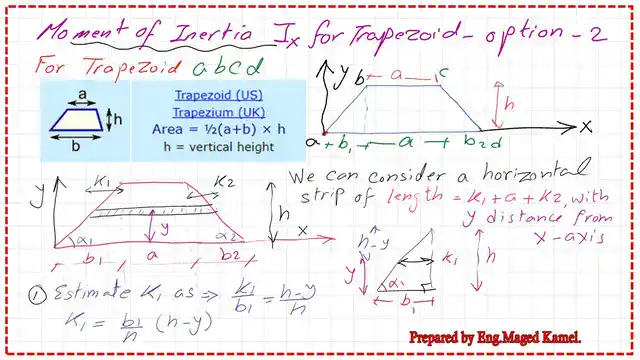
We use a horizontal strip of width dy for the Trapezium’s Ix (second option). The strip is located at a distance y from the Trapezium, which has a length of (k1 + a + k2), where a is the top length of the Trapezium.
For a rectangle of base b, we want an Expression for k1. We consider the left triangle with base b1 and height h. Using the relation (k1/b1)=(h-y)/h to get the K1 value, K1 can be written as b1*(h-y)/h. Please refer to the next slide image for more details.
Derive the Expression for k2 for the horizontal strip distance from the trapezium’s upper-right corner to the strip’s right end.
Similarly, we want k2, the distance from the Trapezium’s upper-right corner to the end of the horizontal strip. We refer to the right triangle with base b2 and height h. We use the relation (k2/b2)=(h-y)/h to find k2. We can write k2 as b2*(h-y)/h. Please refer to the next slide image for more details.

Integrate the horizontal strip from the bottom to the top of the Trapezium.
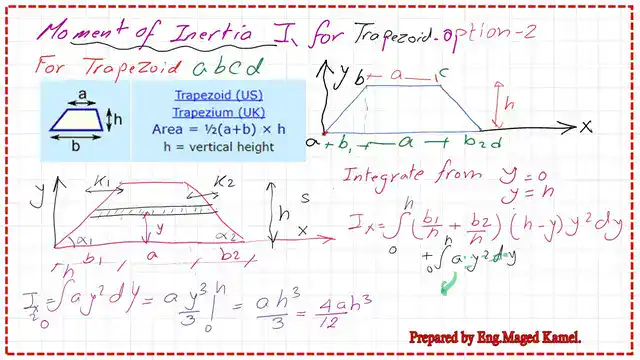
The Moment of Inertia Ix for the Trapezium (second option can be obtained by integrating the horizontal strip from y=0 to y=h, where h is the height of the Trapezium. The length of the horizontal strip can be written as (a+b1+b2)=(a+b1*(h-y)/h+b2*(h-y)/h).
The Inertia of the strip is dIx=(a+b1*(h-y)/h+b2*(h-y)/h)*y^2*dy, where dy is the width of the strip.

We can simplify the Expression to two terms: Ix1 and Ix2. We can clarify the standard terms and arrive at the Expression shown in the next slide. Ix1 can be written as (b1+b2)*h^3/12, where b1 is the distance from the lower-left corner to the upper-left corner of the Trapezium. The distance b2 is the distance from the lower-right corner to the upper-right corner of the Trapezium.
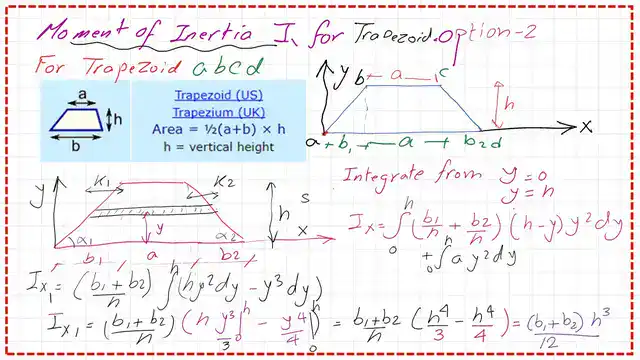
We can clarify the standard terms and obtain the Expression shown in the next slide. Ix2 can be written as (4*a*h3)/12, where a is the length of the upper part of the Trapezium and h is the Trapezium height. Please refer to the next image for more details.
Derive the final Expression for Ix for the Trapezium second option about the lower external x-axis.
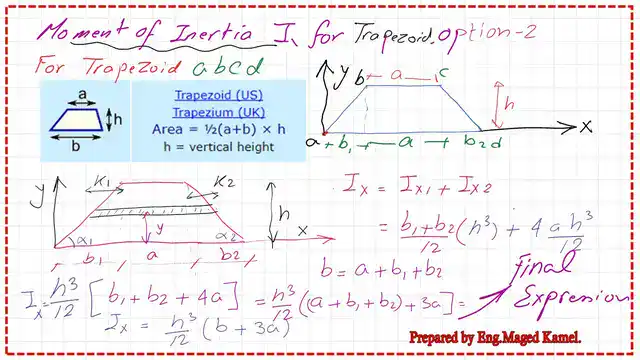
We can add Ix1 and Ix2 to obtain the final Expression for Ix for the Trapezium second option.
The Ix value for the Trapezium can be expressed as h^3*(b+3a)/12, where a is the length of the upper part of the Trapezium, b is the lower base length, and h is the Trapezium height—the same value estimated in the previous post 22. In the next post, we will solve two practice problems on the Moment of Inertia Ix for a Trapezium. Thank you.
You can download and review the content of this post through the following PDF file.
Please find Moments of Inertia – Reference Table for a calculator for various shapes.
This is a link with complete details on how to find the x-bar and y-bar for a Trapezium.
This is the next post. Two practice problems on Inertia for a trapezium.