Last Updated on February 11, 2026 by Maged kamel
Practice problem: longitudinal weld of a C section.
This is a Practice problem for the longitudinal weld of a C section. It is case 2 for the shear lag factor table D3.1-CM-14 and can also be considered case 4 under CM-15 and related 2016 specifications. The Author’s answer is based on VCM#14.
This post will discuss two solutions: the first is based on CM-14, and the second on CM-15.
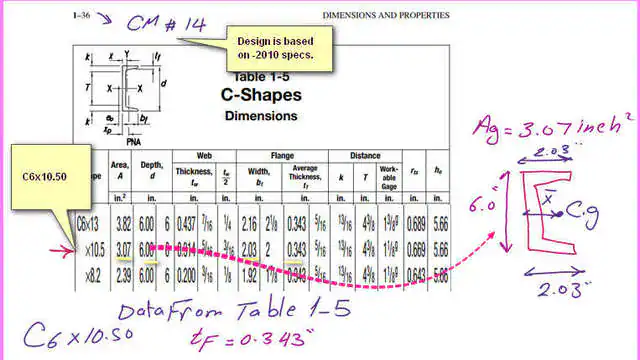
Refer to Table 1-5 part-1 to get the flange thickness and the depth for the given C6x10.50 section.
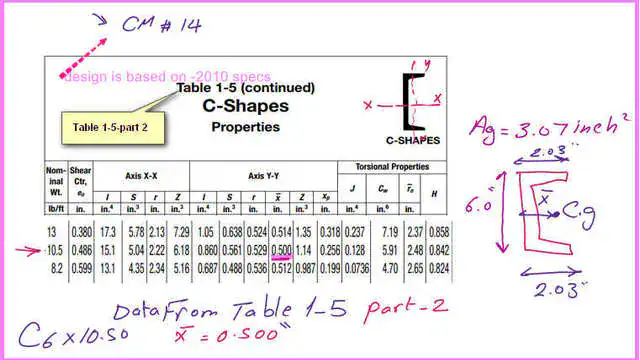
From Part 2 of Table 1-5, we get the x-bar distance.
Shear lag factor U based on CM-14.
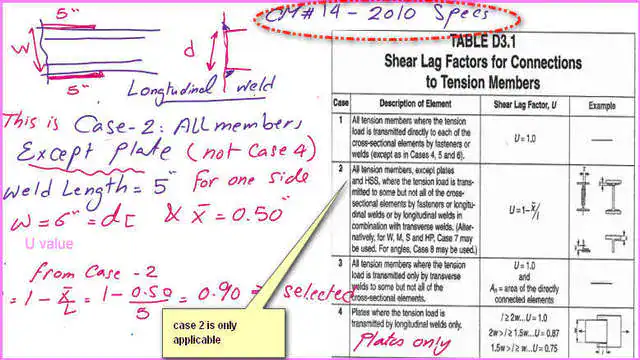
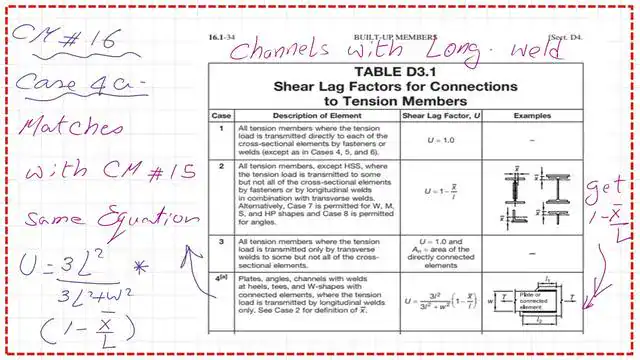
As shown in the next picture for Table D3.1, the shear lag factors for connections to tension members for the longitudinal weld are case 4, but only for plates where the tension load is transmitted by the longitudinal weld. We will use case 2 instead.
The shear lag factor depends on the width of the joint w and establishes a relation between the length of connection L and width W.
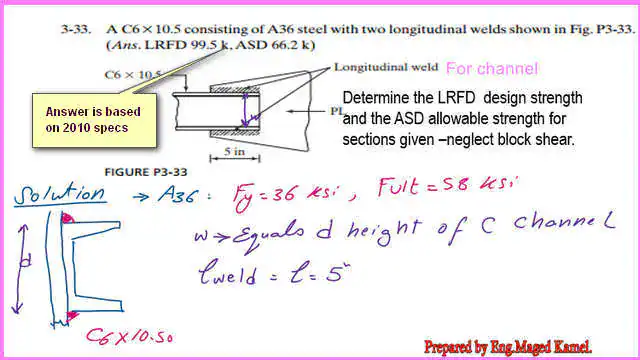
1-From the given Data for the ASTM A36, we can get the yield stress Fy=36 ksi and the ultimate stress Fult equal to 58 ksi.
2—The following data can be found from the given section of C6x10.50. The first item is the area of the given section, which equals 3.07 in^2.
The flange’s width is bf=2.03 inches, the flange thickness is 0.343 inches, and the width of the web is 0.314 inches. The overall depth will be 6 inches.
3- The connection length is given by the given section as equal to 5 inches.
4- The U value equals (1-xbar/L)=(1-0.5/5)=0.90.
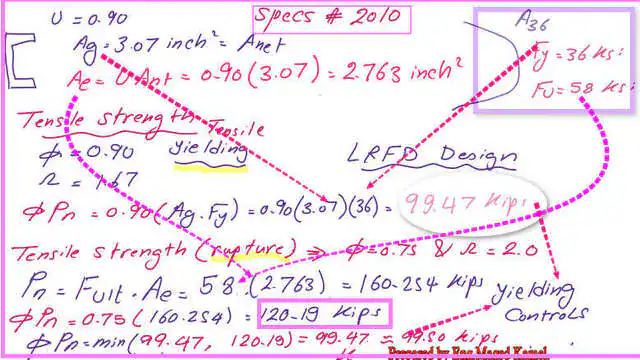
LRFD strength for Practice problem-longitudinal weld of a plate section-CM-14.
The gross area is the area of the C channel, which equals 3.07 inches2, while the effective area equals 0.9* 3.07 = 2.763 inches2.
The LRFD strength value for yielding equals 99.47 kips, while the LRFD strength due to rupture equals 120.19 kips.
We will select the lesser value as our final LRFD strength, 99.50 kips.
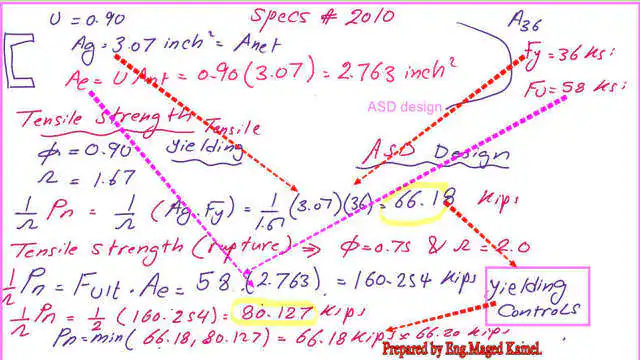
ASD strength for Practice problem-longitudinal weld of a plate section-CM-14
The gross area is the area of the C channel, which equals 3.07 inches2, while the effective area equals 0.9* 3.07 = 2.763 inches2.
The ASD strength value for yielding equals 66.18 kips, while the ASD strength due to rupture equals 80.13 kips.
We will select the lesser value as our final ASD strength, 66.18 kips.
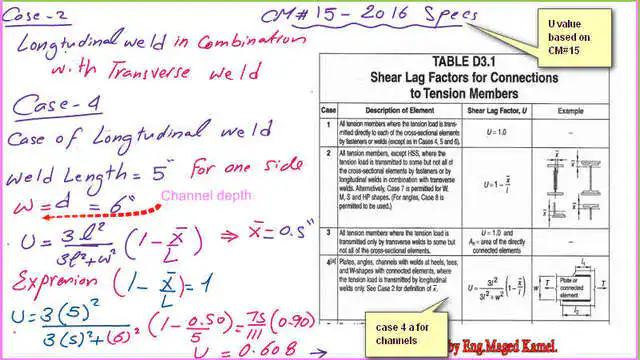
Shear lag factor U based on CM-15 and CM#16.
Referring to Table D3.1 for the shear lag factor based on CM-15and CM#16.The item number for shear lag factor U for the longitudinal weld to a C channel is case 4a. The U value is estimated by the product of (3L^2/3l^2*w2) multiplied by (1-1- x̅/ L).
The section provides the connection length as 5 inches.
The first term (3L^2/3l^2*w^2 equals (3*5^2/(3*5^2+5^2) to be multiplied by (1-(0.50/5), the final value of U=0.608.
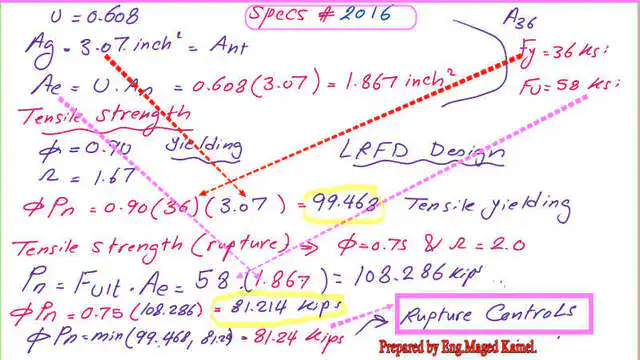
LRFD strength for Practice problem-longitudinal weld of a C section-CM-15& CM#16.
The LRFD strength value for yielding equals 99.468 kips, while the LRFD strength due to rupture equals 81.24 kips.
We will select the lesser value as our final LRFD strength, which equals 81.24 kips. This indicates that the LRFD strength is governed by rupture.
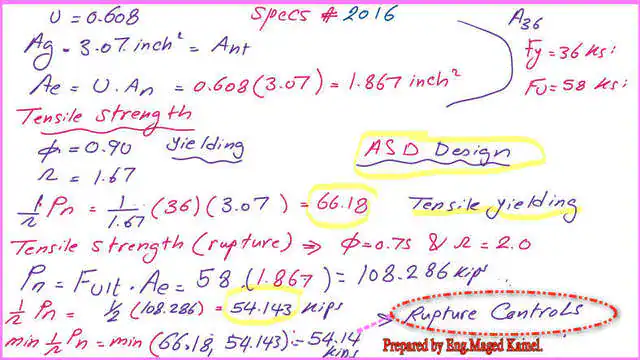
ASD strength for the Practice problem-longitudinal weld of a C section-CM-15 and CM#16.
Based on the estimate, the selected ASD strength for the Practice problem-longitudinal weld of a C section-CM-15 is 54.14 kips; the full data are shown in the next slide.
Practice problem 3-3-6ths edition-longitudinal weld of a C section.
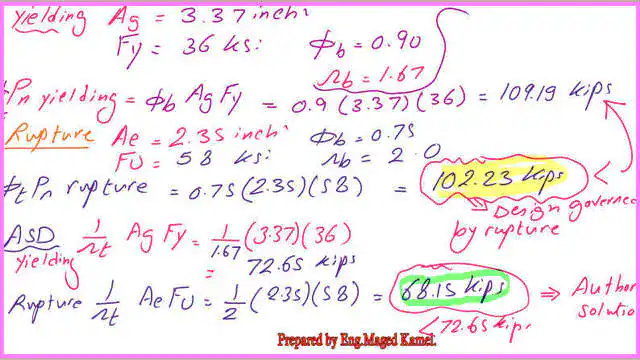
The next slide shows a practice problem 3-33 in the sixth edition of Prof. McCormac’s book. The practice problem includes a C channel C8x11.50 with two longitudinal welds to a gusset plate at the back. I have solved that problem based on Cm#15; the U value is estimated from item 4a, where w is the channel depth and l is the average weld length. Please refer to the next slide for more information on the U estimate.

The last slide includes a detailed estimate of both LRFd and Asd design strength values, which comply with the authors’ solution. Thank you very much.
The PDF file for this post can be viewed or downloaded from the following link.
The next post is post #9d, about how to get an Effective area for a staggered bolted angle.
For a more detailed illustration of block shear, there is a very useful external link to the Tension Members chapter 3. A Beginner’s Guide to the Steel Construction Manual, 14th ed.
Chapter 3 – Tension Members– A Beginner’s Guide to Structural Engineering is a great external resource.A Beginner’s Guide to the Steel Construction Manual, 15th ed.
A useful external link –Tensile yielding and tensile rupture. A Beginner’s Guide to the Steel Construction Manual, 16th ed.