Last Updated on October 21, 2026 by Maged kamel
- Solve for x, y, and z using LU decomposition for a 3×3 Matrix.
- Step 2: Derive the Expression for the U2 and L2 matrices.
- Step 3: Derive the Expression for the Inverse Matrix L-1 for the solved Problem for x, y, and z.
- Step 5: Get the Value of the C Matrix.
- Step 6- Get the Value of the X Matrix for the solved Problem for x, y, and z.
- The final values for x, y, and z are the solution to the x-y-z problem.
Solve for x, y, and z using LU decomposition for a 3×3 Matrix.
We have three simultaneous linear equations; we need to find x, y, and z using LU decomposition. In this example, we will use a C Matrix as the Product of the upper Matrix U and the unknown matrixX.
We start by convertingMatrixx A into the U1 Matrix by setting the a21 and a31 values to zero to constitute an upper Matrix.
Reverse the signs of the estimated two factors to get the Value of L21 as (+4) and for L31 as (+2). L32 is unknown.
For a33, since it is already 0, we do not need to multiply. We will place this zero as the L33 Value in the L1 lower Matrix we created.
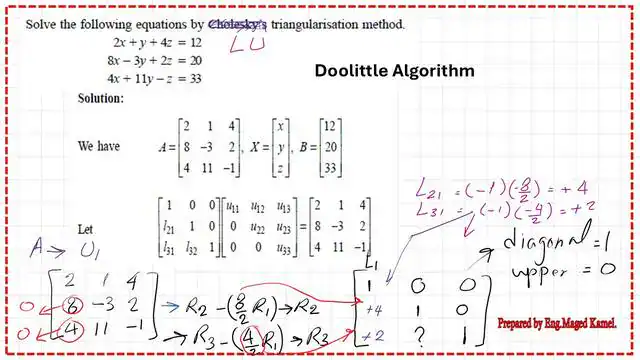
The factors shown are (-a21/a11) and (-a11/a31). The first factor value=-(8/2)=-4, while the second factor=(-4/2)=-2.
The U1 Matrix is formed from the first Row (2 1 4), which contains u11, u12, and u13.
For the second row of the U1-matrix( 0 -7-14) which are the values for U21, U22 U23, the last row is(0 9 -9).
Step 2: Derive the Expression for the U2 and L2 matrices.
Convert a32 (9) to zero by multiplying by (-9/-7) R2 and adding the result to R3. We have used -7 as a Second pivot, and the result, which is (+9/7)-7+9=0, will be the Value of u32. The corresponding L32 Value is the reversed sign factor, which is(-)*(9/7)=-9/7. The detailed calculations are shown in the image on the next slide.
The final shapes of U2 and L2 will form the L and U matrices; both are 3×3, so A can be set to the Product (L*U). A routine check of L*U will produce the same elements as Matrix A.
Step 3: Derive the Expression for the Inverse Matrix L-1 for the solved Problem for x, y, and z.
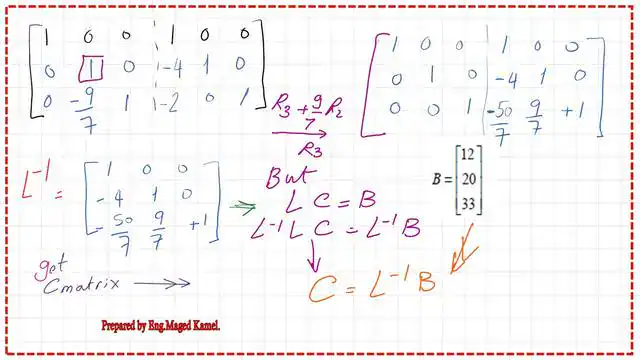
We will use the augmented Matrix to get the Inverse Matrix L-1 Value, which will be a (3×3 Matrix). The process continues until the left side of the augmented Matrix is the identity Matrix, and the right side is the required Inverse of the lower Matrix, denoted L^-1.

Step 5: Get the Value of the C Matrix.
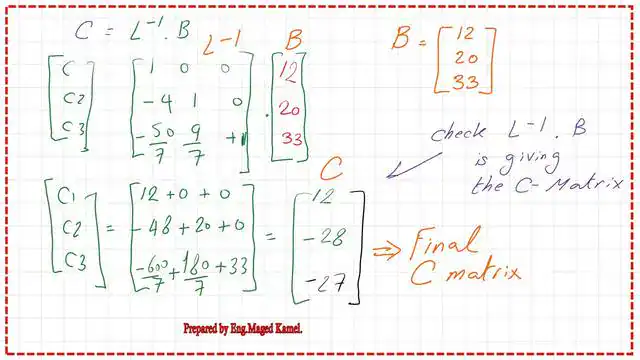
The C Matrix is the Product of the lower Matrix Inverse and Matrix B, expressed as C = L^-1*B; both matrices are known.
The C Matrix is a (3×1). The detailed calculations for multiplying rows by columns are shown in the images on the next slide.
We have U*x=C. We can write the matrices U and X and set their Product equal to the Matrix C.
Step 6- Get the Value of the X Matrix for the solved Problem for x, y, and z.
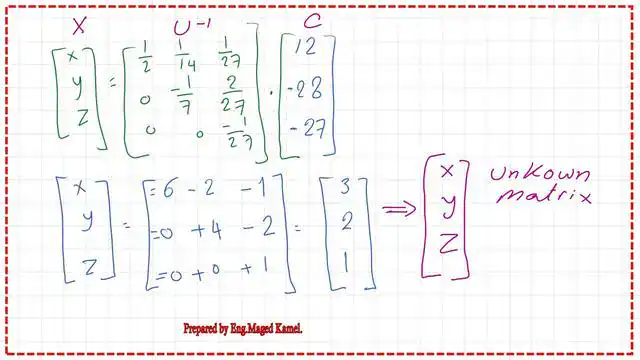
C-matrix is =(12 -28 -27) it is 3×1 Matrix. We have U*X = C, and we need to estimate the Inverse Matrix U^-1 to obtain x = U^-1*C. So we can estimate the final values of x,y, and z by multiplying by the Inverse Matrix of U, which is (U-1)
We will derive the Expression for the Inverse Matrix, U^-1, using the augmented Matrix method. The full details of the necessary calculations are shown in the two slides below.

The steps for obtaining the Inverse of the U Matrix are shown in the next slide.

The Inverse of U is also an upper Matrix, called U-1 and written as (1/2 1/14 1/27) for the first Row, (0 -1/7 12/27) for the Second Row, and (0 0 -1/27) for the third Row. Multiply the Inverse of the Upper Matrix by Matrix C to get the values of x, y, and z.

The final values for x, y, and z are the solution to the x-y-z problem.
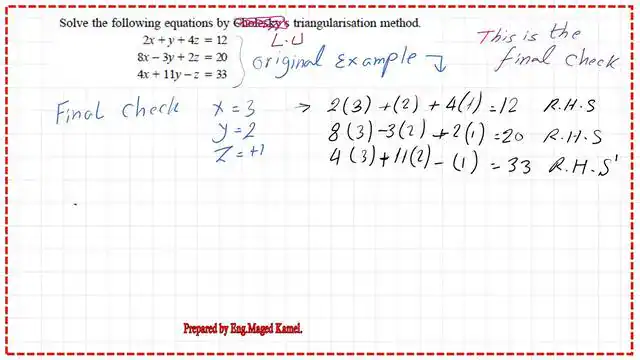
The multiplication of the Inverse of Matrix u by Matrix c is shown, and the final values for x, y, and z are (3, 2, 1). We will perform a routine check of the estimated values of x, y, and z to satisfy the three given equations. The calculations are shown in the image on the last slide.
We substitute the values of x, y, and z into the three equations and check whether the resulting expressions satisfy them.
The PDF data for this Post can be viewed and downloaded from the following button.
The following three posts are
Post 6: Easy Introduction to permutation Matrix.
Post 6a: Easy approach to permutation matrix-Part 2.
Post 7: Solved Problem 9-5 LU decomposition.
This is the Omni calculator for estimating various linear algebra items – LU Decomposition Calculator.
This is a Link to another calculator for matrices.