
Last Updated on October 21, 2026 by Maged kamel
- Find the three unknowns for the Second solved Problem.
- What are the two methods used to solve for the three unknowns?
- What are the values of the minors and cofactors for the lower Matrix L?
- The cofactors C31, C32, and C33 for matrix L.
- Get the Inverse Matrix L-1 and Matrix C.
- What are the minors and cofactors' values for the upper Matrix U?
- Get the Inverse Matrix U-1.
Find the three unknowns for the Second solved Problem.
This video illustrates the content of this Post.
The video timestamps are shown.
- 00:00 Introduction to Minors and Cofactors for a Square Matrix.
- 02:06 Find the Inverse of the lower Matrix L.
- 03:39 The estimate for C11 to C23.
- 04:33 The estimate for C31 to C33.
- 05:05 Find the Expression for the C Matrix.
- 06:00 Detailed estimate for the Inverse of U.
- 07:02 Find the elements of the Inverse of U.
- 07:57 The values of X1, X2 and X3. 08:11 Check A*x=B.
- 08:44 Quick solution to get x1,x2 and x3.
What are the two methods used to solve for the three unknowns?
There are two methods for finding the three unknowns x1, x2, and x3. The first method is to consider A*x = b and let A = L*U. The Matrix A can be rewritten as L*U. The Product A*x can be written as L*U*x = b. Introduce a Matrix C such that C*X=B, and L*C=B.
Solve for C by multiplying L-1*L*C=L-1*B, and then solve for the Inverse of the upper Matrix—finally, x=U-1*B.
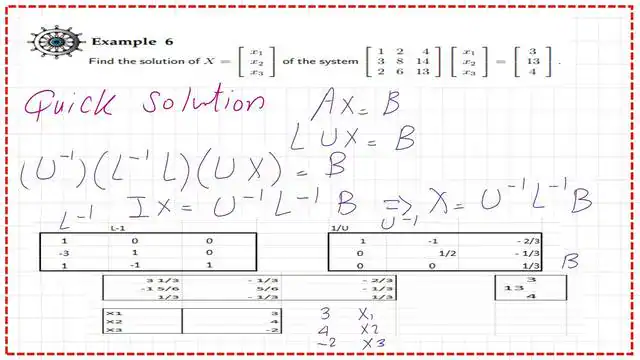
The Second method is to obtain L and U, compute their inverses, and then compute U-1*L-1*L*U*X. The Product of these matrices gives I*x = U-1*L-1*B. Hence, we can get the values of the three unknowns. Please refer to the following slide image for more details.
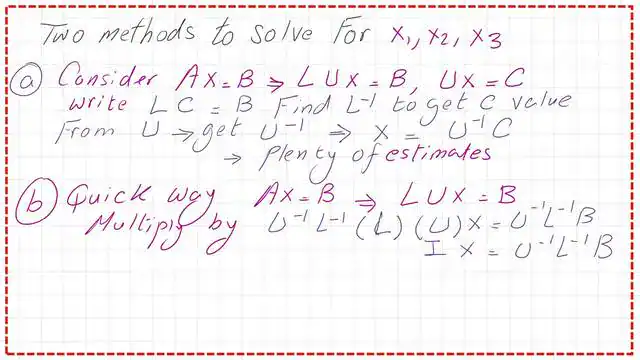
To find the Inverse of a Matrix, we use its minors and cofactors. The next slide shows the minors and cofactors.
What are the values of the minors and cofactors for the lower Matrix L?

We estimated the L Matrix in the previous Post; now we need to find its Inverse. We need to find the cofactors for the first Row (C11, C12, C13) and the Second Row. C21, C22, and C23. The following slide shows how to estimate the cofactors and their values from the Matrix L.
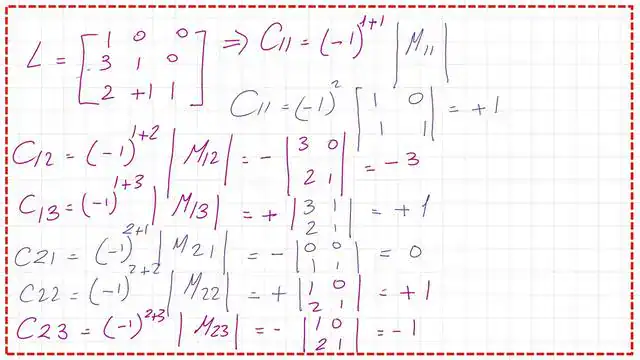
The cofactors C31, C32, and C33 for matrix L.
The following slide shows the values of the cofactors C31, C32, and C33 for Matrix L. To get the cofactor values in the column-wise form for the Inverse, we need the determinant of Matrix L. The determinant Value equals 1, and all diagonal values are 1 for the L Matrix.
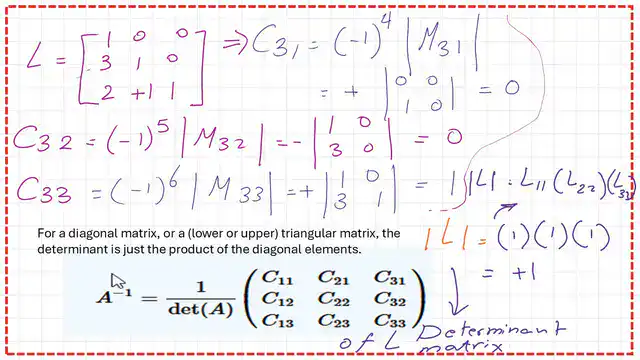
Get the Inverse Matrix L-1 and Matrix C.
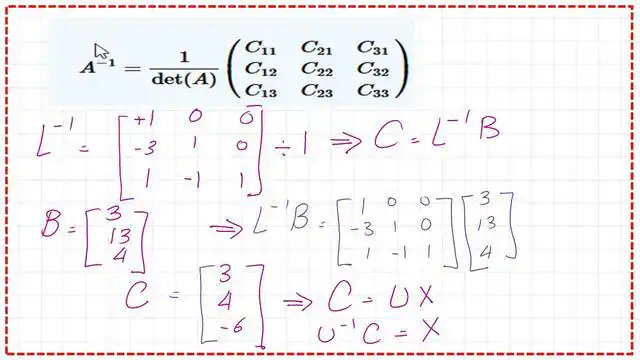
For the Second solved Problem, LU decomposition, we need to estimate the Inverse Matrix of L, which is the Cofactor Matrix divided by 1. The Inverse Matrix of L is( 1, 0, 0, -3,1, 0, 1-, -1,1). We use the Expression L*C = B. We multiply both sides by L-1 to get C = (L-1)B. The Value of C is (3, 4, -6), which is a (3×1) Matrix. Please refer to the following slide image for more details. But U*X=c. We need to estimate the Inverse of the Matrix U to get the column vector X.
What are the minors and cofactors’ values for the upper Matrix U?
We estimated the U matrix in the previous Post; now we need to find its Inverse. We need to find the cofactors for the first Row (C11, C12, C13). The adjugate of the upper Matrix is the transpose of the cofactor Matrix. The cofactor C11 is +6; the cofactor C12 is 0. The cofactor C13 equals 0.
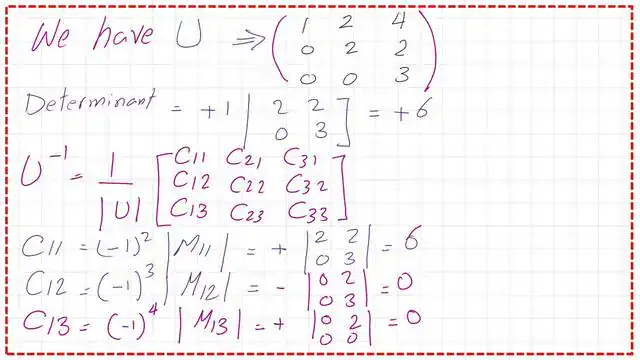
The following slide shows the cofactor values for the Second Row. C21, C22, and C23 of Matrix U. The adjugate of the upper Matrix is the transpose of the cofactor Matrix. The cofactor C21 is -6, C22 is +3, and C23 is 0.
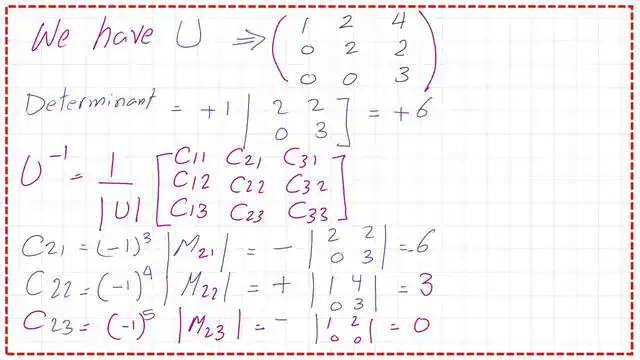
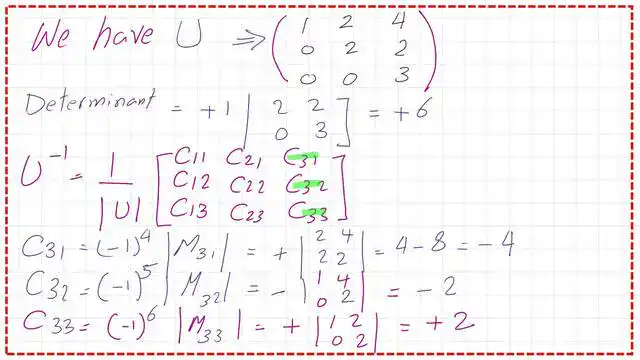
The cofactor C31 is -4; the cofactor C32 is -2. The cofactor C33 equals +2.
The determinant Value of the Upper Matrix is equal to +6.
The Inverse of Matrix U is a 3×3 Matrix with the first Row as (6, -6, 4, 0, 3, 2, 0, 0, 2), all divided by 6.
Get the Inverse Matrix U-1.
For the Second solved Problem, LU decomposition, the Product of the Inverse of U and C equals the column vector X. X1 = 3, X2 = 4, X3 = -2.
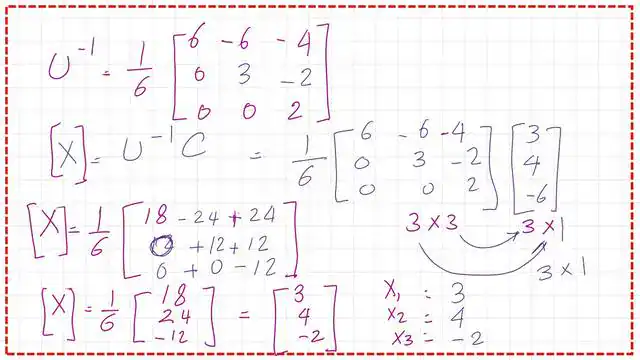
It is essential to check that the three unknowns are correct; we double-check by multiplying A by x and verifying that the Product equals vector b.
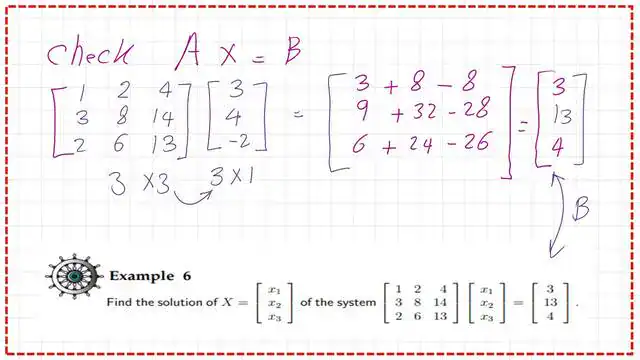
As shown on the next slide, we can obtain the X column vector by computing U-1*L-1*b to get x1, x2, and x3.
This is the PDF for the Second part; click the following button to view or download it.
The following Post post: 5c- Solved Problem for x-y-z values by LU decomposition.
HELM-Helping Engineers Learn Mathematics.
This is the Omni calculator for estimating various linear algebra items – LU Decomposition Calculator.
This Link links to another Matrix calculator.