
Last Updated on October 21, 2026 by Maged kamel
Permutation Matrix.
This Post introduces permutation matrices. A permutation Matrix is an identity Matrix with rows interchanged.
I have created a YouTube video that covers this Post and the next Post.
The Timestamps for the video are shown next. The content of this Post is included from 0:00 to 12:23.
- 00:00 Introduction and a summary of the content of the video.
- 01:47 Review of the identity Matrix for 2×2.
- 04:18 Placing a permutation Matrix on the left will change columns.
- 06:14 The difference between permutation matrices P12 and P21.
- 07:02 The number of patterns
- 12:23 Permutation Matrix P312.
- 13:35 Permutation Matrix P321.
- 14:38 Permutation Matrix P132.
- 15:40 Permutation Matrix P231.
- 16:23 Property of permutation Matrix.
Using this permutation Matrix, we can create a new Matrix that differs from the old one by rearranging its rows. This is a brief illustration of the Matrix quoted from Prof. Mathew W. Reid. The author explains that, by changing the multiplication process, we can obtain either a Row swap or a column swap.

First, we start with the 2×2 identity Matrix. In the identity Matrix, we have 1s in the upper-left and lower-right corners, and zeros in the remaining corners. Multiplying an identity Matrix by a Matrix will change the arrangement of rows or columns.
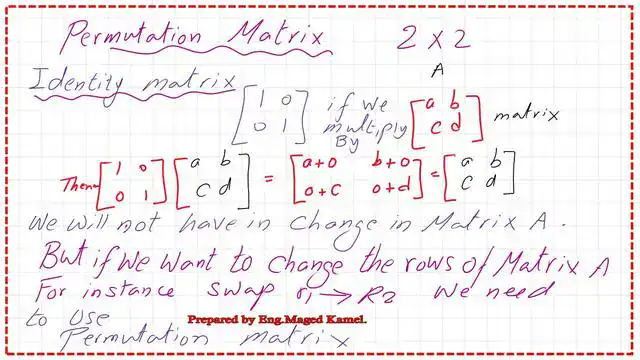
How to swap the first Row in a 2×2 Matrix?
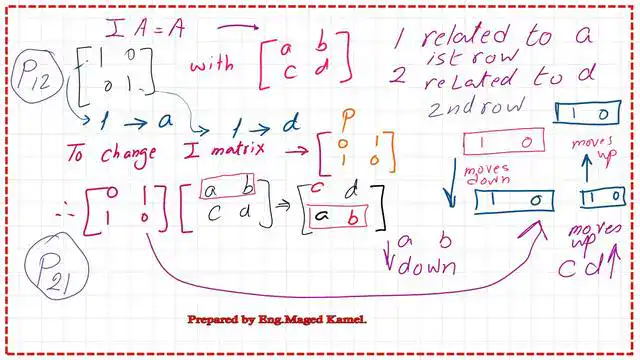
We have only two options for swapping rows in a 2×2 Matrix. The first option is to swap the first and Second rows by multiplying the given Matrix on the left by a Matrix P.
The Second option is to swap the Second Row with the first Row in the new Matrix. Moving the first Row of an identity Matrix to the Second Row and vice versa, then multiplying by another Matrix, yields a new Matrix with shifted rows, as shown in the next slide.

How to swap the first column in a 2×2 Matrix?
To change the column arrangement of a Matrix, we can multiply it by a permutation Matrix with the first column (0, 1). Its Second column is (1, 0). This arrangement will produce a new Matrix with (b a) in the first column and (d c) in the Second column. The original Matrix arrangement was (a b) in the first Row and (C d) in the Second Row. Multiplying any Matrix on the right by the Matrix (0 1, 1 0) swaps the columns.

How many permutation matrices are in a 3×3 Matrix?
We have (3x2x1)=6 permutation matrices for a 3×3 Matrix—6 sketches showing these arrangements are in the next slide image.
The first option is the standard identity Matrix I, where Row 1 is followed by Row 2, and Row 3 is last. The Matrix has only one 1 in each Row and column. No more than 3 1s in the case of a 3×3 mMatrix Multiplying the identity Matrix by any 3×3 Matrix will not change the Row order.

What is a permutation Matrix P213?
This is the Second arrangement of a 3×3 Matrix (P213), with a swap between rows 1 and 2, and the third Row remains unchanged.
When you multiply such a matrix by any other Matrix, the first Row of the result is the Second Row of the original Matrix, and the Second Row of the result is the first Row of the original Matrix.
An example of multiplying a Matrix P213 by a 3×3 Matrix is shown in the next slide.

You can review the content of this Post and the next Post in the following PDF file.
This is a Link to the next Post, Post 6a: Permutation Matrix, Part 2.
This is the Omni calculator for estimating various linear algebra items: LU Decomposition Calculator.
Link to the Omni calculator: LU Decomposition Calculator.
Another calculator to use is the Calculator for Matrices.