
Last Updated on January 18, 2026 by Maged kamel
Definition of absolute value, rational numbers, fraction.
What is the absolute value of a number?
This is a review of the information about the absolute value, which is usually written for any number enclosed by two small vertical lines, which is the absolute value of ABS of -4=4. If we draw a number line with equal distances, writing from 0 to 5 till infinity, and from the left side, we write (-1) to (-5) to infinity—absolute means how far from zero.
For any number, regardless of being positive or negative. When someone needs to know the distance from zero for any given number, the answer will be 4′ 5, or 6, depending on that number.
The absolute value of a number is the distance of that number from zero. We will not say(+4) or(+5); you will write a number without a sign, then the distance for the ABS of (-4); there are four spaces from the zero, which is the same distance for the positive value of 4.

The fraction of a number.
Then the rational number is(1/5). But if the denominator is zero, we get infinity when dividing any number by zero.
The fractions of numbers like 1/2,3/4, and 7/10 are the family of fractions; the upper part is called the numerator, and the lower part is the denominator. The fraction can be divided into parts; the first part is the proper fraction. If the denominator value is > the numerator value, this will give a value <1.

If we have the reverse, when the numerator is greater than the denominator, for instance, this will give a value greater than 1. Like (4/3) and 6/3 = 2, and 8/5 will give 1.60. The second type is called an improper fraction. At the same time, the first type is called a proper fraction.
The following slide images explain the definition of fractions and the various types of fractions, quoted from Basic College Mathematics by Prof. Aufmann.


What is factoring?
The product and factoring. When we have x^2 + 4x + 2, and it is required to factor, we can say that (x^2 + 4x + 2) is a factor of itself, i.e., (x + 2) (x + 2), which means it is returned to its significant elements. When multiplied, we get the original element. For instance, number 12 has the following factors: (112), (34), and (2 × 6). These elements, when multiplied, will get 12. For elements a and b, multiplying them yields c.

Then c is the product of the factors a and b. The product can be broken down into its elements by factoring. What is an Irrational number? We have said that every number is a ratio.
Integer 5 can be approximated as 5/1. Also, 7 can be written as 7/1, which is an Improper fraction.
Irrational numbers.
What are the irrational numbers? These are real numbers that cannot be written as simple fractions. For example, if we use the calculator to get the square root of 3, we get 1.732050808.
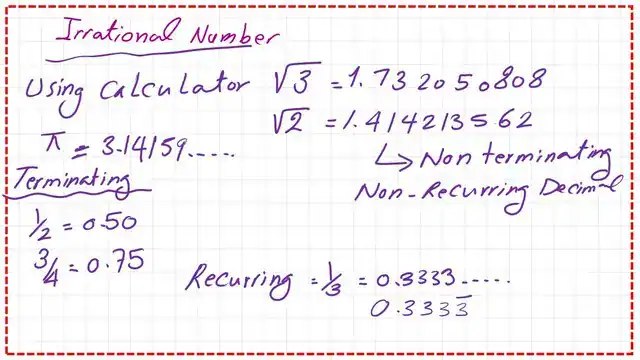
The square root of 2 is 1.41412135. Pi is an irrational number; its value is 3.14159 and continues to infinity.
Non-terminating -Non-recurring decimal. Non-Terminating item, to give an example of a terminating number 1/2=0.50, there is a continuation of numbers.
For the square roots of 3 and 2, the values are never terminating.
Additionally, in the Pi value, it is written as 3.14159, followed by dots, indicating a recurring decimal. For example, 1/3 equals 0.33333. While for the square root of 2, every decimal is not the same value or repeated numbers.
The definition of irrational numbers encompasses these two conditions and results in a non-rational number. These are the expansions for irrational numbers.

A general shape for all types of numbers.
Here is a shape, he started with the Natural numbers, then a new square of Whole numbers after adding the zero.

Then add the negative and call that box Integers. As if moving up a higher degree. Then followed by the rational numbers, afterwards the irrational numbers, including for instance the negative value(-) of the square root of 8, sqrt(15), and PI. The big box is called the Real number and a symbol was given as capital R.
The expanded form of a whole number.
The next slide image shows the expanded form of a whole number and how we can express any number as a combination of ones, tens, hundreds, thousands, and more, depending on its value.

What is rounding a number?
Rounding is an essential topic. Rounding numbers: for instance, if the number is greater than 5, it will be rounded up to a higher value. On the contrary, if the number is less than 5, the number will be reduced. So, numbers from 1, 2, 3, and 4 can be rounded down.
For numbers 5, 6, 7, 8, and 9, the rounding will be to the nearest 10. For example, for 27, it is required to round to the nearest 10.
We put a line after the 7, since the number on the right side of the line is more than 5, then round up to 30. While for number=33, put a line at the 3. The 3 to the right of the line is < 5, so the rounded 33 is 30, and it is a round-down.

For making rounds to the nearest one hundred and the nearest one thousand and beyond. The next slide provides examples of God’s will.

Round 4827 to the nearest ten. Since 7>5, then the number at the left of 7 will be upgraded to 3, and 7 will be 0. 7>5. The final number will be 4830. For the same number, round to the nearest hundred. For 4827, put a line to the left of 2; since 2 is <5, then 4827 will be rounded down, and then 4827 will be rounded to 4800.

While for 4827 to be rounded to the nearest thousands, take a line between 4 and 8, and check the right side of the line, we have 8 >5, then the number 4827 will be rounded up to 5000, which was for the nearest Thousands We cannot say 4900, since we upgraded 4 to 5.

The PDf data for this post can be viewed or downloaded from the following document.
For an external link, Math is Fun provides details on absolute value.
For the next post, how to round decimal numbers?