
Last Updated on September 23, 2026 by Maged kamel
The bisection method.
The Bisection Method is a numerical root-finding technique used to solve equations that lack analytical solutions and to find the roots of polynomial equations. It works by dividing an interval into smaller intervals and iteratively narrowing the range of possible solutions.
What is the bracketing method?
Introduction to the bracketing method. The bracketing method is a Numerical method that finds two values of a function with opposite signs; the root lies between them. We first solved one example analytically, as shown in the next two slides.
The root is the Value of x when y = 0. The bracketing method depends on two values for f(x): one negative and the other positive. The required root lies between these two brackets, which is called the bracketing method.
Bisection method.
This is a bracketing method. To find the root of f(x), the bisection method uses the average of the bracket endpoints, substitutes it into the function, and determines whether the new point is left- or right-bracketed.
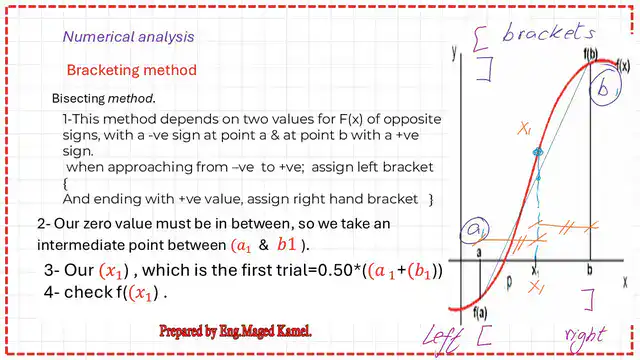
Then, perform a series of bisections until the function Value at a point approaches zero.
The bisection method steps continue, as shown on the next slide.
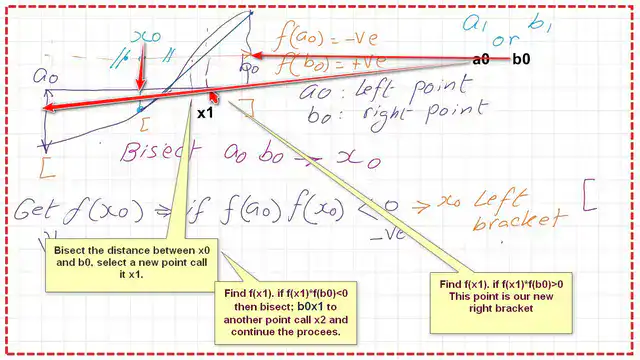
Let us trace the findings after using the bisection method; when the new F(x) is either positive or negative, please refer to the next slide for an illustration.
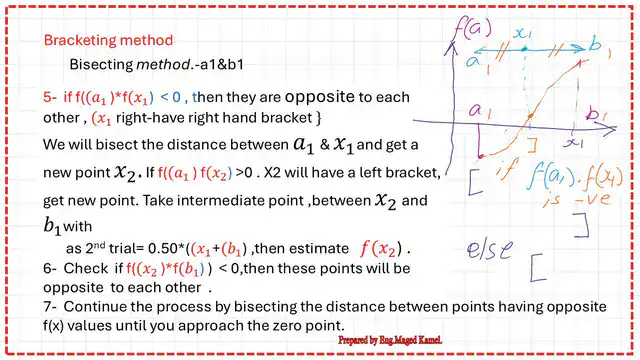
The following sketch shows the case where a1 and b1 are the endpoints, and point x0 is the new left bracket-bracket point.
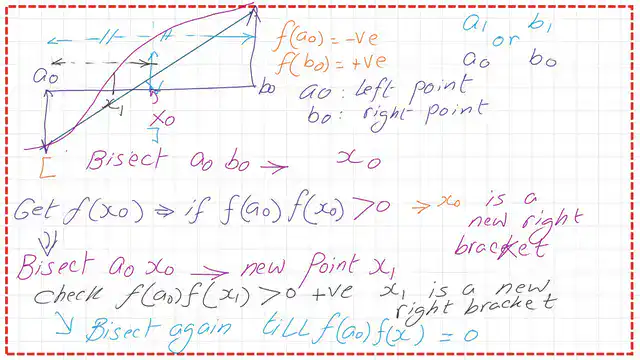
The following sketch shows the case where a1 and b1 are the endpoints, and point x0 is the new right bracket-bracket point.
A solved example for the bisection method.
This is a reminder of the analytic solution for the solved example. We will find the roots by using synthetic division for f(x)=x^3-6x^2+11x-6. This function has three roots: x = 2, x = 3, and x = 1.
Please refer to the slide image below.
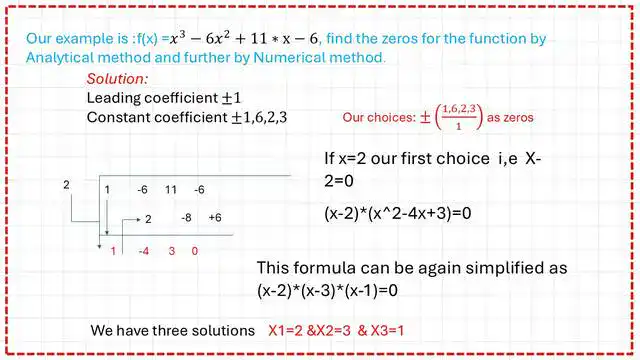
The solution uses the analytic method for the same example. The x Value equals 3, which is one of the roots.
1-Now, refer to our previous example and solve it using the bisection method. We have x = 2.50, which gives a negative Value for F(x); it is a left bracket. While x = 4 gives a positive Value for F(x), it is the right bracket.
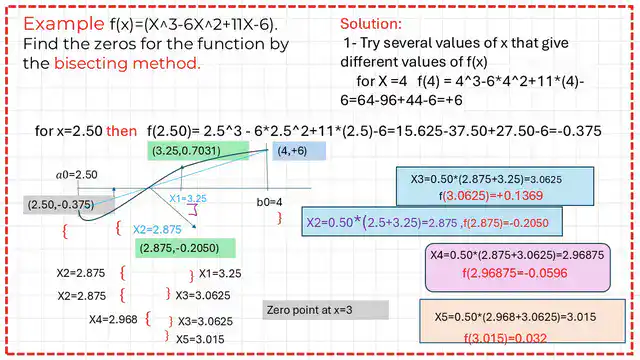
Take the average Value: (2.50 + 4) = 0.50 * (6.50) = 3.25.
2- Get the Value for f(x), when x=3.25, so f(3.25)=2.5^3+11*2.5-6=0.7031. This is a new right bracket.
3- We make sure that f(a)*f(b) is >= 0; we want to make sure that we have a negative sign, so (f(2.5)* f(3.25)=-0.375*(+0.7031)=-0.2636. The zero root is between these two points.
Point (3.25) is a new right bracket.
4—Let us take the average between the left and right bracket points (3.25,+2.50) as the new x Value, x2=0.50*(3.25+2.504)=+2.875. Check whether it is a right bracket or a left bracket.
5- Get the Value for f(x), when x=2.875, so f(2.875)=2.875
2.875^3+11*2.875-6=-0.20508.This is a new left bracket.
6-We make sure that f(a)*f(b) is >=<0; we want a negative sign, so (f(2.5)*f(2.875)) =- 0.375*(-0.20508) = +0.0769.
The Product is positive. A new Point (x=2.875) is a new left bracket. Then, take the average between this last point (2.875) and our right bracket, x = 4. The average is 0.50*(2.875+4)=3.0625.
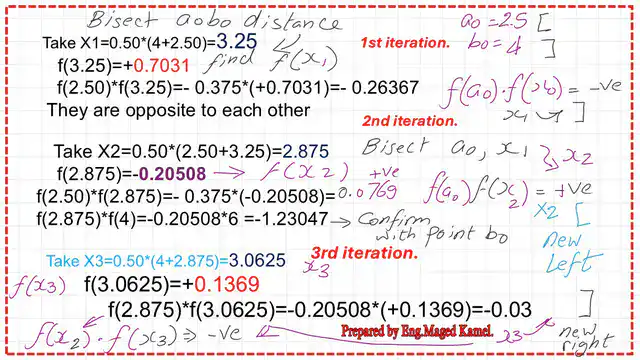
7-Get the value for f(x), when x=3.0625, so f(3.0625)=3.0625^3+11*3.0625-6=+0.1370.The value of 3.0625 is a new right bracket.
8-We make check that f(a)*f(b) is >=<0, between the recent left bracket(2.875) and the recent right bracket(3.0625).
We want to ensure a negative sign, so (2.875)* f(3.0625)=-0.0281. Since the Product is negative, (3.0625) is a new right-bracket point.
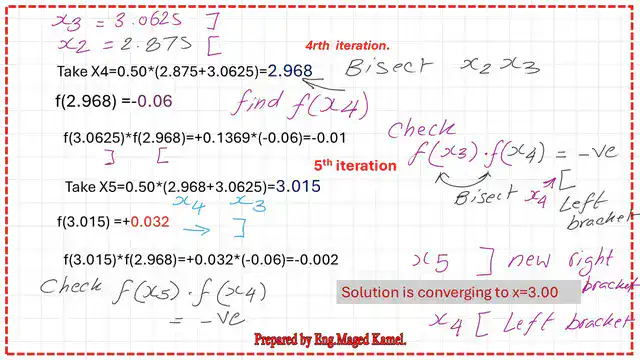
Take the average of (3.0625, 2.875) = 2.968. Every operation is called an iteration. Here are thee details ofthee iterations.. For more detailed information on iterations, please refer to the following two slides.
8-Get the Value for f(x), when x=2.9688 so f(2.9688)=2.968^3+11*2.9688-6=-0.0595. The Value of 2.9688 is a new left bracket.
7-We make sure that f(a)*f(b) is >=<0 between the recent left bracket (2.968) and the recent right bracket (3.0625).
We want to ensure a negative sign, so (f(2.968)* f(3.0625)=-0.0082. Since the Product is negative, point (2.9688) is a new left bracket point. After five iterations, we obtain an approximate solution for x, which is close to 3.00.
This equation is used for the number of iterations and the relative error.
For error estimation, the number of iterations n should be greater than or equal to log10 ((b0-a0)/e) for a given error Value of 0.001, divided by log10 (2).
In our example, a0 = 2.50 and b0 = 4 are the tolerance errors for the Value 0.001.
We can substitute like this: n is greater than or equal to log10(4 -2.50)* (-3). That is, log Value 10 of error 0.001, which is =-3, divided by log 10 of 2 is = (—0.16 6091)—1-(-3))/0.301029, giving us 10.55, which can be approximated to 11.
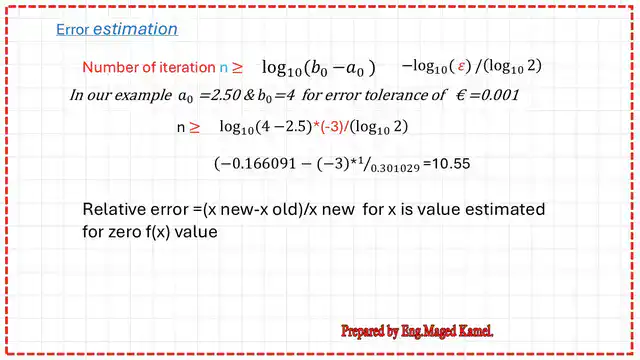
Relative error equals (x new – x old) / x new. For x, the Value is estimated to be f(x) = 0.
You can download the PDF data for this Post from the following document.
The next topic is the false position method, another numerical method for root finding.
A very important source is Holistic Numerical Methods.