Last Updated on March 5, 2026 by Maged kamel
- Solved Problem-6-8 for local buckling-CM#15 For HSS section.
- Detailed descriptions of problems 6-8 on local buckling.
- Check which direction controls the design, whether X or Y.
- Find FE, check whether the HSS section is long or inelastic.
- Check whether the HSS section is slender.
- How do we estimate the effective B and h?
- Find the modified B value.
- Find the modified h value.
- LRFD value for Nominal load.
- ASD value for Nominal load.
Solved Problem-6-8 for local buckling-CM#15 For HSS section.
Description of data.
The following slide image contains a brief description of the content of this post. I will resolve Example 6-8 from McCormac’s book for determining the available strength of a given HSS section. This time, the solution will be based on CM#15, and we will confirm our answer using Table 4-3. The same problem 6-8 was solved in post 14, but using CM#14.

This is a brief description of sections that are not slender for compression members, from Prof. Segui’s handbook, with slenderness ratios included for each shape.

Detailed descriptions of problems 6-8 on local buckling.
For the solved problem 6-8, determine the axial compressive design strength Φc Pn and the allowable design strength Pn/λc of a 24 ft HSS of 14x10x1/4 inch column section; the base of the column is considered to be fixed. From the first part of Table 1-11, we obtain the area value of 10.80 inch2, h/t = 57.10, and Ix = 310.0 inch4.

The upper end is assumed to be pinned—The yield stress fy=50 ksi instead of 46 ksi as in the same problem based on CM#14. The effective length factor k for the column is 0.7, but the recommended value is 0.8. Refer to table C-A-7.1 of the specification. Please refer to the following slide image.

This is part 2 of Table 1-11, from which we obtain the values of ry and Iy: ry = 4.14 inches and Iy = 186 inch4 for the HSS section 14x10x1/4 inches.

Check which direction controls the design, whether X or Y.
The next step is to check which direction controls the design. For the x-direction, we estimate Lex/rx (0.8*24×12/5.35)=26.92.
While in the y-direction, Ley/ry (0.8*24×12/4.14)=55.65. We select the bigger value; the design is governed by buckling in the Y-direction.

Find FE, check whether the HSS section is long or inelastic.
The next step is to check whether the column is inelastic or long; the limiting ratio is 4.71*sqrt(E/Fy)= 4.71*sqrt(29000/50)=113.43. Since ley/ry equals 55.65, which is less than 113.43, the column is inelastic. For the Euler stress, we have fe=Pi^2*E/(le/ry)^2; the Fe value equals 92.42 Ksi.
Check whether the HSS section is slender.
To determine whether the HSS section is slender, we check the b/t value against the limiting value for the slenderness ratio for a stiffened HSS section.
The limiting value equals (1.4* sqrt( E/Fy)=33.72. The b/t=39.90 from table 1-11, while h/t=57.10. The section is slender since b/t & h/t are bigger than 33.72. Please refer to the next slide image for more details.

The following slide image shows the relationships between L/r and critical stress values, along with the curves used to estimate the critical stress.

The following slide image shows the hatched areas representing the effective areas for slender HSS and W sections; the modified b and h are to be estimated to obtain the effective area.

How do we estimate the effective B and h?
Based on B4.1b for stiffened elements, it is recommended to calculate a modified b=b-3*td and modified h to be equal to h-3td where t design equals 0.233 inches, h=14 inches, and b=10 inches.
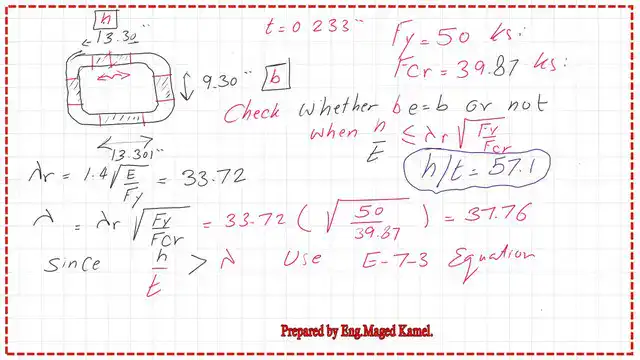
The value of b=10-3*(0.233) =9.301 inch, while h =14-3*(0.233)=13.301. Since the column is inelastic, we estimate fcr as equal to 0.658^ (50/92.42)*50=39.87 ksi.

Find the modified B value.
To determine whether we need to consider Be or the same b value, we need to check for λ value against λ, Fy, and fcr. based on the two equations E7.2 and E7.30.

Check for λr value, which is the ratio we get from Table B4.1, equals 33.72, against λ, which is equal to sqrt(Fy/Fcr)=33.76. Since b/t from the table is>37.76, we need to adjust B and estimate be. Later, we will also check for h.

We need to estimate the elastic local buckling stress Fel, which is equal to (C2*λ/λ)^2*Fy. The value of Fel is found to be 68.01 ksi. We can proceed to estimate the value of Be using the E7.3 equation. The final value of be equals 8.974 inches.

Find the modified h value.
Check for λr value, which is the ratio we get from Table B4.1, equals 33.72, against λ, which is equal to sqrt(Fy/Fcr)=33.76. Since h/t from the table >37.76, then we need to adjust h and use equation E7-3.
We need to estimate the elastic local buckling stress, Fel, which equals (C2*λr/λ2)^2*Fy. The value of Fel is found to be 33.21 ksi; it differs because the Lambda value is higher. We can proceed to see the value of He using the E7.3 equation. The final value of he or the effective length equals 9.923 inches.
We can estimate the effective area of the HSS section, which is 9.074 in2. The nominal load Pn equals =Ae*Fcr=9.074*39.87=361.78 kips. The effective area is used to estimate the nominal load.

LRFD value for Nominal load.
For LRFD, Φc=0.90,Φc*Pn=0.9*361.78=325.60 kips.

ASD value for Nominal load.
For the ASD, Pn/Ωc=361.78/1.67=216.63 kips.

Use Table 3.1 to get the factored loads.
We will estimate the Ley for the lex, buckling length in x, we will divide by rx and multiply by rx, Lecy equivalent = 19.20 /(5.35/4.14)=14.86 feet, while lcy=19.20 feet, which is bigger, and that is the length that will be used in Table 4-3.

The factored fcr based on the LRFD design is 326 kips, which is very close to our estimate.

The factored fcr based on the ASDD design is equal to 216.4 kips, after interpolation, very close to our estimate.

In the footnote, you can check the gross area, Ix and Iy, and the ratio of rx/ry for the given section.

This is the PDF file for this post.
If you have the link, refer to theprevious post: A Solved problem 5-3 for local buckling of columns.
The following post: A solved problem 6-19-4.
For a good A Beginner’s Guide to the Steel Construction Manual, 14th ed. Chapter 7 – Concentrically Loaded Compression Members.
For a good A Beginner’s Guide to the Steel Construction Manual, 15th ed. Chapter 7 – Concentrically Loaded Compression Members.
For a good A Beginner’s Guide to the Steel Construction Manual, 16th ed. Chapter 7 – Concentrically Loaded Compression Members.
.