Last Updated on September 21, 2026 by Maged kamel
- Deposit Value for Uniform series, A.
- The first solved problem finds the deposit Value A for a Uniform series in terms of n, I, and F.
- The first solved problem: find the deposit Value for a Uniform series using the Cash flow method.
- The first problem solved is finding the deposit Value for a Uniform series using the A/F method.
- A Table was used to determine the deposit Value for the Uniform series with i = 7%.
- Use the Excel PMT function to find the deposit amount for the Uniform series.
- A second solved problem is finding A for a Uniform series: use the Cash Flow Moment.
- Use the Expression of A/P to find the deposit Value A for a Uniform series.
Deposit Value for Uniform series, A.
The first solved problem finds the deposit Value A for a Uniform series in terms of n, I, and F.
The title is College Savings Plan: Find A, given F, N, and I. F is the future Value, N is the number of years, deposits, and Time periods, and I is the interest.
You want to set up a college savings plan for your daughter, who is currently 10 and will attend college at age 18.
She needs at least $100,000 in the bank, which she must deposit.
The bank offers a 7% interest rate. Deposits are made in equal amounts at the end of each year. This applies to the Uniform series, A. The factor used (A/F) is called the sinking fund factor.
You need $100,000. This sum is the future Value; A is unknown, given n and interest rate i%. The N Value is 8 deposits over 8 years, and i = 7%.
The first solved problem: find the deposit Value for a Uniform series using the Cash flow method.
Suppose we use the Cash flow Moment method at a pivot point, t = 0. The Moment caused by the future Value F will be Equivalent to that caused by the Uniform series of deposits at the same point.
To get the Moment due to the future Value, treat F as a positive number, and place it to the left of the pivot point; the Moment arm to the pivot point at t = 0 is (1+i)^-8. The Moment Value is $100,000 × (1.07)^-88}$
For the Moment, this is caused by the Uniform series of deposits. It will be -A*(1+i) ^-8 + (-A)*(1+i) ^-7, and so on until we complete the deposit Expression. The sum of moments is zero. After adjustments, the result is A multiplied by 5.97129.
The Product of A*5.97129 will equal $100,000/(1.07) 8=$100,000/1.7181. We simplify the result to 100,000/10.2598 = $974.78. The final Value of A is $974.78, payable at the end of each year for 8 years to achieve a future Value of $100,000.
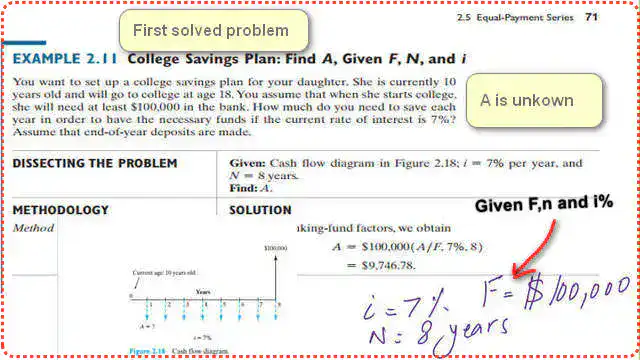
Use the Cash Flow Moment at the pivot point t=0.
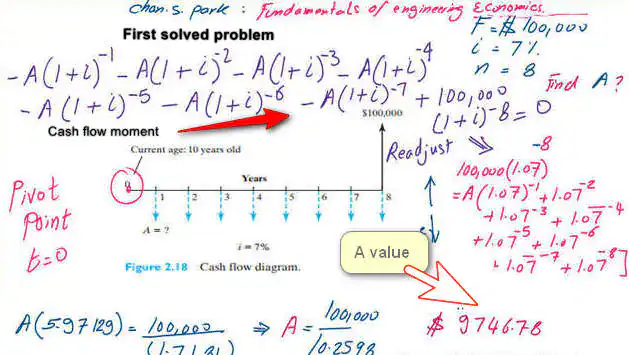
The first problem solved is finding the deposit Value for a Uniform series using the A/F method.
The second method uses the equation, A =$100,000*(A/F,7%,8)=$9746.71. This Value matches the estimate from the Cash Flow Moment method.
A/F can be estimated by using the formula, A/F=(i)/((1+i)^n-1), i=7%,n=8. We substitute to get A/F as (0.07)/((1.07)^8-1))=0.09746. Multiply the Value by $100,000 to get A. A Value will be $100,000*0.09746=$9746.78.
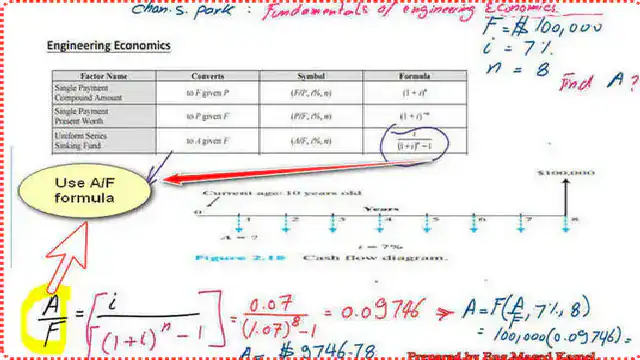
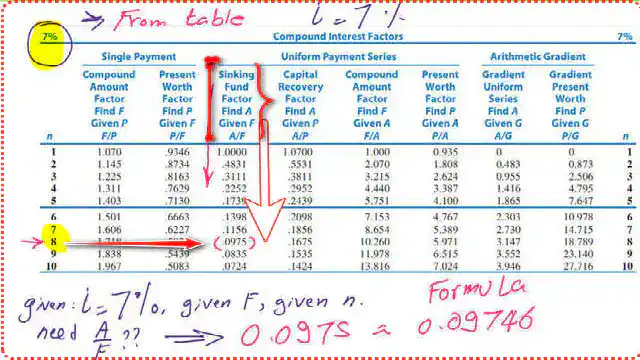
A Table was used to determine the deposit Value for the Uniform series with i = 7%.
The next method uses the interest rate Table. We use the 7% interest rate Table; n = 8. We need to find the A/F Value. Check the sinking fund factor A/F to find A in terms of F. Go vertically and find the intersection at n = 8; we get 0.0975.
This number matches the previous calculations.
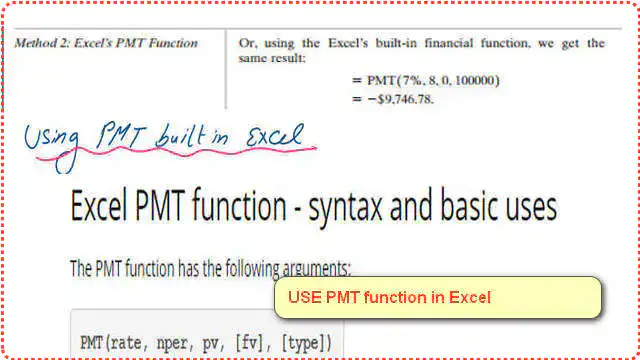
Use the Excel PMT function to find the deposit amount for the Uniform series.
Another way to find A/F is to use the Excel PMT function. The inputs are 0.07, Nper is 8 deposits, PV stands for present Value (0), FV stands for the futureValuee ($100,000), and type is 0. The A Value is negative because the Uniform series is an outflow.
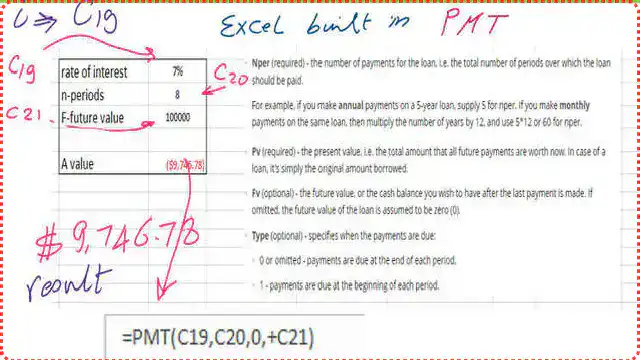
If we use an Excel sheet, use cells. Cell C19 has an interest rate of 7%. The N periods are 8. Cell C21 is for a
Future Value F is equal to 100,000. In the last cell, C23, we can get the A Value as a negative number. I have taken a screenshot of the cell.
PMT(C19,C20,0,+C21). You can get the Value in the A Value using the Excel sheet.
A second solved problem is finding A for a Uniform series: use the Cash Flow Moment.
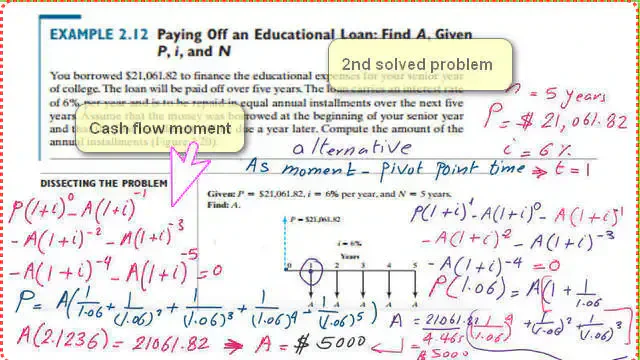
Check another problem: 2.12, paying off an education loan. Find A, Given P, I, and N. This is another way to get A, but this Time in terms of P, where P is the present Value. You borrow from the bank to finance your educational expenses. You must repay the loan to the bank within the next five years.
The interest rate is 6% per year. The payment should be in equal annual installments. The loan will be paid off over five years. As we know, for a Uniform series, payments begin one year after the loan is taken out.
The first installment is due a year later. We need to estimate the amount of the annual installment A. Refer to Figure 2.20. This solved problem requires estimating A in terms of P, while the previously solved problem requires estimating A in terms of F.
In this solved problem, I and n are given. First, we will use the moment-of-cash-flow method to estimate the Moment of Cash flow about the pivot point. Take the pivot point at Time t=0. If P is pointing upwards, then it is +P.
The Moment arm for P is (1+i)^0; whether from the right or the left, P coincides with the point, and the arm length is equal to 1.
. The sum of moments equals zero. P will be on the L.H.S., and the Product of A by the arm will be set as the R.H.S., with a changing sign.
The negative exponents are considered fractions.
The equation is modified as we can see , P=A*(1/(1.06)+1/1.06^2)+1/(1.06)^3++1/(1.06)^4+1/(1.06)^5)). The P-value is $21061.82. We equate it to the correct Value (4.2123)*A. Finally, A == 5000.
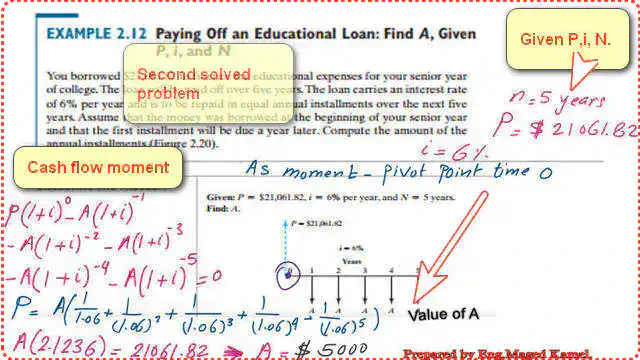
This is another example that uses a pivot at t = 1; the sum of moments is shown based on the selected pivot point. Please refer to the right side of the slide for a comparison between Cash flow moments based on a pivot point at t = 0 and at a pivot point at t = 1—finally, A = $5000.
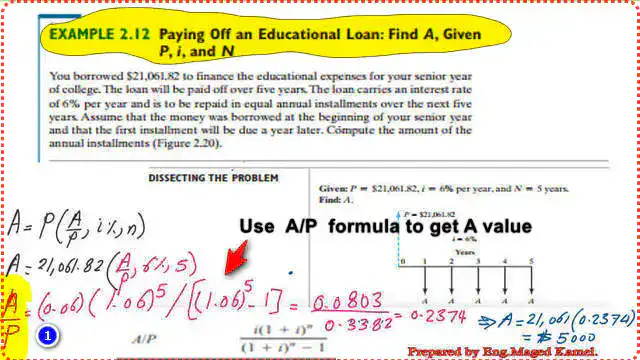
Use the Expression of A/P to find the deposit Value A for a Uniform series.
We use the equation A = P(A/P, i, n), with P given and A unknown. P = $21061.82. A/PValuee can be obtained from the known equation as (i*(1+i)^n/(1+i)^n-1)). The A/P Value is equal to 0.2374. A/P will be multiplied by P. The deposit Value A =21061*0.2374=$5000. This Value matches the previous calculation at the Moment of Cash flows.
You can view or download the PDF file used for the Post from the following document.
This relates to the previously solved problem: Value for Uniform series deposits.
This is a good Link: Applying Theory to Practice. A good reference.