Last Updated on September 9, 2026 by Maged kamel
Practice problem: transverse weld of a WT section.
This is a Practice problem for the Transverse weld of a WT section; this is case 3 for the shear lag factor table D3.1.
A given WT5x15 section of A922 steel with a transverse weld to its Flange, as shown in Figure P3-32, is required to find the LRFD and ASD values, neglecting the block shear.
Estimate the minimum value of the shear lag factor U.
1-From the given Data for ASTM A992, we can get the yield stress Fy=50 ksi and the ultimate stress Fu = 65 ksi.
2—From the given section of WT5x15, we can find the following data. The first item is the Area of the given section, which equals 4.42 in^2.
The Flange’s breadth is bf=5.81 inches, and its width is 0.51 inches. The overall depth is 5.24 inches, and the stem width is 0.30 inches.
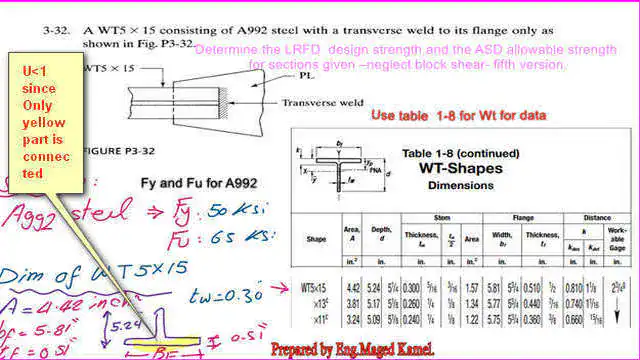
3- The minimum value of the shear lag factor U can be estimated as the ratio of the connected Area of the transverse weld to the total Area of the Wt section.
4—The connected Area is equal to the width of the Flange by its thickness, which is the Product of 5.81* 0.51 = 2.9631 inch2.
5- The U value equals the connected Area over the Area of the section, or equal to 2.9631/4.42 =0.67.
The estimation of the effective Area.
The Flange is connected to the gusset plate but not to the entire Wt section, and the connection is made only through a transverse weld.
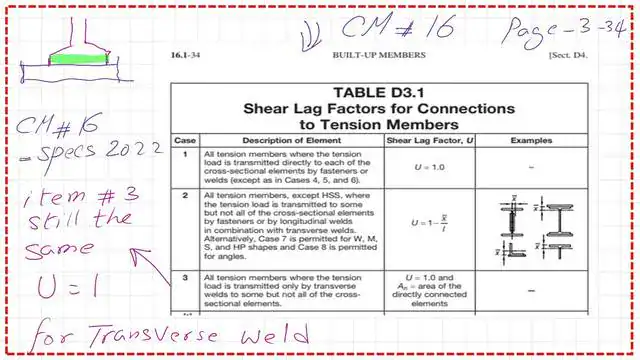
6-To get the effectiveAreaa, multiply the value of U, which is equal to one, by the connected Area, which is equal to 2.963 inch2. The next slide image shows the details of Table D3.1 based on #2010 specs case 3.
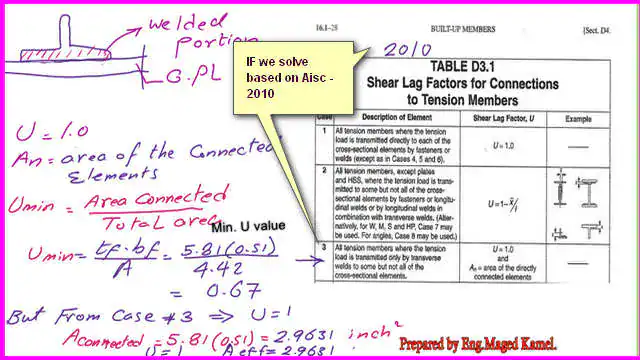
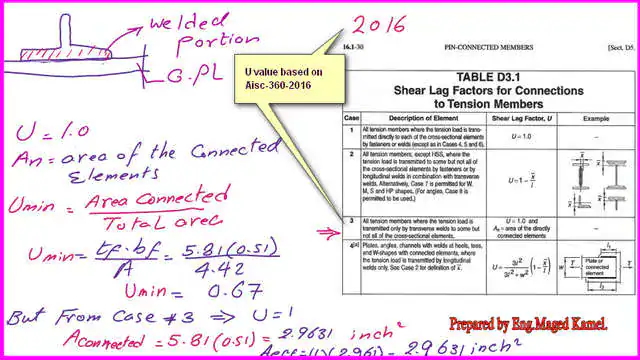
The same estimates match the CM#15 and 2016 specifications, and case 3 is also marked. For CM#16, specification 2022, there is NO change for item #3.
The next slide image shows the equations used to estimate the factored nominal strength for tensile Yielding and Tensile rupture.
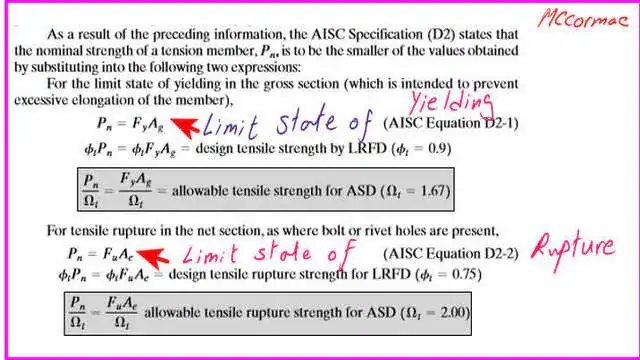
Nominal strength for Practice problem: transverse weld of a WT section.
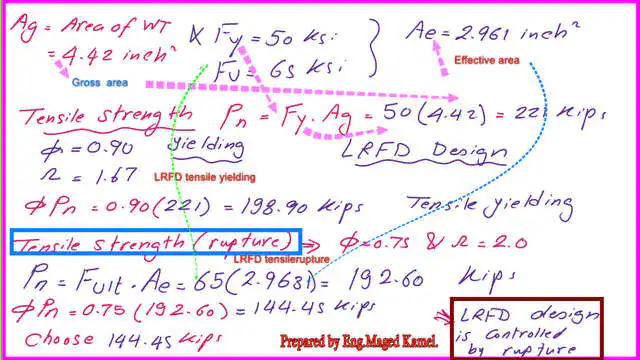
We have two cases for the nominal strength. The first case is tensile Yielding, for which we consider the Area as the full Area. Tensile strength equals the yield stress multiplied by the cross-sectional Area and is (4.42*50) = 221 kips.
The second case for tensile strength is rupture strength, which equals the effective Area multiplied by the ultimate stress, and is given by (2.963*65)=192.6 kips.
The U value explained for Case -3 is that all tension members transmit the tension load only through transverse welds to some, but not all, of the cross-sectional elements.
LRFD strength for Practice problem: transverse weld of a WT section.
Multiply the first value of the strength due to yield by the reduction value of φ equal to 0 .90; we can get the LRFD strength due to Yielding as 199 kips.
Multiplying the second strength value due to rupture by the reduction factor φ = 0.75 yields the LRFD strength due to rupture of 144 kips.
We select the lesser value as the final LRFD strength, which is 144 kips. This indicates that rupture governs the LRFD strength.
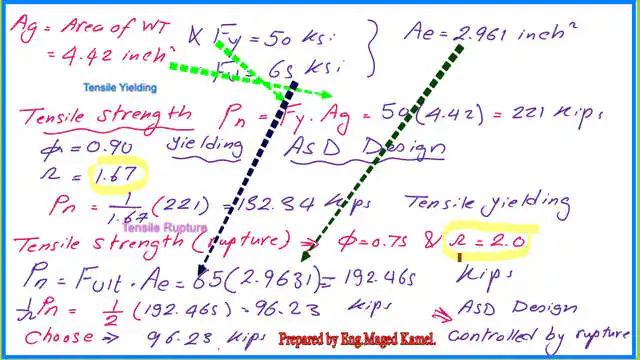
ASD strength for Practice problem: transverse weld of a WT section.
Multiply the first value of the strength due to yield by the reduction value (1/Ω) equal to (1/1.67); we can get the ASD strength due to Yielding as equal to 132.33 kips.
Multiply the second strength value due to rupture by the reduction value of (1/Ω) equal to (1/2), and we can get the ASD strength due to rupture as equal to 96.30 kips.
We will select the lesser value as our final ASD strength, which equals 96.30 kips. This indicates that rupture governs the ASD strength.
You can view or download the PDF for this post from the following link.
The next post is 9B– Practice problem: longitudinal weld of a plate section.
For a more detailed illustration of block shear, there is a very useful external link to Chapter 3, Tension Members—A Beginner’s Guide to the Steel Construction Manual, 14th ed.
Chapter 3 – Tension Members —A Beginner’s Guide to Structural Engineering is a great external resource. AABeginner’s Guide to the Steel Construction Manual, 15th ed.
A useful external link: Tensile Yielding and Tensile Rupture. A Beginner’s Guide to the Steel Construction Manual, 16th ed.