Last Updated on November 3, 2026 by Maged kamel
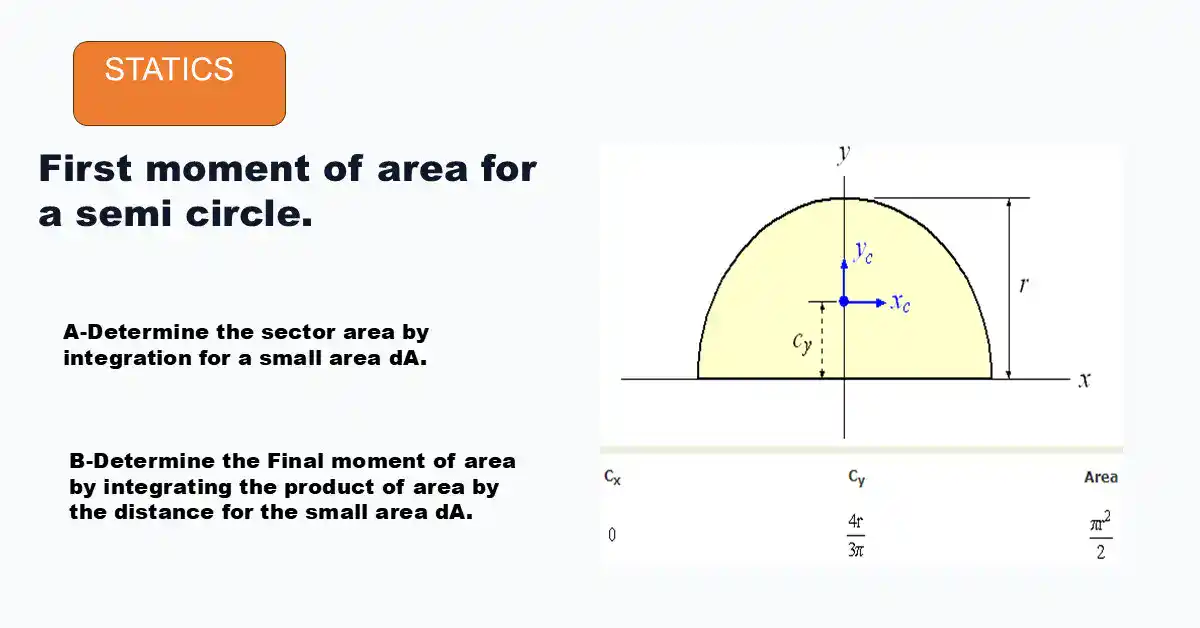
- Area and Cg for a semicircle.
- Reference handbook: 10.00 Value for the Area and CG for a semicircle.
- Area and CG for a semicircle- select an Area dA.
- Area and CG for a semicircle, first Moment of Area about the Y-axis
- Use a vertical strip to obtain the first Moment of Area about the Y-axis
- Area and Cg for a semicircle, first Moment of Area about the X-axis.
- Use a vertical strip to obtain the first Moment of Area about the X-axis.
Area and Cg for a semicircle.
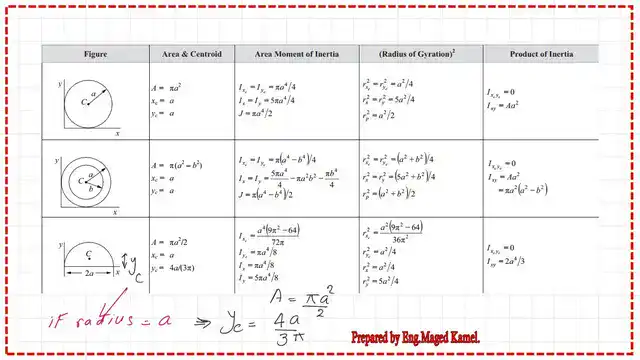
Reference handbook: 10.00 Value for the Area and CG for a semicircle.
A List of common round-shaped areas and CG values. Our third case is a semicircle. The external axis Y is tangent to the semicircle, which has a diameter of 2a. The x-axis passes through the center of the semicircle.
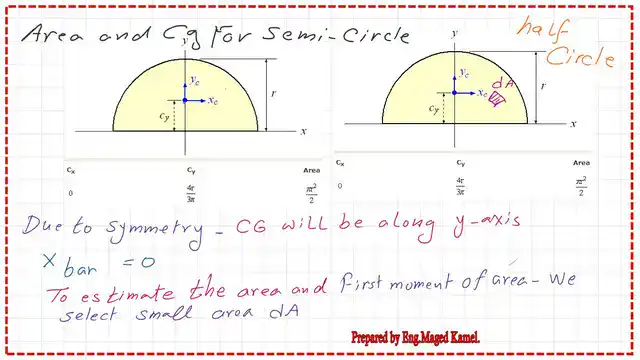
Area and CG for a semicircle- select an Area dA.
We have a semicircle with radius a and need to find its Area and CG. We can find that there’s an internal axis Y that divides the semicircle into two similar parts. Because of that symmetry, we expect the CG, or center of gravity, to lie on the y-axis at a distance y from the external x-axis. We have taken the radius of the semicircle to be r.
We need a small Area dA to estimate the first Moment of the Area and obtain the total Area of the semicircle.
Area and CG for a semicircle, first Moment of Area about the Y-axis
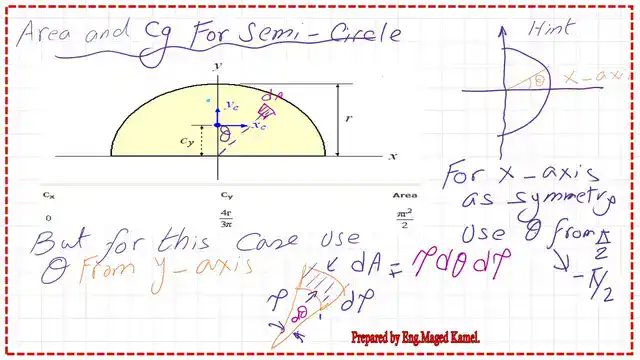
For the Area and CG for a semicircle about the y-axis. We have two intersecting axes, X and Y, and we will select a small Area dA with radius ρ centered at their intersection.
We will consider two cases: the first, which we are facing, where the Y-axis is the axis of symmetry; in this case, we take an angle θ between the Y-axis and the line to the Cg of the strip dA. For integration, θ ranges from -π/2 to π/2.
The Second case, where the X-axis is the axis of symmetry, is as follows: we will take an angle θ between the X-axis and the line to the Cg of the strip dA. For integration, θ will range from -π/2 to π/2, and x bar will not be zero.
The first Moment of Area for the small Area dA about the Y-axis is the Product of that Area by the vertical distance to the Y-axis. The Area of the strip equals(ρ*dρ*d θ).
The horizontal distance is x, which equals ρ sin θ. The Moment dMx=dA*(y)=(ρ*dρ*d θ)*(ρ*sin θ). It will be simplified to (ρ^2*dρ*sin θ*dθ).
We will use double integration to compute the first Moment of Area for the entire semicircle, since we have to integrate ρ from ρ=0 to ρ=r. The Second integration is for the angle dθ, from θ = -π/2 to θ = π/2, or from -90 degrees to +90 degrees. dA*y=∬(ρ^2*dρ*sin θ*dθ).
The integral about the Y-axis is zero, which indicates that the Cg is at the center of the semicircle.

Use a vertical strip to obtain the first Moment of Area about the Y-axis
We can use a vertical strip as an alternative to the x-bar distance for the semicircle. The strip height is y, the thickness is dx, and the Cg vertical distance is y/2.
The Area of the strip equals (dx*y), while the first Moment of Area about the y-axis equals x*dx*y. We can use the Expression y = sqrt (r^2-x^2), where r is the semicircle radius, and u is equal to y^2; the Value of du equals =-2x, then X=-du/2.
Back to the first Moment equation, it equals -u*du/2. The strip moves from -r to r, which is from u = 0 to u = 0. The first Moment of Area about the y-axis is zero, as shown in the next slide.
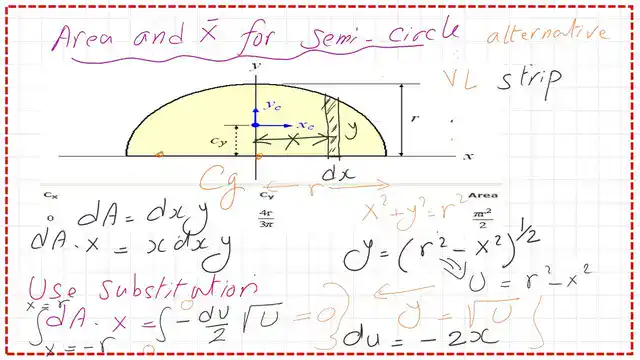
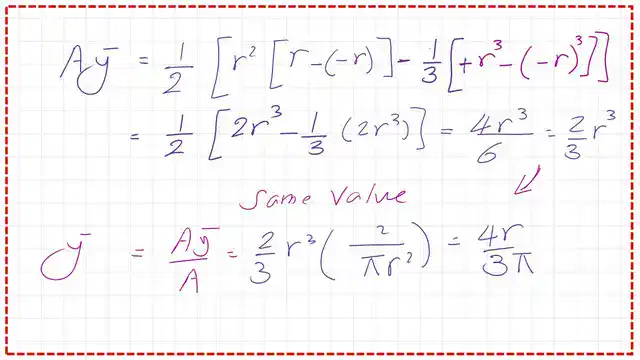
Dividing A*y/A to get y-bar leads to y-bar = (2* (r^3/3)/0.5*π*a^2=4a/3*π. This assumes that the Cg lies on the X-axis.
Area and Cg for a semicircle, first Moment of Area about the X-axis.
For the Area and Cg for a semicircle about the X-axis, the first Moment of Area dA about the X-axis is dMy = dA* (y) = (ρ*dρ*dθ)*(ρ*cos θ). It will be simplified to (ρ^2*dρ*cos θ*dθ).
We will use double integration to compute the first Moment of Area for the entire semicircle, since we have to integrate ρ from ρ=0 to ρ=r. The Second integration is for the angle dθ, from θ = -π/2 to θ = π/2. dA*y=∬(ρ^2*dρ*cos θ*dθ).
The Value of the first integration is equal to ∫ρ^2*dρ from zero to r=1/3*ρ^3; after substitution, this leads to 1/3*(a^3-0)=a^3/3, while ∫(cos θ*dθ)=sin(θ), after substitution from -π/2 to π/2. The Value will be (+2r^3/3)
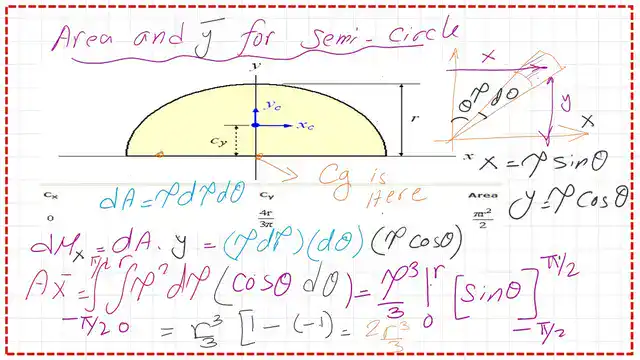
We have estimated the Area of the semicircle to be 0.5*π*r^2, as shown in the next slide.
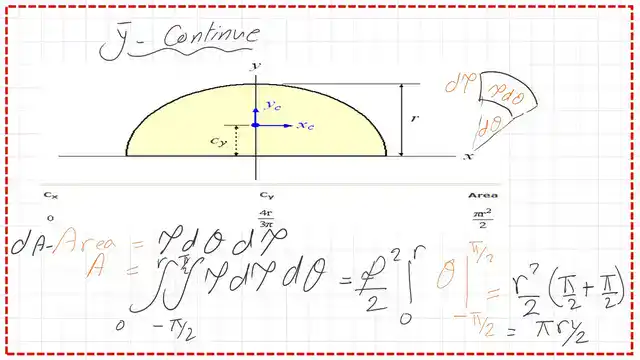
The CG distance is Y bar = 4r/3, as shown on the next slide.
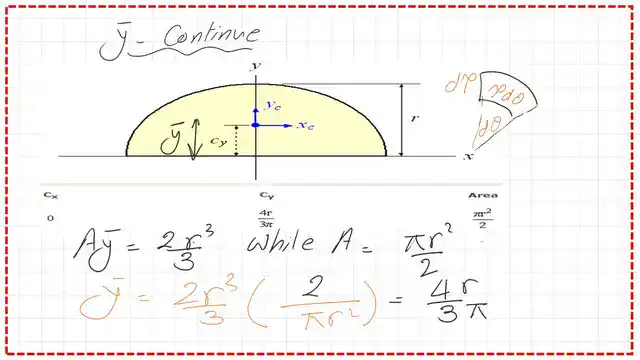
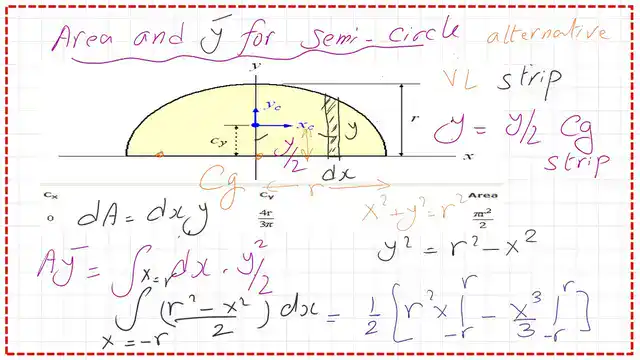
Use a vertical strip to obtain the first Moment of Area about the X-axis.
We can use a vertical strip instead of y-bar for the semicircle. The strip height is y, the thickness is dx, and the Cg vertical distance is y/2.
The Area of the strip is dx*y, and the first Moment of Area about the x-axis is y*dx*y/2 = (1/2) y^2*dx. Use the Expression for y^2 = r^2- x^2. We integrate from -r to +r.
Back to the first-moment equation, it equals -u*du/2. The strip will move from -r to r, which is from u=0 to u=0. The first Moment of Area about the y-axis is zero, as shown in the next slide.
We have completed the subject of the Area and CG for a semicircle.
You can view or download the PDF of this Post’s Content from the following document.
The next Post will be on estimating the Area and CG for a circular sector.
This links to a very useful site: Engineering Statics Open and Interactive.