Last Updated on September 10, 2026 by Maged kamel
Area and CG for a circular sector.
Reference handbook 10.00 value for the Area and CG for a circular sector.
A list of common round shapes’ Area and CG values. Our fourth case is a circular sector.
You can click on any picture to enlarge, then press the small arrow at the right to review all the other images as a slide show.
The circular sector is a portion of a circle that is closed by two radii and an arc. In our case, we treat it as two radii of length a, with an enclosed angle of 2θ. The external axis Y passes through the left point of the circular sector, which has a radius value of a. The x-axis bisects the circular sector angle.

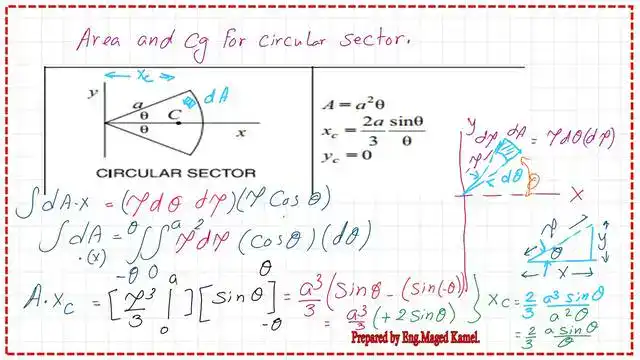
Area and CG for a circular sector- select an Area dA.
We have a circular sector with radius a, and we need to find its Area. We can find an internal axis x that divides the circular sector into two similar parts. Due to that symmetry, we expect that the Cg or the center of gravity,, will be located along the X-axis at a certain distance x from the external axis Y. We have used the radius of the circular sector as equal to a.
The angle θ is the angle enclosed between the Cg of the strip dA and the X-axis. The angle dθ is the angle enclosed by the strip dA.
The circular sector Area can be found from the integration of dA= ∬(ρ*dρ*dθ) from ρ=0 to ρ=a and enclosed by an angle equal to dθ. The integration is from θ equals (- θ) to θ=( θ), the final Expression for the Area is dA=1/2*ρ^2*(θ-(-θ)=1/2*a^2(2*θ)=a^2*θ. The steps followed to find the Area for the circular sector are shown in the next slide image.

Area and Cg for a circular sector, first Moment of Area about the Y-axis.
For the Area and Cg for a circular sector about the Y-axis. We have two intersecting axes, X and Y, and we will select a small Area dA with radius ρ centered at the intersection of the two axes.
The first Moment of Area for the small Area dA about the Y-axis is the Product of that Area and the horizontal distance to the Y-axis.
The horizontal distance is x, which is equal to ρ*cos θ. The Moment dMy=dA*(x)=(ρ*dρ*d θ)*(ρ*cos θ). It will be simplified to (ρ^2*dρ*cos θ*dθ).
For the first Moment of Area of the entire circular sector, we will use double integration, since we have to integrate with respect to ρ from ρ=0 to ρ=a. The second integration is from θ equal to (- θ) to θ equal to (+ θ).
The total value of the first Moment of Area for the circular sector will be equal to =2*(a^3/3)*(sin(θ-(sin(-θ)=(2*(a^3/3)*sin(θ).
We can find the horizontal distance of the Cg from the Y-axis by dividing the first Moment by the Area value; this will lead to 2*(a^3/3)*sin(θ))/a^2*θ=(2/3)*(a*sin θ)/θ. The details of the horizontal value of the horizontal distance of the Cg to the y-axis are shown in the next slide image.
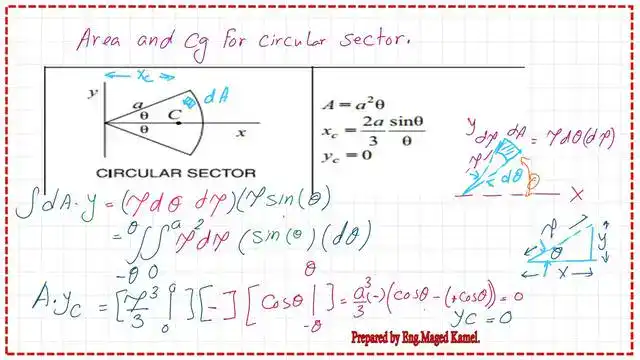
Area and Cg for a circular sector- first moment of Area about the X-axis.
For the Area and Cg of a circular sector about the X-axis. We have two intersecting axes, X and Y, and we will select a small Area dA with radius ρ centered at the intersection of the two axes.
The first Moment of Area for the small Area dA about the Y-axis is the Product of that Area and the vertical distance to the X-axis.
The horizontal distance is Y, which is equal to ρ*sin θ. The Moment dMx=dA*(y)=(ρ*dρ*d θ)*(ρ*sin θ). It will be simplified to (ρ^2*dρ*sin θ*dθ).
For the first Moment of Area of the entire circular sector, we will use double integration, since we have to integrate with respect to ρ from ρ=0 to ρ=a. The second integration is from θ equal to (- θ) to θ equal to (+ θ).
The total value of the first Moment of Area for the circular sector about the X-axis will be equal to =2*(a^3/3)*(-cos(θ-(cos(-θ)=(2*(a^3/3)*0=0.
The vertical distance of the Cg to the x-axis will be=0, which means that the CG point is located along the X-axis. The calculations for the first Moment of Area of the circular sector about the X-axis are shown on the next slide.
We have completed the Area and CG for a circular sector.
You can view or download the PDF for this post from the following document.
The next post will cover how to estimate the Area and CG of a circular segment.
This is a very useful site: Engineering statics, open and interactive.