Last Updated on November 12, 2026 by Maged kamel
- PA = LU Factorization: Solved Problem 2.17 for a 3×3 Matrix.
- Video for the solved Problem with Partial Pivoting: A Complete Guide- 3×3 Matrix-solve for x1, x2, and x3.
- Solve for the C Value.
- Use the Expression U*x = C.
- Another alternative method to get the values of X1, x2, and X3.
- Find the Inverse of U: Solved Problem 2.17.
- Find the Inverse of L: Solved Problem 2.17.
PA = LU Factorization: Solved Problem 2.17 for a 3×3 Matrix.
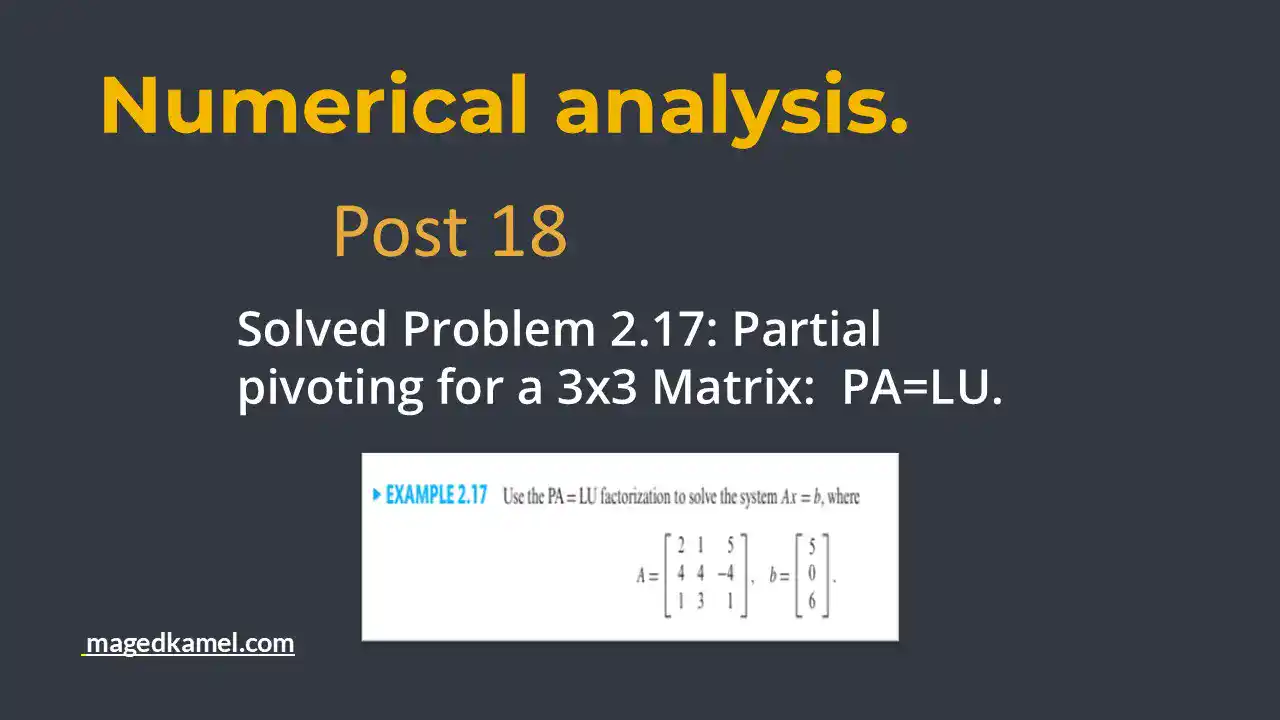
This Post is a continuation of the previous Post, and it explains how we can find the three unknowns x1, x2, and x3 from the estimated data for the L and U matrices and the permutation Matrix P231. We will discuss example 2.17. Use the PA = LU factorization to solve the system A*x = b, where A is a 3×3 Matrix.
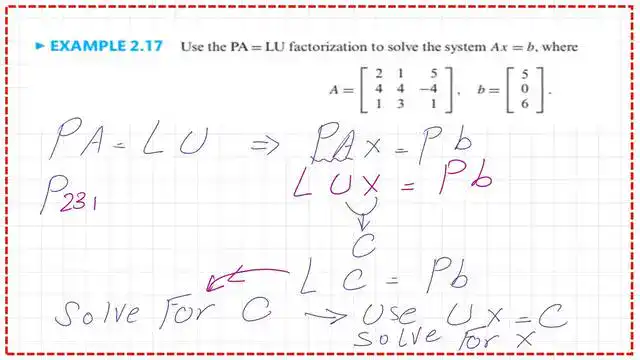
The elements are (2, 1, 5; 4, 4, -4, 1; 3, 1), and the b right-hand side vector is 3×1 with elements (5, 0, 6). In the previous Post, we covered partial pivoting, where we have the Expression PA = L*U. For the equation AX = b, we multiply both sides by P, where P denotes the permutation Matrix. P*A*X equals P*b, and we utilize the Expression PA equals L*U.
We are going to modify the left-hand side of the equation P*AX; it will become L*U*X equals P by small b. Then we will express U*X as equal to C and substitute it back into the equation. We are going to rewrite *LC equal to P by b. We solve this equation: LC equals B multiplied by b. We know the permutation Matrix, which is P231, and we already know b.
Given the lower matrix L we estimated in the previous Post. In the lower Matrix, we have three knowns and one unknown. We will solve for the Value of C. Then we come back to the Expression Ux = C.
We know the Value of the upper Matrix U already; we have estimated C. Then we can directly solve for the vector X for the three values. Please refer to the following slide for more details.
Video for the solved Problem with Partial Pivoting: A Complete Guide- 3×3 Matrix-solve for x1, x2, and x3.
The following video illustrates the Content of this Post.
Timestamps for Video:
- 00:00 Introduction to solving for x1, x2 and x3 using partial pivoting for a 3×3 matrix.
- 02:32 Determine the value of vector C using L, P231, and B matrices.
- 04:35 The values of C1, C2 and C3.
- 05:20 What are the values for the x1, x2 and x3 using C and U matrices?
- 07:14 The exact values for the three unknowns.
- 07:50 Verify the validity of the solution.
- 08:58 The other alternative solution for x values using inverses of L, U, P, and b matrices.
- 10:45 Find the Inverse of U using an augmented Matrix/elementary matrices.
- 12:30 The Details of the corresponding elementary Matrix E1.
- 13:35 The Details of the corresponding elementary matrices E2 and E3.
- 17:14 The Value of the Inverse of U by the augmented matrix.
- 17:55 The Value of the Inverse of U by the three elementary matrices
- 20:02 Verify the Value of the Inverse of U by multiplying it by U to get the identity Matrix.
- 24:21 The Details of the corresponding elementary Matrix E1.
- 26:13 The Details of the corresponding elementary Matrix E2.
- 26:59 The Value of the inverse of L by the augmented Matrix.
- 27:15 The Value of the Inverse of L by the two elementary matrices.
- 28:21 Verify the Value of the inverse of L by multiplying it by L to get the identity matrix.
- 31:00 What are the values for the x1, x2 and x3 using L-1, U-1 P and b matrices?
Solve for the C Value.
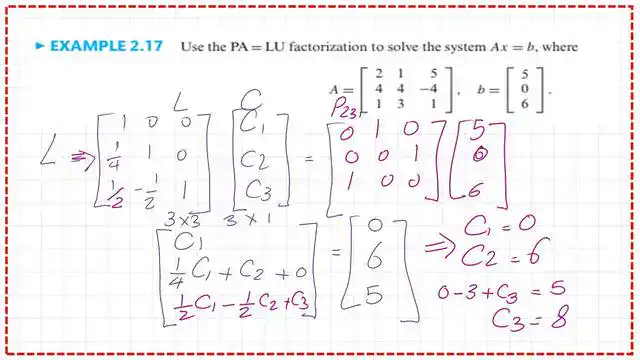
We’ll express L, as we estimated earlier, as a 3×3 Matrix. The first Row is 1, 0, 0; the Second Row is 1/4, 1, 0. The third Row is 1/2, -1/2, and 1. We’ll express L*C equal to P by small B, where C is the vector (3 by 1), C1, C2, C3, and P231 is (0 1 0 1, 0 and 0 0 1 and, 1 0 0.
The small B, which is the vector 5 0 6, we have 1 0 0 multiplied by C1. We get three equations that give the values C1 = 0, C2 = 6, and C3 = 8.
Use the Expression U*x = C.
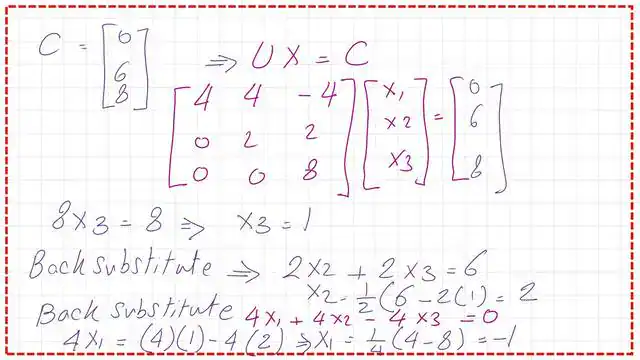
We have C as 0, 6, and 8, which we have estimated. We utilize the Expression of U*X equal to C.
The upper Matrix, as we know, is 4, -4, 0; 2, 2, 0; 0, 0, 8, and the vector X has three elements: x1, x2, x3, and this is the C already: 0, 6, and 8.
We use back substitution from the first equation. We have 8×3 = 8, which means x3 = 1. We have 2x^2 + 2×3 = 6. We can get an x2 Value as (6 minus 2 x 3) divided by 2, which is 6 minus 2 multiplied by 1.
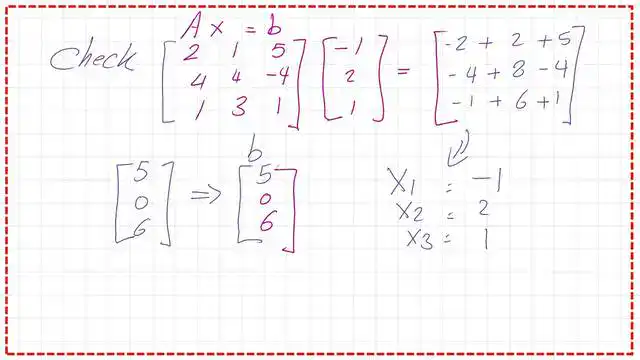
We get the Value of X1 as equals -1. X2 =2 and X3=1. Please refer to the following slide for more details.
We are going to check whether multiplying A by X leads to the vector B, as given. We have 2 by minus 1 is minus 2 plus 1 by 2, which is 2 plus 5 minus 2 plus 2 plus 5, which gives us 5. While multiplying this Row by the column, we have 4 × (- 1) + 4 × (1/2)- 4 × (1/1). This will give us minus 4 plus 8 minus 4, which gives us 0. The third Row by the column vector: we have 1 × (-1) plus 3 × 2 plus 1 × 1, which gives us -1 plus 6 plus 1, which gives us 6. This is Equivalent to the vector Matrix given as 5 0 and 6.
Hence, we acknowledge that the solution x1 = -1, x2 equal to =3 ,= 1 is the correct answer.
Another alternative method to get the values of X1, x2, and X3.
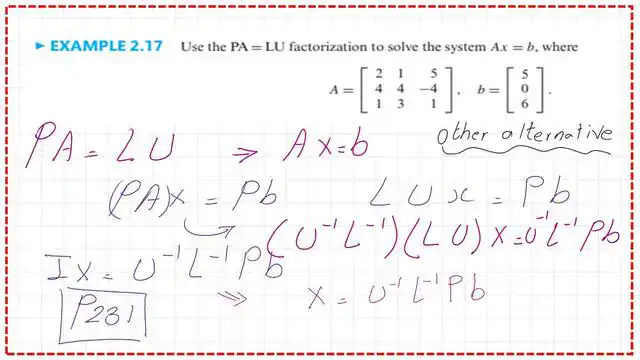
We have another alternative solution we can use. We have P*A equals LU, and as we know, P*A*x equals P*b. But before we know that, we can substitute P*A*x with L*U*x = P*b.
If we multiply the left-hand side by the Inverse of L, then by the Inverse of U.
This is the left-hand side, and we are going to multiply this into the right-hand side by U Inverse, by the inverse of U, and by the Inverse of L. Let us check the left-hand side.
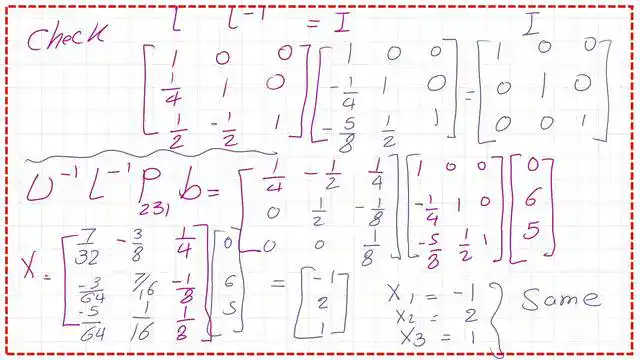
The Inverse of L times L will give us I. The Inverse of U times U gives us I. So we have I*X equal to U minus 1*L minus 1*P by B, which leads to x = U -1*L-1*P by b. B is a given vector 3 by 1: 5, 0, 6. P is the permutation Matrix P 231.-1 is the Inverse of L, and U-1 is the Inverse of U.
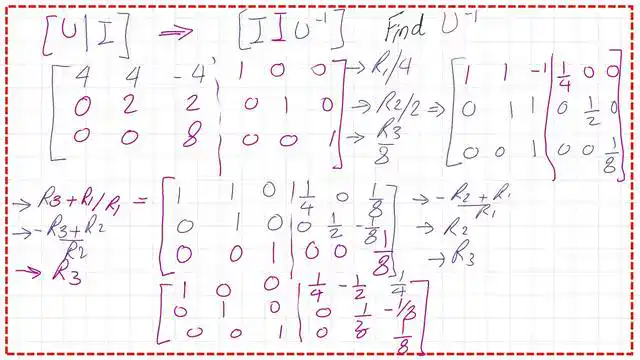
Find the Inverse of U: Solved Problem 2.17.
We are going to use U augmented with I, and we will perform Row operations to convert U/I to I augmented with U-1 to find the Inverse of U. Starting with the elements of U: 4 4 -4, 0 2 2, 0 0 8, and this is the dotted line separating U from I. I is the identity Matrix: 1 0 0, 0 1 0, 0 0 1, and at the same Time we are going to write the elementary matrices that correspond to the Row operations. The details of the elementary operations are shown in the following slide.
Finally, the elements of U Inverse are (1/4 -1/2 1/4;0 1/2 -1/8; 0 0 1/8).
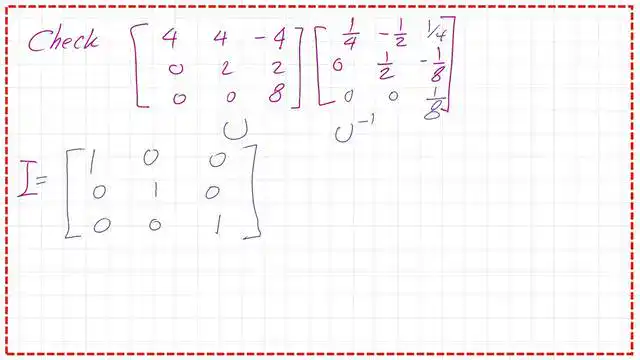
The following slide image shows how we verify that U is correct by multiplying it by its Inverse. The Product is the Identity Matrix.
Find the Inverse of L: Solved Problem 2.17.
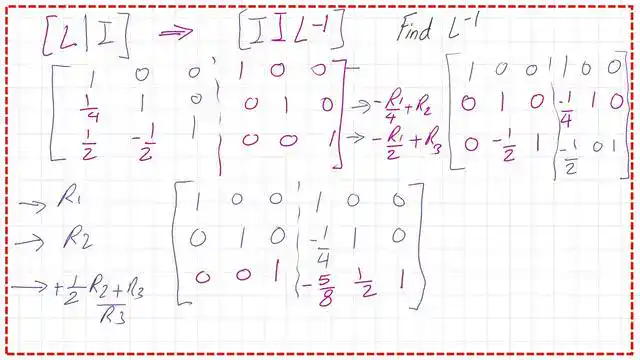
We are going to use L augmented with I, and we will perform Row operations to convert L/I to I augmented with L-1 to find the Inverse of L. Starting with the elements of L: 1 0 0, 1/4 1 0, 1/2 -1/2 1, and this is the dotted line separating L from I. I is the identity Matrix: 1 0 0, 0 1 0, 0 0 1, and at the same Time we are going to write the elementary matrices that correspond to the Row operations. The details of the elementary operations are shown in the following slide.
Finally, the elements of L Inverse are (1 0 0;-1/4 1 0; -5/8 1/2 1).
The following slide image shows how we verify that L is correct by multiplying it by its Inverse. The Product is the Identity Matrix. The Inverse of U times the Inverse of L times the permutation Matrix p231 times b will be Equivalent to the column vector X. We can see that we have obtained the X values.
You can view and download the PDF for the solved Problem from this Link.
Link to the Previous Posts: 16-Solving Systems with PA = LU Factorization.
Link to Post 17-PA = LU Factorization: Solved Problem 2.16
This is the Omni calculator for estimating various linear algebra items: LU Decomposition Calculator.
Link to the the Omni calculator:: LU Decomposition Calculator.
Another calculator to use is the Calculator for matrices.