Last Updated on November 11, 2026 by Maged kamel
- PA = LU Factorization: Solved Problem 2.16 for a 3×3 Matrix.
- Video for the solved Problem with Partial Pivoting: A Complete Guide- 3×3 Matrix
- Introduction to Partial Pivoting.
- Solved Problem 2.16 for Partial Pivoting for a 3×3 Matrix.
- Step 1: Swap the first Row with the Second Row.
- Step 2: Swap the third Row with the Second Row.
- Step 3: Write the elements of L and U Matrices.
- Check PA = LU Factorization: Solved Problem 2.16.
PA = LU Factorization: Solved Problem 2.16 for a 3×3 Matrix.
This Post demonstrates why partial pivoting is necessary when solving a 3×3 linear system with Gaussian elimination. This Post covers how to use the Expression PA = LU Factorization for a 3×3 Matrix.
Video for the solved Problem with Partial Pivoting: A Complete Guide- 3×3 Matrix
The following video illustrates the Content of this Post.
Timestamps for Video:
- 00:00 Introduction to partial pivoting for a 3×3 Matrix.
- 00:50 Introduction to the Expression of PA=LU.
- 01:59 Solved Problem 2.16.
- 02:32 Determine which Row to swap based on the maximum absolute values.
- 06:30 Why should we make another Row swap?
- 07:42 What are the values for the L and U matrices?
- 09:03 Verify that PA=LU.
- 14:04 Verify the solution matches the author’s solution
Introduction to Partial Pivoting.
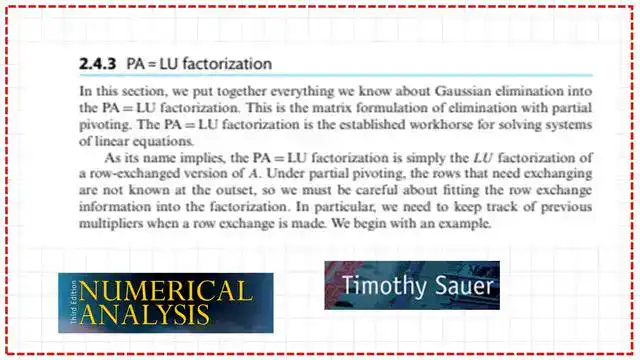
We refer to the numerical analysis book by Timothy Sauer.
Under item 2.43, PA equals LU factorization. Once we move a Row or swap rows, the A Matrix is no longer equal to LU, but the swap makes A equal to PA. In that case, PA equals LU. And that process is called partial pivoting.
And the author is saying the PA = LU factorization is the established workhorse for solving systems of linear equations.
Solved Problem 2.16 for Partial Pivoting for a 3×3 Matrix.
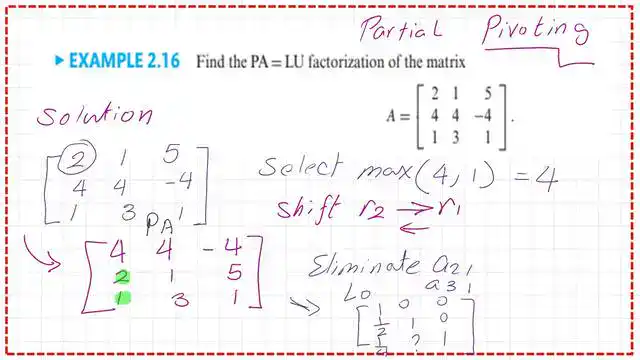
Next, we have example 2.16. For partial pivoting, we need to find the PA = LU factorization of the Matrix. This Matrix A is a three-by-three Matrix. We have three rows and three columns.
The elements of that Matrix are (2 1 5, 4 4 – 4,1 3 1).To apply partial pivoting, we check the maximum absolute Value in column 1 below the pivot (a21 and a31). We have 4 and 1.
Step 1: Swap the first Row with the Second Row.
The absolute maximum Value between 4 and 1 is 4. Then we decide to swap the Row that contains the maximum Value with the left-side element.
We swap from R2 to R1, and the first Row moves to the Second position.
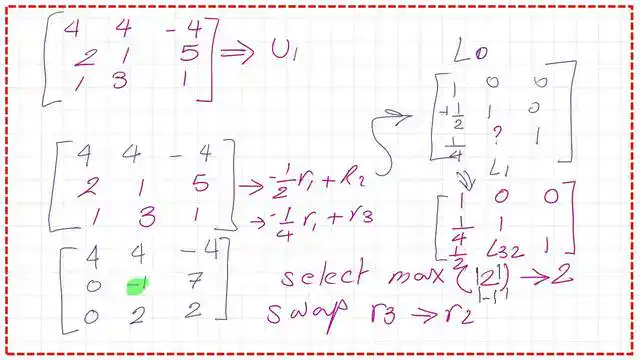
Our new Matrix in that regard is no longer A, but it will become, or we will write it as PA. It would be (4 4, -4; 2 1 5; 1 3 1). We could write the lower Matrix L0 by dividing 2 by 4. We can write 1/2 as L21. We divide 1/4 and set it as L31, and keep 1 on the diagonal, based on the Doolittle method, where L11, L22, L33 = 1.
Still, L32 has an unknown Value. But we have to be careful because we need to check whether another swap is needed; if so, we have to multiply again by a permutation Matrix. And this will affect the final lower Matrix elements. As we will see on the next slide, to convert (4 4 – 4; 2 1 5; 1 3 1) to an upper Matrix, we will use this new element 4 as a pivot.
We will multiply R1 by -2/4 and add it to R2; we place the Value in the new R2 position. Similarly, for R3, we multiply R1 by -1/4, add it to R3, and place it in the R3 position.
We will perform the operations to create an upper Matrix. The first Row is the same: 4, 4,-4.
For the Second Row, we have -1/2*4=-2; we add it to a21, and it becomes 0. -1/2 multiplied by 4 is 2; we add it to 1. -2+1=-1. 1/2 multiplied by -4 is +2; we add it to 5, and it becomes 7.
For the third Row, -1/4 times 4 is -1; we add it to 1, and we have 0. -1/4 times 4 is 1; we add it to +3, and we have +2. -1/4 times -4 is 1; added to 2, it becomes+2. We check the Second column; we find that the maximum absolute Value of (2 and -1) is 2. We need to swap the Second and third rows. Matrix 1 is shown in the following slide as (1 0 0, 1/4 1 0; 1/2 L32 1), after swapping the third Row with the Second Row.
Step 2: Swap the third Row with the Second Row.
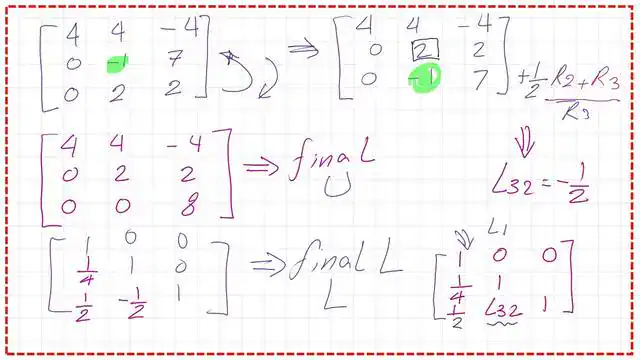
The following slide shows that we will swap the third Row with the Second Row and vice versa.
We will use 2 as the pivot for a22, multiply (+1/2) by 2, and add to R3. a32 will be a zero and for the a33, we will have (1/2*2+7)=8. The element L32 is -1/2.
Step 3: Write the elements of L and U Matrices.
We obtained the Final U Matrix: (4 4 -4; 0 2 2; 0 0 8). The final L Matrix is written as (1 0 0; 1/4 1 0; 1/2 -1/2 1). Please refer to the following slide for more details.
Check PA = LU Factorization: Solved Problem 2.16.
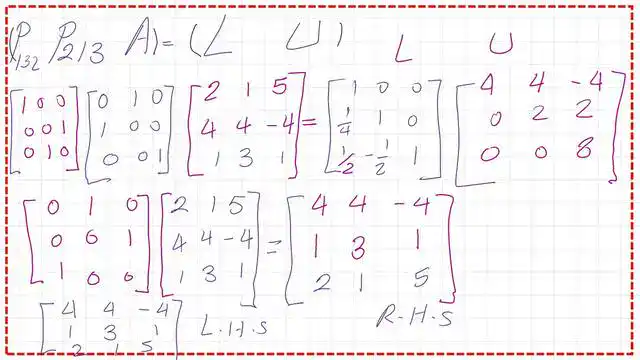
The following slide shows the process we used to obtain the L and U matrices. We started with Matrix A. We swapped the Second and First rows, so we multiplied A from the left by the P213 permutation Matrix. We swapped between rows two and three. We will multiply by the P132 permutation Matrix. Multiplying P132 by P213 produces the permutation Matrix.
MultiplyingP231 by Matrix A will provide elements (4 4, -4; 1 3 1; 2 1 5). Please refer to the slide image below.
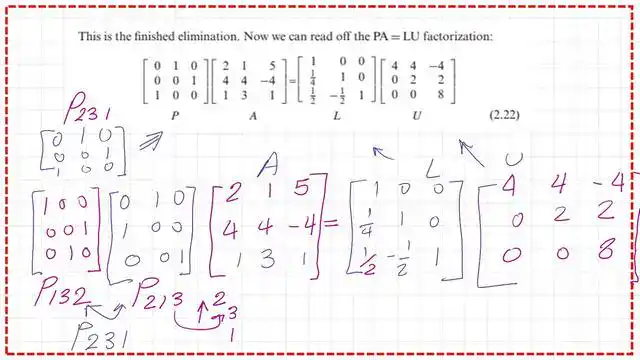
The following slide image shows the solution of PA = LU, which matches the author’s solution.
You can view and download the PDF for the solved Problem from this Link.
Link to the Previous Post: 16-Solving Systems with PA = LU Factorization
Link to the following Post:18-PA = LU Factorization: Solved Problem 2.17
This is the Omni calculator for estimating various linear algebra items: LU Decomposition Calculator.
Link to the Omni calculator: LU Decomposition Calculator.
Another calculator to use is the Calculator for matrices.