Last Updated on September 1, 2026 by Maged kamel
Mohr’s Circle of Inertia part-2.
Point of minimum value of inertia.
We will continue our discussion about Mohr’s circle of inertia in part 2. Part 1 illustrated how to draw Mohr’s circle of inertia and find the values of Imax, Imin, and Ixy. The next question is how we could see the principal axes directions?
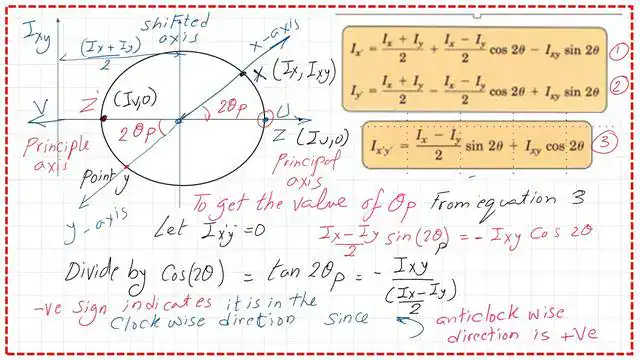
The point of the minimum value of inertia is point Z’, where the Ixy value equals zero. What about the direction of the V axis?
The direction is obtained from Mohr’s circle of inertia by an enclosed angle of (180-2θp) in the anticlockwise direction or (2θp )from the Y-axis in the clockwise direction.
In the Normal view, it has an angle of (90- θp) from the x-axis in the anticlockwise direction.

The expression of tan 2θp.
In Mohr’s Circle of Inertia part-2, the value 2θp can be estimated from the third equation by setting Ix’y’ to zero. This will give the tan (2θp) value equal to (-Ixy/(Ix-Iy/2)). The negative sign indicates that the angle is clockwise.
The expression of Imax using Mohr’s circle.
The value of Imax or Iu can be estimated as equal to the distance between Ixy and the center of the circle, which equals (Ix+Iy)/2 plus the radius value. By checking the tan 2θp expression, we can draw an angle and obtain the radius values for Ixy, Ix, and Iy.
Please refer to the next slide for the derivation of the radius R.

The expression of Imin using Mohr’s circle.
From the next slide in Mohr’s Circle of Inertia part-2, the value of Imin or Iv can be estimated as equal to the shift, which is (Ix+Iy)/2 minus the radius value.
Checking the tan 2θp expression, we can draw an angle, get the radius value of Ixy, Ix, and Iy, and deduct the value of (Ix+Iy)/2.

The expression of the pole point.
The pole point in Mohr’s circle of inertia is the point from which you can get direction, and the circle’s center is the pole point when you are dealing with central angles not in the normal view. When we join point X, it will give the X-axis.
When joining with point Y, you can get the Y direction. Similarly, a line from the circle’s center to point Z will give the principal maximum or U direction.

The pole point in Mohr’s circle for the normal view.
From the last slide, we can get the pole of the standard view as point Z’ joining the mirror point of x, which will give the U direction in the normal view, and joining the mirror of point y will give the V direction.
The U direction makes θp from the x-axis measured clockwise. For the V direction, it makes an angle of (90-θp) from the same axis but in an anti-clockwise direction. This maintains a 90-degree angle between the U and V axes which is opposite to the view of 180 degrees from the center of the circle.

Thanks a lot, and peace be upon you all.
You can view or download the PDF data for this post and the previous one. In the prior post, the slides cover the subject from 1-7. For this post, the slides start at number 8 and continue to the end.
A video covers the topic of the previous post and this Post.
The following post is Easy Approach to Mohr’s Circle of inertia-First Case.
This link to a useful external resource: a calculator for Cross-Section, Mass, Axial and polar area moment of Inertia, and Section Modulus.