
Last Updated on September 6, 2026 by Maged kamel
What is Economic Equivalence?
Solved problem 1-2: how to get the past value of invested Money for a given interest rate, given time?
The example is from Leland Blank and Anthony Tarquin’s handbook, The Basics of Engineering Economy.
Example 1.2 a) Calculate the amount deposited 1 year ago to have $1000 now at an interest rate of 5% per year.
B) Calculate the amount of interest earned during this period. We have an Investor who deposited 1 year ago at an interest rate of 5% and has now received $1,000.
This is the case of an investment: someone has deposited Money at 5%.

The original amount of Money is unknown. Provided the Investor has received $1,000 now, the formula states that the interest is the amount received now minus the original deposit.
The interest rate that is given as 5%, can be written as I%=(Money amount now – original deposit)/ original deposit,
The original deposit can be rewritten as Money received now/(1 + I%). Original*(1+0.05)= Money received now.
The required amount of the original deposit=1000/1.05=$952.38. This is part of the solution to the problem. Please refer to the next slide image.
This is part b, where the amount of interest can be estimated as interest value=Final amount- initial amount=1000-952.38=$47.62. This is the formula used to calculate the interest rate.


The following slide shows the formula for the interest value.

The second solved problem: 1.4
Another example: 1.4, A Stereophonic Incorporation Plans to borrow $20,000 from a bank for 1 year at 9% interest for new recording equipment.
a- It is required to estimate the interest and the total amount due after one year.
b- Construct a column graph starting with $20000 as the original amount borrowed.
The solution: The given interest rate is 9%, and the Incorporation should repay $20,000 + 9% per year on the original amount. The interest amount is 0.09 × 20,00000 = $1,800, to be added to the original amount. The total due is $20,000 + $1,800 = $21,800.

In the graph, he compares the two graphs, which are drawn on two axes: the horizontal axis X represents the time elapsed, and the vertical axis y represents the amounts in dollars. The first graph has a height of $20000, while the second graph has a height of $21800 ($2000 + $1800).
Economic Equivalence.
There is another subject: engineering Equivalence. The equivalent in other subjects is used to convert between units and measures; for instance, 1 km = 1000 m and 1 pound = 0.4536 kg. As for economic Equivalence, it indicates a different amount of money at a different point in time.

The monetary value is considered equal to its time value. Considering the time value of Money, the following simple example illustrates the concept of Equivalence. The value now = the future value after considering a specific rate, and again, is = the past value after deducting the interest rate.
Let us have a look at an example: what is the equivalent amount of $100 one year before and one year after? Future value of money =money value now*(1+interest rate%)=100*(1+0.06)=$106.
The amount from one year earlier is related to the amount now by the formula: Money one year earlier * (1 + interest rate) = Money now.
Money one-year before=money now/(1+interest rate%)=100/(1+0.06)=$ 94.34.
Both values, whether $100 or $94.43, are equivalent provided that the same interest rate is used, 6% in this example.
$100 of interest=6% one year from now will be equivalent to =100*(1+0.06)=$106.
The same $100, with interest at 6% for one year, will be equivalent to $94.34, $100/(1.06).

The next figures show the Equivalence values of the three amounts at a given interest rate; the x-axis represents the time interval, and a histogram of the time value is also shown. The value for one year at 6% is $94.36, as shown in the first histogram. The second histogram shows the current Money value, which is $100.
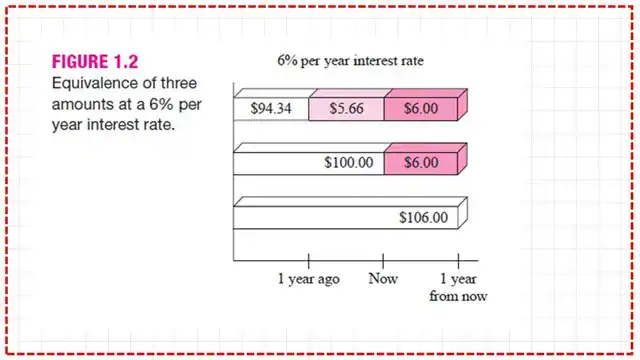
For one year from now, add $6.00; this is shown in the third histogram.
The economic Equivalence assumes that $100 now = $106 one year from now = $94.34 one year before.
The PDF used to illustrate this post can be downloaded from the following document.
The next post is A Solved Problem for Economic Equivalence.
Engineering Economy: Applying Theory to Practice is a good reference.