
Last Updated on September 6, 2026 by Maged kamel
What is Capital Recovery in the Economy?
The new Item is Capital recovery, or CR. According to Investopedia, Capital recovery, or CR, is a term with several related meanings in the world of business. It is primarily the recovery of the initial funds invested in an investment. When an investment is first made in an asset or a company, the Investor initially sees a negative Return, until the initial investment is recouped.
The Return of that initial investment is known as capital recovery. Capital recovery must oc ur before a company can earn a profit on its investment.
These are the objectives of this lecture, but in this post, we will discuss Capital Recovery.
Capital recovery is the equivalent annual Cost obtained by adding the asset’s value and the salvage value, and then converting it to the Purchase price. The Capital is divided into two parts: the purchase price (or initial investment), P, and the salvage price. The salvage price is the equipment’s selling price at the end of its life.
There are three values of great concern for capital recovery: purchase price, earnings, and Salvage. These values areconvertedd to annual worth. As we remember, these annual values are equally spaced in Time. I quote: Aw is comprised of two components. The capital recovery for the initial investment P at a stated interest rate (MARR) and the equivalent annual amount A.

We have P as the initial investment on the next slide; the total first Cost of all assets and services. They are required to initiate the alternative. The salvage value (SV) is the terminal estimated value of Assets at the end of their useful lives.
Term A is the Annual amount, the equivalent annual amount; typically, this is the annual operating Cost (AOC). We will discuss these terms in the coming solved problem, God willing.
First, the initial investment is considered, followed by the operating costs as an Annual amount, and then the alternatives are compared. Compare the purchase price and maintenance Cost, and then evaluate the Capital recovery.
The maintenance Cost is either greater than or less than the profit he can achieve from the given option. There is a stated MARR that the company defines. These are the objectives of this lecture, but in this post, we will discuss Capital Recovery.

The General equation to estimate Capital recovery.
To convert into annual values. We have two values: the general monetary transaction associated with the purchase and eventual retirement of a Capital asset is its initial Cost (C), and its salvage value (S) reflects these sums.
The Capital recovery CR(i) at the stated interest rate, as MARR or as given in the example, is equal to an investment I(A/P, I, N), which is then converted into an annual value by the relation A/P. Where Capital I is the investment value, while i is the stated interest rate, and N is the number of years, which is the lifetime minus the salvage S, the price at the end, or the future worth, to be returned as A multiplied by the (A/F) factor, I, N.

This is the other alternative equation for CR(i).In the next slide, as we can see, we have an investment I as cash out, and while there is a cash-in at the end, S. This cash in and out can be converted into CR(I), the capital recovery with an equal amount and equal periods, same as annual worth. The A is considered a negative value.

A solved problem for capital recovery.
We have solved the problem. Consider a machine that costs$20,000 and has a five-year useful life. At the end of the five years, it can be sold for $4000—the annual operating and maintenance costs are $500. The firm can earn an after-tax $ 5,000 per year with this machine.
In the cash flow diagram, we draw an annual worth as upward arrows, representing cash inflows from t=1 to t=5. Should it be purchased at an interest rate of 10%? All benefits and costs associated with the machine are accounted for in these figures. We need to estimate Capital recovery using the equation CR = I(A/P, i, N) – S(A/F, i, N). The interest rate is 10%, nd N, the number of years, is 5

We can use the tables for i%=10% and N=5 years.
We get the value of A/ to be to be 0.2638. We get the value of AA/F = 0.1638. The purchase price of 220,000 multiplied by 0.2638 will yield a downward A value. We need to estimate the Capital recovery using the equation CR(i) = (A/P, i, N) – S(A/F, i, N).
The interest rate is 10%, and the N value is 5 years. We get the value of A/P tobe 0.2638. We get the value of AA/F = 0.1638. The purchase price of 20,000, multiplied by 0.1638, will produce a downward A value. We can use the tables for %=10% and N=5 years.

The $ 4,000 salvage value is multiplied by 0.1638 and treated as an upward adjustment. We make a sum of m-576+ 655.2. We get A1 + A2 = -4620.8, and we include $500 as an operation pointing downward. So we get =-4620+(-500)= 5120.8.

This is the alternative equation, which we can use to get The Value of CR(I). This equation will produce the final value of Cr the same value as estimated by letting CR(I)=I(A/p, I, N)-S(A/F, I, N)
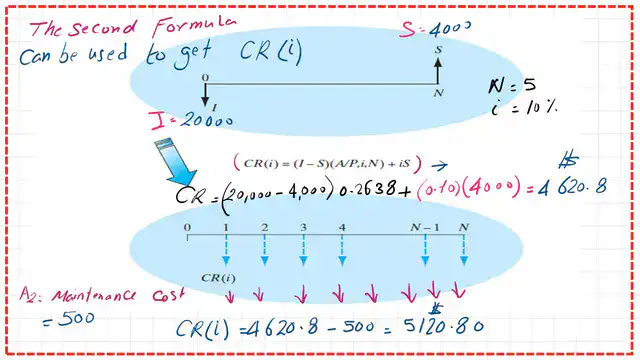
From revenue, we have 5,000 in income. So finally, there is a loss of -120.80, due to income of 5,000 and a maintenance Cost of -5,120.80. The net value is -5120.80 5000. This value is the difference between the revenue and The Cost of Capital. Then, the offer should be rejected. This is the final solution done on one page, using the CR (Capital recovery) formula.

The PDF for this post can be viewed or downloaded from the following button.
In the next post, we will review the different terms EAB, EAC, and EAW. There is a solved example that demonstrates the practical use of EAC to determine whether an investment is profitable.
For a useful external resource, Engineering Economy is a good reference.