
Last Updated on September 13, 2026 by Maged kamel
Practice problem 5-2-3-verify Zx for W18x50
A video that illustrates the content of this post is included.
Timestamps for video:
- 00:00 Introduction to practice problem 5-2-3. Verify Zx of a given W18x50
- 00:30 Represent the W section as two WT sections of WT9x25.
- 01:15 Find the Y-bar for WT9x25 from part 2 of Table 1-8.
- 01:51 Determine the distance between Compression and tension forces.
- 02:03 Find the value of Zx for WT
- 02:33 The value of Zx from Table 1-1
- 02:54 Using calculations to verify the Zx value.
Practice Problem 5-2-3: Verify Zx for W18x50.
Verify the value of Zx for the W18x50 section, which is tabulated in the dimensions and properties Tables in Part 1 of the manual. We will consider two ways to estimate the Zx of W18x50.
The first method considers the W section as composed of two Wt sections. Each Wt section is WT 9×25.
The second method considers the W section as an assembly of three plates and finds Yct and Ates.
We can represent the W18x50 as two Wt sections assembled.
As seen in the sketch, each Wt is 9×25. Table 1-8 of the manual has two parts. Part 1 gives us the dimensions of the Wt section. The breadth and thickness of the Flange, as well as the overall height and thickness of the stem, are important.
From Part 1, I need the Area for Wt 9×25, which is 7.34 in², and the depth of the Wt section, which is 9 inches.
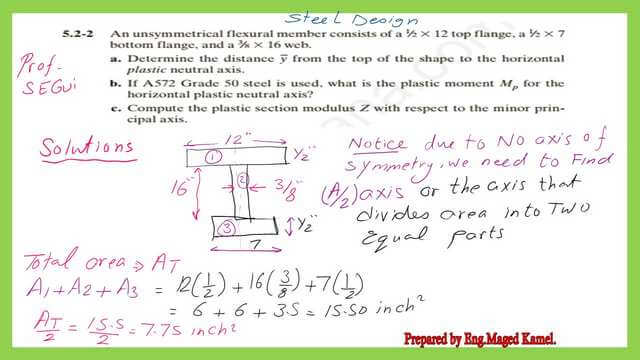
The distance y-bar from the top of the WT9x25.
In the next slide, I need part 2 of Table 1-8 for the value of y-bar, which is the distance from the top of the Flange to the section’s cg. The value is 2.12 inches.
I drew the W section on the third slide, assembled from the two WT sections. In this section, we can find the value of YCt, or the distance between the compression and tension forces, and each force acts on the CG.
The Yct value equals ( d-2y bar), where d is the overall depth of the W18x50 section, and a and b are what we got from the previous slide. Then, the distance YCT value is equal to 18-2*2.12=13.76 inches. The Area of At/2 equals 7.34 inches2, which we obtained from Table 1-8. We apply the equation Zx = At/2*(yct) = 7.34*13.76 = 101.0 in^3.
The next slide shows two parts of Table 1- 1; the first part gives the dimensions of the W section. The Flange’s breadth is 7.50″, and the overall depth is 18 inches. The Area is 14.70 inch2.
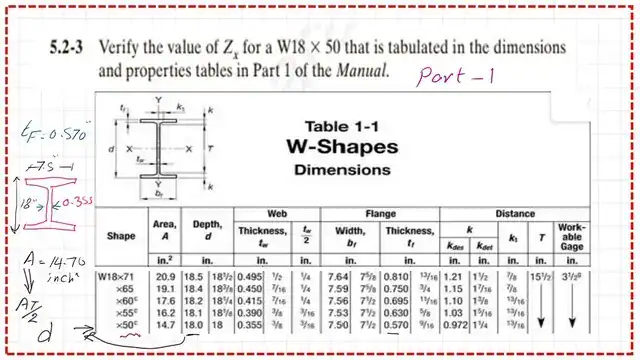
Find the Zx for W18x50 from Table 1-1.
In the next slide, we show the second part, which gives Zx = 101.0 in^3. This matches the value estimated from Table 1-8. It matches our previous calculations as a two-weight section. The validation is okay.
Verify Zx of W18x50 by considering the Flange and web areas.
If we consider the W section composed of areas, the first is the Flange, which is 7.50″ by 0.57″.The second is the web, with a height of (18-2*0.57)= 16.86 inches. The last is the lower Flange Area, which is 7.50″ x 0.57″.
The total Area is At = At n². Consider the plastic section modulus Mp/Fy, which can be rewritten as C*yct/Fy = At/2*yct.
The Area(At/2)=0.5*14.70=7.35 inch2. Use the sum of areas*y distance and divide by At/2 to get the H-y bar distance.
The next slide shows the h-ybar value (the distance from the point of application of At/2 to the top of the Plastic neutral axis), equal to 6.8622 inches, and the Zx value of 99.742 inches, less than 101.0 in^3.
This is the PDF file for the content of the post.
The previous post is “6A-Practice problem 5-2-2 Find y bar, Zx, and Zy for the unsymmetric section.
Here is the Link to Chapter 8, “Bending Members.” A Beginner’s Guide to the Steel Construction Manual, 14th ed.
Here is the Link to Chapter 8, “Bending Members.” A Beginner’s Guide to the Steel Construction Manual, 15th ed.
Here is the Link to Chapter 8, “Bending Members.” A Beginner’s Guide to the Steel Construction Manual, 16th ed.
The following post is “6c-Practice problem 6-17-5-find Sx and ZX for W18x35.