Last Updated on October 21, 2026 by Maged kamel
How do you derive expressions for the L and U values for a 3×3 Matrix?
I have created a video to illustrate the content of this Post.
The video timestamps are shown below.
- 00:00 Introduction and a summary of the content of the video.
- 02:05 What are the expressions for the L and U matrices for the elements?
- 03:28 Consider Matrix A as a Product of L and U matrices.
- 06:21 Find the Value of u11, u12, U13 and L21 and L31.
- 07:55 Find the expressions for the values of U22 and u23.
- 09:30 Find the Expression for L32. 10:59 Find the Expression for u33.
- 11:20 The details for the Expression for the Lower Matrix.
- 11:55 The details for the Expression for Matrix U1. 13:31 The matrices L1 ands U1 side by side.
This explains the terms for both the upper and lower L-U values in Doolittle’s method for the 3×3 Matrix.

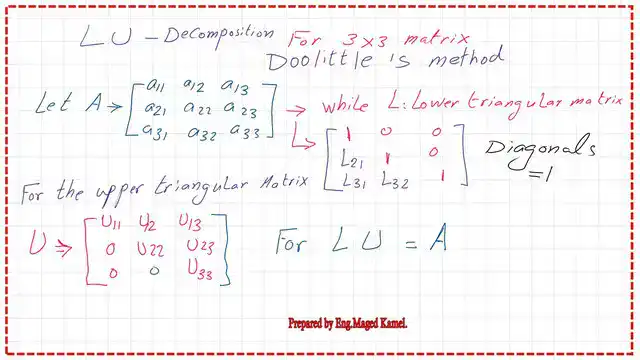
For the 3×3 Matrix, A is represented by (aij), where i is the Row number, and j is the column number.
The Matrix A (3×3) can be represented as the Product of the Lower triangular Matrix L (3×3) and the upper triangular Matrix U (3×3).
For the terms of the L Matrix, we also use the notation a _ {ij}. For the L Matrix, the diagonal entries are 1, and the off-diagonal entries are a11 = a22 = a33 = 1.
For a12, the element in the first Row and second column, a12 = 0. Below the diagonal, all remaining elements are nonzeros.
In contrast, the upper triangular Matrix has U11, U12, and U13, and all diagonal elements are nonzero, while all elements below the diagonal (U21, U31, and U32) are zero.
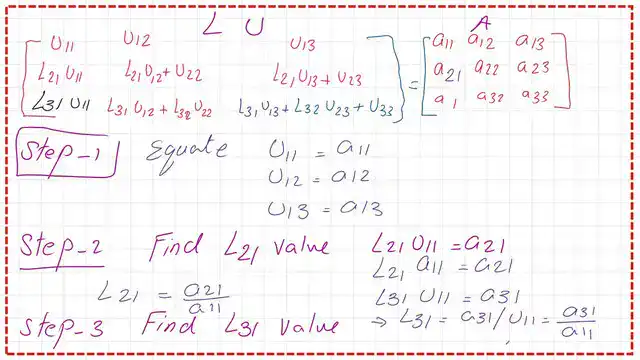
Step 1: Equate the Product of the L and U values for a 3×3 Matrix with the Value of Matrix A.
Since Matrix A is the Product of LU matrices, we can equate the values of the elements of A with the Product of LU for the corresponding items.
A 3×3 Matrix represents the Product L*U, as shown in the next slide image. The first Row contains (U11, U12, and U13), which equals the first Row of Matrix A; therefore, we can proceed to the next step.
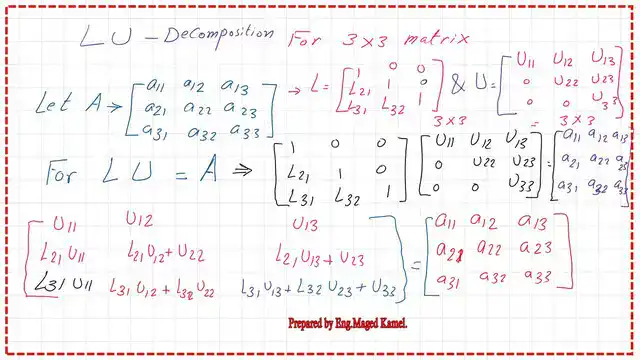
Step 2: Find the expressions for the L and U elements for a 3 x 3 Matrix.
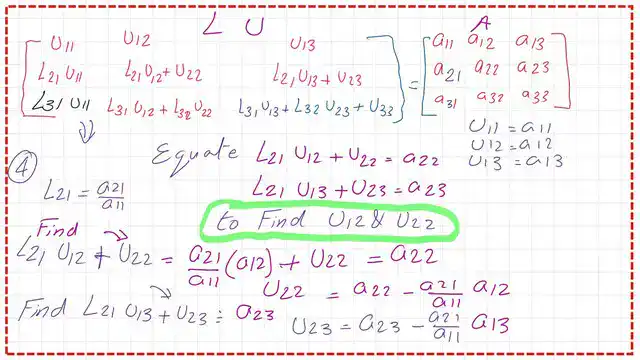
1-Equate the first element of (L*U) decomposition to the first element a11 of the Matrix A as follows: U11=a11. Similarly, we can equate the second and the third elements to the corresponding elements of Matrix A.
So, U12 = a12 and U13=a13.
2-We will move to the second Row of the L*U Matrix to get the Expression for L-U values.
3- We equate L21*U11 to a21, also, L21*U12+U22 to a22, and L21*U13+U23 to a23, we will use the derived values for U11 as a11, U12 as a12 from which we have estimated from step 1.
4- We can get the values of L21 and L32.
We set L21*U12 + U22 equal to a22; we substitute u12 = a12 and L21 = a21/a11.
5- We can get U22, and U23 as shown in the next slide image.
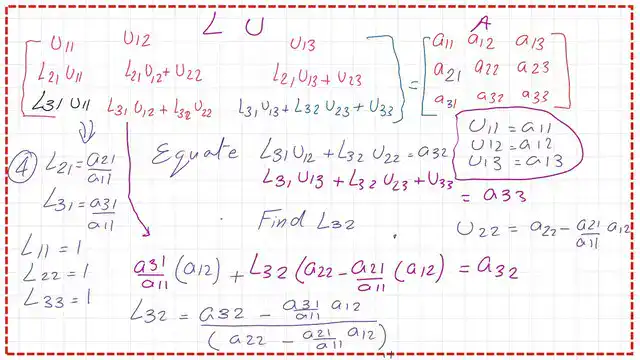
The following slide shows the Value of L32 in more detail.
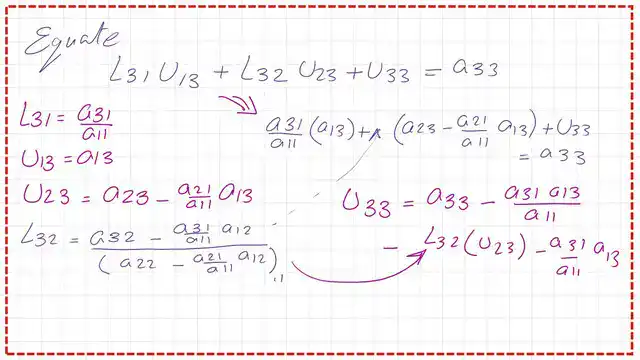
To find U33, we set L31*U13 + L32*U23 + U33 equal to a33 and use the estimated values to obtain an Expression for U33. Please refer to the slide image below.
The following slide shows the components of the lower Matrix L that we need to create the U1 Matrix to compute L32.
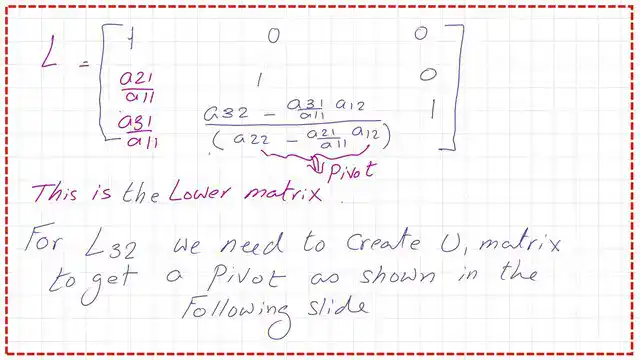
To create the U1 Matrix, we multiply the second Row of Matrix A by -a21/a11*R1 and add it to the second Row. We multiply the third Row of Matrix A by -a31/a11*R1 and add it to the third Row. In that Matrix, U21 = U31 = 0.
The element u22 = a22- (a21/a11)* a12; this is the pivot element we need to find L32.
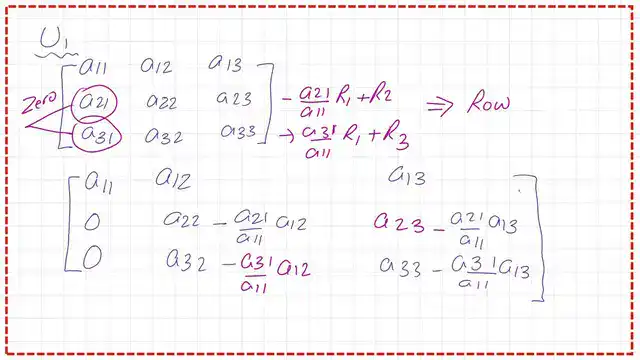
The next slide image shows how to get the Value of L32. It is equal to ((a32-(a31/a11)*a12/a22-a21*(a12/a11). We take U21 as a pivot.

The following slide shows how to obtain U33.
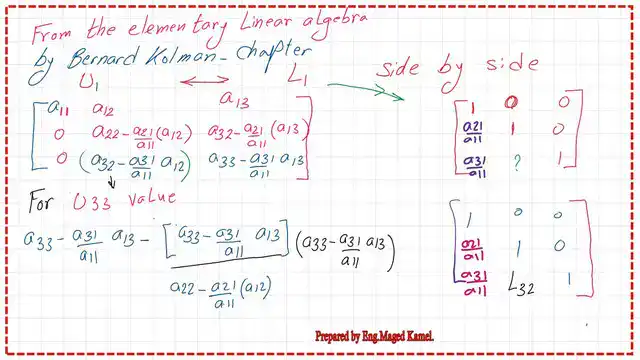
Thus, we have completed the method for deriving the L-U expression for a 3×3 Matrix.
In the next Post, we will use a solved Problem to apply this method and discuss whether all matrices have an LU decomposition. You can download the PDF file for this Post.
This is a direct Link to the next Post: the First solved Problem, LU decomposition for the 3×3 Matrix.
HELM-Helping Engineers Learn Mathematics.
This is the Omni calculator for estimating various linear algebra items: LU Decomposition Calculator.
This is a Link to another calculator for matrices.