
Last Updated on October 5, 2026 by Maged kamel
The First Moment of Area and Product of Inertia at the CG.
The Expression of the First Moment of Area at the CG.
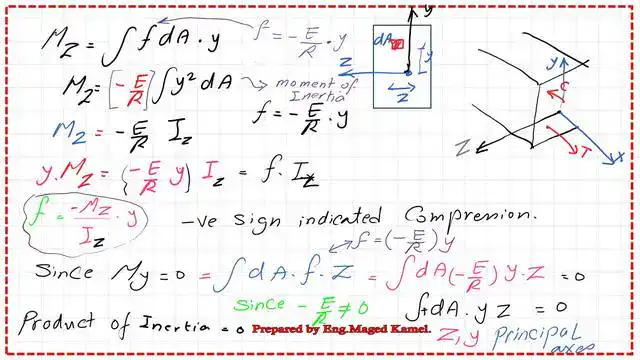
We will now discuss the first Moment of Area and pure bending. This is an isometric Beam, though.
The Z-axis faces the reader, the Y-axis is perpendicular to the X-axis, and the X-axis is longitudinal. In pure bending, as shown by the red arrow spinning about Z, we depict it in isometric form. For directions, please visit the previous Post.
Thus, we’ll refer to it as MZ and circle Z. The transverse section shows the Z-axis oriented to the left and the Y-axis oriented vertically.

Neither compression nor tension is present because we are only experiencing pure bending.
Since there are no tension or compression forces across the section, the total force for the strip dA, where the stress equals (-y*E/R), is zero. We will next perform the integration.
Since this stress = (-y*E/R) = 0, we set it to 0 for the entire segment. Furthermore, E/R cannot equal zero because it has a Value.
The (-) sign on y indicates that when y has a positive Value, we have compression from the neutral axis to the uppermost part of the section; for the lower part, it will become positive when we multiply the strain by Young’s Modulus for elasticity, E, and we will get a positive stress Value (+).
We will examine a small strip dA at distance y from the Z-axis using the Expression we obtained: strain is (-y/R) at that distance.
Thus, ∫y*dA is the only term that would be zero, and the first Moment of Area, which is well known, is zero for any section passing through the C.G.
The Expression of the Product of Inertia at the Cg.
From that relationship, the z-axis passes through the centroid. We have a Moment, and the Moment about Z is given by _ f* dA * y.
We have the strip; dA is separated by y, and (f*dA) is the force (F*y), which gives the Moment we integrate around Z.
We know that stress equals (-y*E/R), so we replace f in the Mz equation with ∫f*dA*y, leaving ∫(-E/R) ∫(Y^2*dA).
We are familiar with the Expression ∫ dA*y^2, which is the Moment of Inertia, but this Time, it is a Moment of Inertia around Z. We can write Mz. =-(E/R)*Iz. Again, the (-) sign indicates this in the upper portion of the y; it is compression, and since (f =- E/R*y), we will multiply the left side by y.
.
On the right-hand side, multiply by y; looking at this (f =- E*y/R/R), we considerf =- E*y/R*y/R). We have (y*Mz) = f*Iz.
We get a new Expression for the stress due to pure bending: f = (M*y)/Iz; Mz*y/Iz again, and the negative sign indicates compression above the neutral axis.
The stress becomes tension, and since we don’t have a bending Moment around y, we can write ∫dAfz=0, which is the Product of the Inertia Expression.
How can local and global axes be expressed using SAP 2000? The following slide image shows axis 1-1 as the global X-axis for a horizontal member, while axis 2-2 is the minor axis of the cross-section and represents the Z-axis. The major axis 3-3 for the cross-section represents the Y-axis.
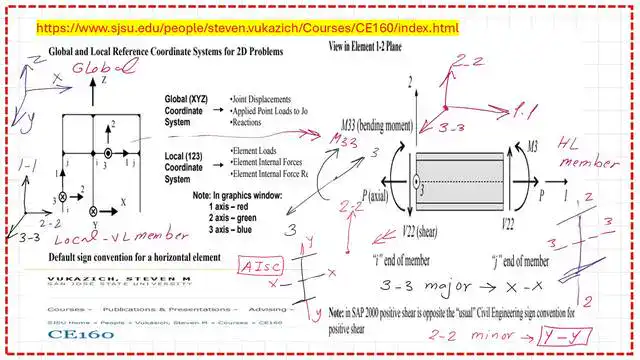
The following slide shows how to express local and global axes for vertical elements in SAP 2000.

Please find the Link to the CE 160 files, which provide more detail on SAP 2000.
You can view or download the PDF data for this Post by clicking the following button.
This is the Link for an external resource. Bending Equation Derivation
This is the Link to the next Post: Estimation of Maximum and Minimum Moments of Inertia for a section.
This is the Link to a video illustrating the content of this Post.