
Last Updated on February 18, 2026 by Maged kamel
- Steel beams and types of buckling.
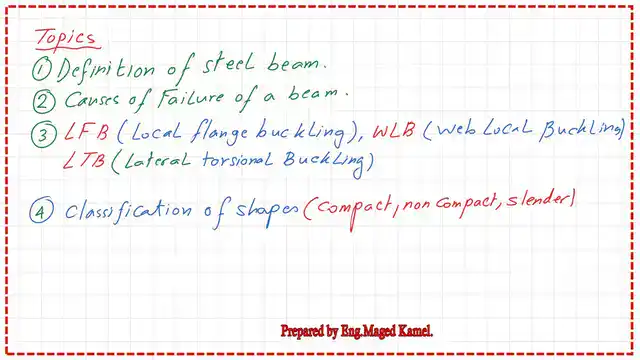
- What are the beams?
- Types of failures for a beam under a flexural moment.
- What is the difference between general buckling and local buckling?
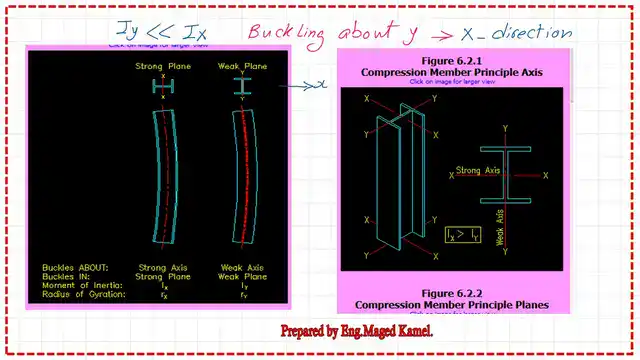
- What is the difference between the major axis and the minor axis?
- What is LFB, local flange buckling for beams?
- What is WLB (web local buckling) for beams?
- What is LTB, lateral-torsional buckling for beams?
Steel beams and types of buckling.
The topics included in the post.
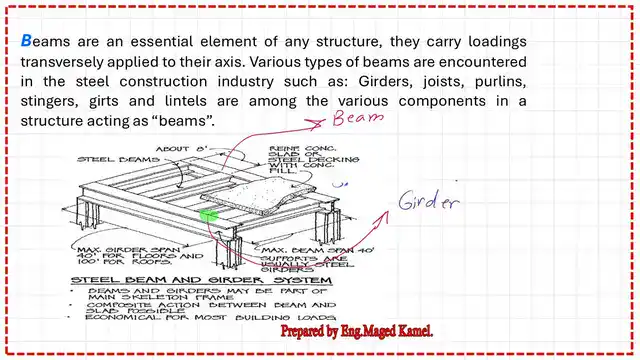
What are the beams?
Beams and girders may be part of the main Skeleton frames. Composite action between beams and slabs, slabs
Transfer loads to the beams, then the beams transfer the load to the girders.
Girders are the main beams supported by Columns. The secondary beams are called joists.
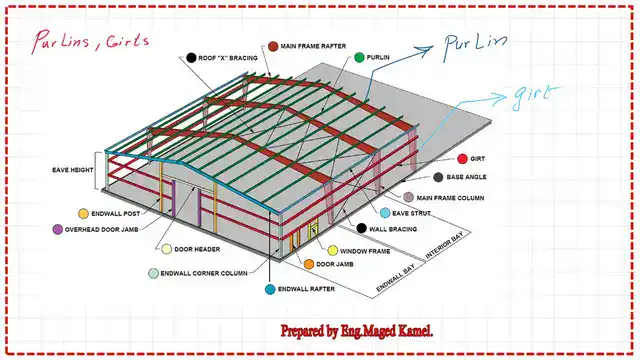
What are purlins and girts?
There is another sketch: a series of frames and purlins, which are small C-channels connecting the frames.
Each frame has a sloped portion, and the eave height is the lowest level of the frame. Purlins are a type of beam that carries roof loads to the steel frames.
Girts are horizontal beams that carry loads from the block to the external sides of the steel frame, which then transfer them to the frame columns, as shown on the next slide.
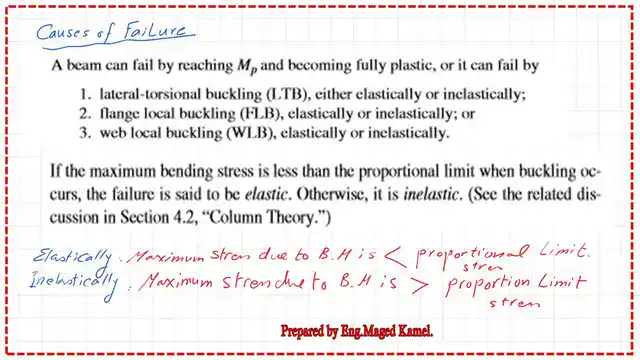
Types of failures for a beam under a flexural moment.
The next point will be the causes of beam failures. lateral-torsional buckling LTB either elastically or inelastically. A beam can fail by reaching the plastic hinge limit state (Mp).
The failure can be one of the three types of buckling as shown in the next slide.
1-( LTB) is the first reason for failure.
2- the flange local buckling (FLB). Elastically or inelastically.
3-The web local buckling (WLB), elastically, or inelastically.
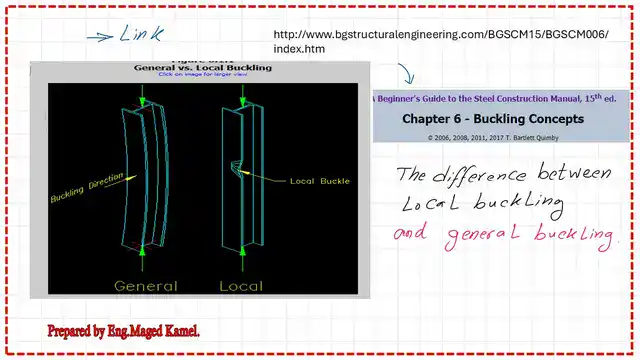
What is the difference between general buckling and local buckling?
A review of the buckling concept to understand the difference between local and general buckling. The data is quoted from the following link.
What is the difference between the major axis and the minor axis?
The major axis is the axis with the higher moment of inertia; for instance, in the I-beam shown, Ix> Iy, so the x-axis is the major axis. To get the buckling shape, consider that buckling about the minor axis is in the direction of the opposite axis, which means that in this case, the buckling is in the x-direction.
What is LFB, local flange buckling for beams?
Let us check the moment of inertia about the y-axis, which is (hw*tw^3/12), and the inertia in the direction of x, which is tf*hw^2/12. To imagine the buckling direction about y.
Imagine a shift in the y-axis in the x-direction. The coefficient is called λweb = h/tw, where h is the height h_web/t_web. hw=total depth d-2*kdes, or as the distance between the two rounded portions at the top and bottom flanges.
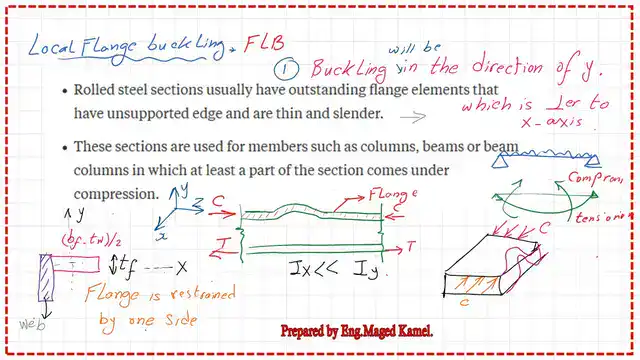
LFB, Local flange buckling in steel beams occurs when a flange has a thin unsupported edge and experiences compression stresses from bending; buckling can occur in some locations, which is why it is called local buckling.
If we have a beam with an I-beam section, the flange of the section, if we draw it like this, consists of several plates.
The plate is subjected to a compressive force due to the bending moment, causing the upper flange to be in compression while the lower flange is in tension.
This compression force acts on the upper flange above the neutral axis, causing lateral buckling as if the flange acts as a column.
The flange is partially fixed by the web and spans more than half its width. We might ask, is the inertia in the x-direction or the Y-direction? If we consider x as the horizontal axis, for the whole width of the flange, Ix =Bf*Tf^3/12, while Iy=tf *bf^3/12, the lowest value will be Ix.
Buckling will occur perpendicular to the x-axis, will be in the Y direction, and then localised buckling in
the flange will occur, as shown as a curved portion; this curvature is called local flange buckling. A new factor will arise: λf = Bf / 2tf, for a cantilever portion with thickness tf.
What is WLB (web local buckling) for beams?
WLB, consider the web of the I-section. Web local buckling, denoted WLB, occurs between the two flanges subjected to a bending moment, causing a compressive force above the neutral axis.
The web is partially restrained at the top by the flange and at the other edge by the tension in the web; as a result, the buckled shape will take the form of a curve around the vertical y-axis.
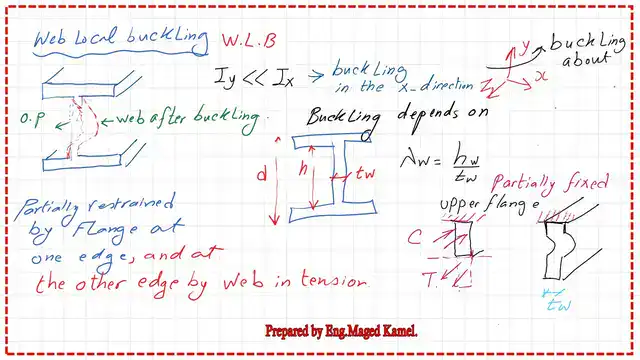
A new factor will arise, which is lambda λw=hw/tw, where hw is the web height,t and tw is the web thickness, and can be shown as follows:
What is LTB, lateral-torsional buckling for beams?
LTB (lateral torsional buckling) in steel beams occurs due to compression stresses at the connection of the upper flange, causing lateral buckling that is resisted at the other edge, which is restrained by the web in tension.
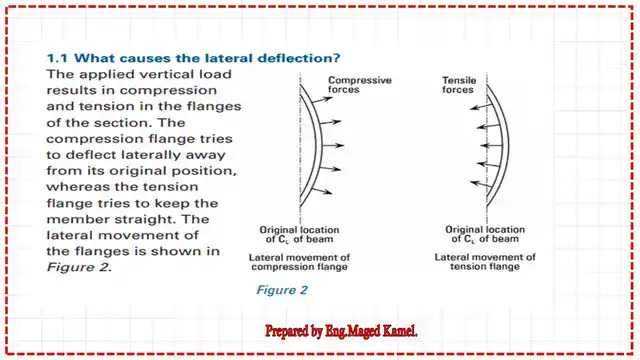
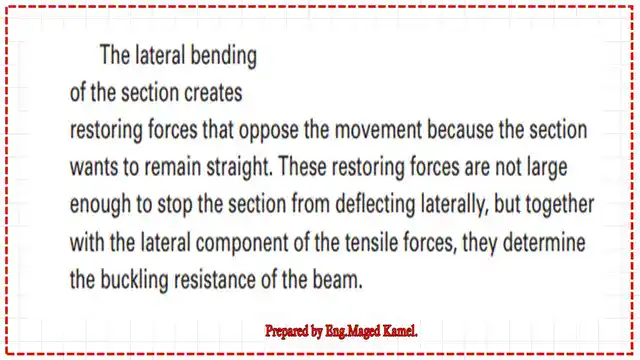
Here is further discussion of the section’s lateral bending.
Due to no bracing in the length, the lower chord resists the buckling, since it is under tension, while the upper chord has compression. Accordingly, the compression force causes bulging.
While the tension force causes attraction to the inner side, during collapse, the upper portion of the flange moves outward, and the lower portion moves slightly outward, as if you were applying torsion to the section.
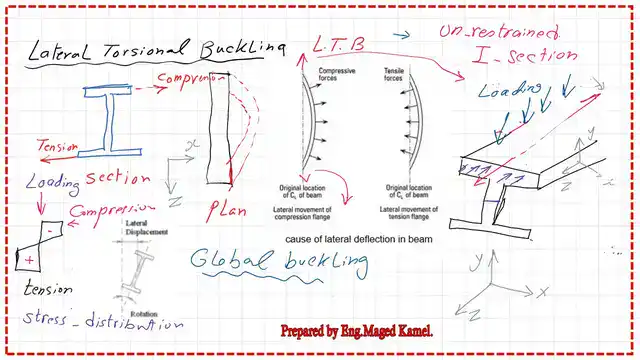
Then, the steel section is displaced and rotated by an angle; that is why it is called lateral-torsional buckling. Why did it happen laterally? The next slide shows and explains more data regarding LTB.
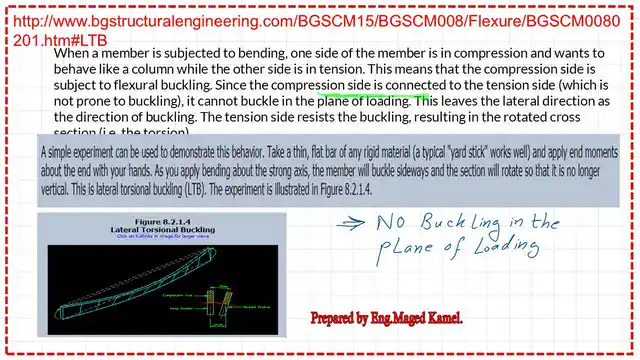
The PDF file for this post can be viewed or downloaded from the following link.
Here is a link to the next post, post 2: “Easy Approach to Compact and Non-compact Sections for Steel Beams.”
Here is the link to Chapter 8, “Bending Members.” A Beginner’s Guide to the Steel Construction Manual, 14th ed.
Here is the link to Chapter 8, “Bending Members.” A Beginner’s Guide to the Steel Construction Manual, 15th ed.
Here is the link to Chapter 8, “Bending Members.” A Beginner’s Guide to the Steel Construction Manual, 16th ed.
This links to the next post, 10-lateral-torsional buckling for steel beams.