
Last Updated on September 4, 2026 by Maged kamel
- Practice problems for Gauss-Jordan elimination.
- Practice problems for Gauss-Jordan elimination- first practice problem.
- Practice problems: Gauss-Jordan row reduction: use a11 as a pivot to eliminate a21 and a31.
- Use a22 as a pivot to eliminate a32.
- Use a33 as a pivot to eliminate a23& a13.
- Use a22 as a pivot to eliminate a12.
- Practice problems for Gauss-Jordan elimination- second practice problem.
- Use a22 as a pivot to eliminate a32.
- Use a33 as a pivot to eliminate a23& a13.
- Use a22 as a pivot to eliminate a12.
Practice problems for Gauss-Jordan elimination.
Practice problems for Gauss-Jordan elimination- first practice problem.
We will introduce a practice problem for Gauss-Jordan elimination, or the reduced echelon form. Practice problem number #33 is from Stewart’s book, College Algebra.
For the first practice problem #33 for Gauss-Jordan elimination. Solve the following systems of linear equations. We have three simultaneous equations: x+2y-x + 2y- z = -2, x + z = 0,2x- y- z = -3.
Practice problems: Gauss-Jordan row reduction: use a11 as a pivot to eliminate a21 and a31.
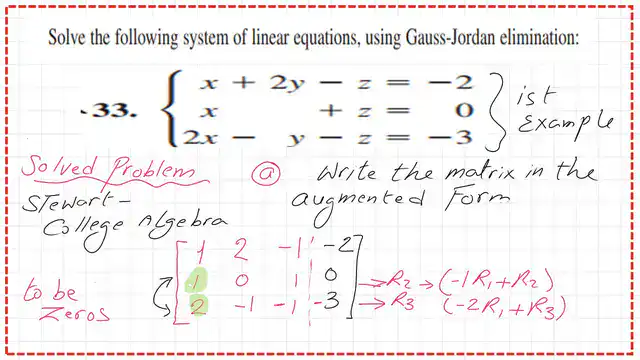
We will write these equations in augmented form for the given system of linear equations.
We will introduce a vertical line between the third and fourth columns to show the augmented matrix. The next step is to set a21, or the second row/first column, to zero.
Make sure that the element a11 is equal to 1, then add (-a21/a11)*R1 to row 2 to get the zero value. In this process, we consider a11 as the pivot element. In our practice problem #1, we will multiply R1 by (-1) and add the result to the second row.
Similarly, let a31, or the third row/first column element, equal zero. Add (-a31/a11)*R1 to row 3 to get the zero value. Again, in this process, we consider a11 as the pivot element. We will multiply R1 by (-2) and add the result to the third row. Please refer to the following slide image for more details.
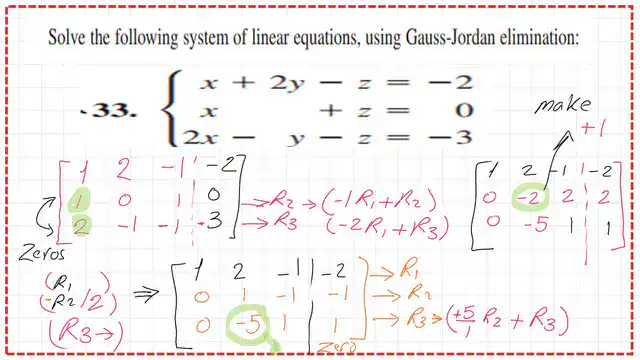
Carry on the row operations. Make sure that element a22 is equal to 1, and this is done by multiplying row 2 by (-1/2).
Use a22 as a pivot to eliminate a32.
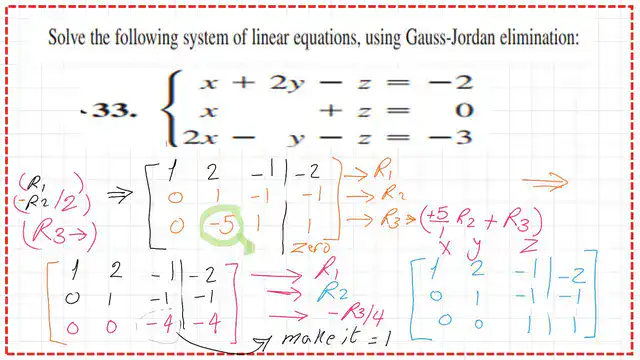
Use a22 as a pivot by adding R3 to -(a23/a21)*R2. Perform the row operations to obtain the reduced echelon form, or simply an upper triangular matrix with three ones on the diagonal.
We will multiply R2 by (+5) and add the result to the third row. Please refer to the following slide image for more details.
Refer to the slide image to see the necessary row operations for Gauss elimination in reduced row echelon form. We divide the third row by -4, obtaining an upper triangular matrix with matrix-ith diagonal elements equal to 1.
Use a33 as a pivot to eliminate a23& a13.
We will multiply R3 by (1) and add the result to the first row. We will multiply R3 by (1) and add the result to the second row. Please refer to the following slide image for more details.
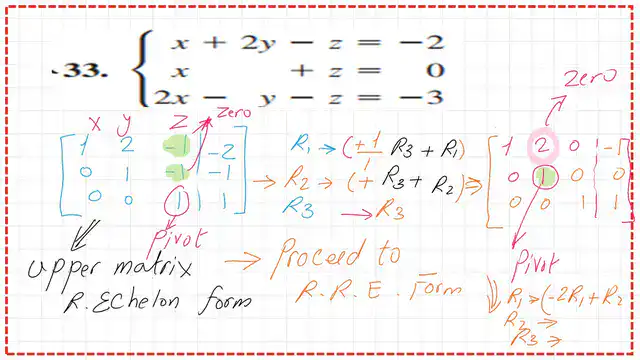
Use a22 as a pivot to eliminate a12.
We will use the element a22 to eliminate a12; this is done by adding(-a12/a22)*R2 to R1. We have now obtained the required reduced row-echelon form (Gauss-Jordan); please refer to the next slide for clarity.
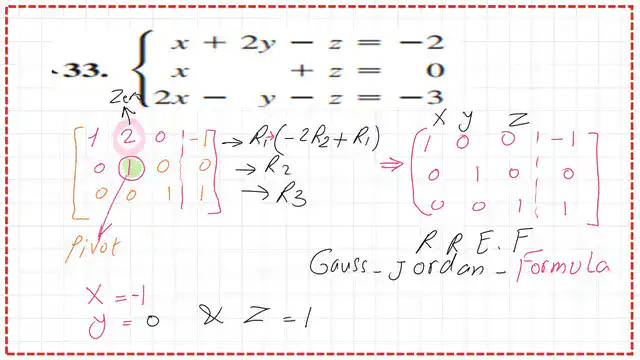
We can then get the values Z = 1, Y = 0, and X = -1. In this method, we do not need to make back substitutions. However, it is important to check the Values of X, Y, and Z in any of the three systems of equations to ensure that the solution is accurate.
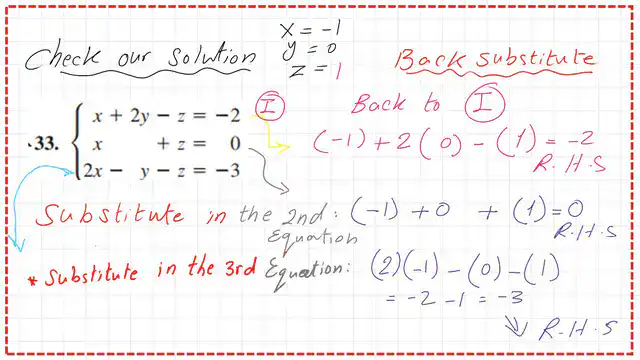
Practice problems for Gauss-Jordan elimination- second practice problem.
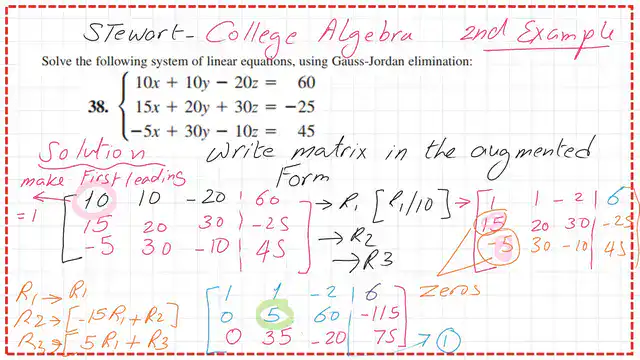
1-For the second practice problem #38 for Gauss-Jordan elimination. Solve the following systems of linear equations. Solve the following systems of linear equations. We have three simultaneous equations: 10x+10y-20Z=60& 15x+20y+30z+=-25 and -5x+30y-10Z=45. The following slide image shows the details of the matrix given for practice problem #38.
We will write these equations in augmented form for the given system of linear equations.
We will introduce a vertical line between the third and fourth columns to show the augmented matrix. The next step is to make a21, the second row/first column element, equal to zero.
Make sure element a11 equals 1. First, we will divide the first row by 10. We will add (-a21/a11)*R1 to row 2 to obtain a zero in the 2nd row. In this process, we consider a11 as the pivot element.
Similarly, let a3,1, or the third row/first column element, equal zero. Add (-a31/a11)*R1 to row 3 to get the zero value. Again, in this process, we consider a11 as the pivot element.
Use a22 as a pivot to eliminate a32.
First, divide R2 by 5 to let the pivot a22 equal 1; also, divide R3 by 5 to minimize the numbers.
Multiply the second row by -7 and add the result to the third row. Divide the third row by -88 to make a33 equal to 1.
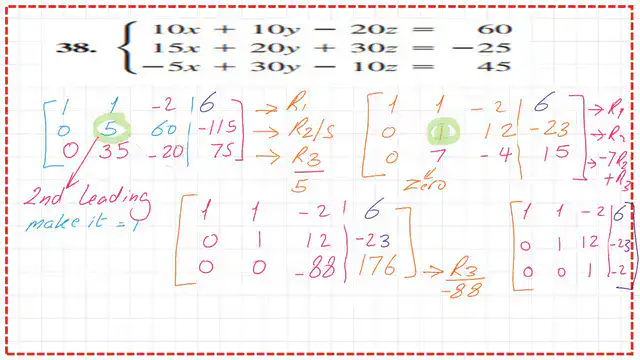
Perform the row operations to obtain the reduced echelon form, or simply an upper triangular matrix with three ones on the diagonal.
Use a33 as a pivot to eliminate a23& a13.
Similarly, we use the element a33 to eliminate a13 by adding (-a13/a33)*R3 to R1 to obtain the zero value. Again, in this process, we consider a33 as the pivot element. We have now obtained the required diagonal matrix with 1s on the diagonal; please refer to the next slide for clarity.
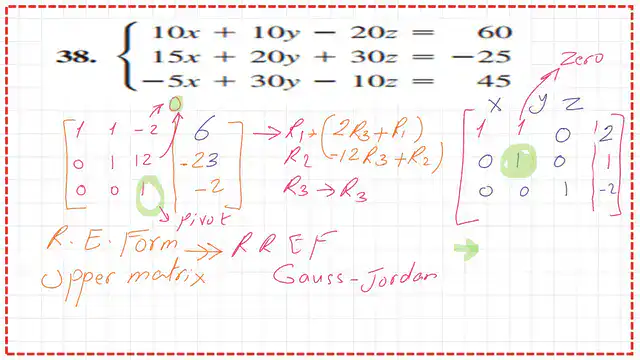
Use a22 as a pivot to eliminate a12.
We will use the element a22 to eliminate a12; this is done by adding(-a12/a22)*R2 to R1. We have now obtained the required reduced row echelon form (Gauss-Jordan). Please refer to the next slide for clarity.
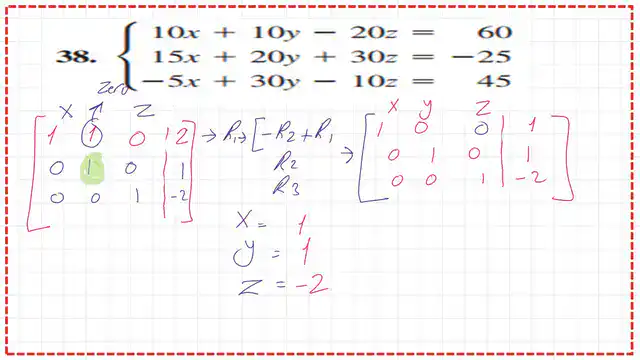
We can then obtain the values Z = -2, Y = 1, and X = +1. In this method, we do not need to make back substitutions. However, it is important to check the Values of X, Y, and Z in any of the three systems of equations to ensure the solution is accurate.
We can review the PDF data or download it from the following document.
The next post will discuss the Practice problems for reduced echelon form.
This is a link to the matrix calculator.
For a useful external link, Math is Fun for the matrix part.