
Last Updated on February 22, 2026 by Maged kamel
A solved problem for Load combination.
A solved problem for load combination, problem 2.1, quoted from Prof. SEGUI’s handbook, will be discussed in this post. Given the dead load& floor live load & roof live load, and snow load, it is required to estimate the load combinations.
Before introducing the solved problem, we will review the basics of load combination and the different combination factors as follows. The first discussion will be on the LRFD coefficients.
What is the LRFD?
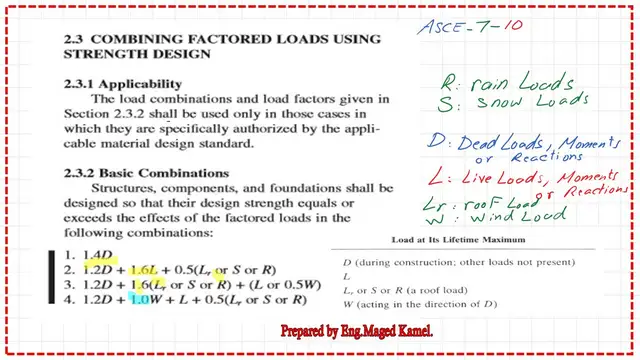
LRFD is the abbreviation for load and resistance factor design. The following description is for the combinations based on the LRFD design.
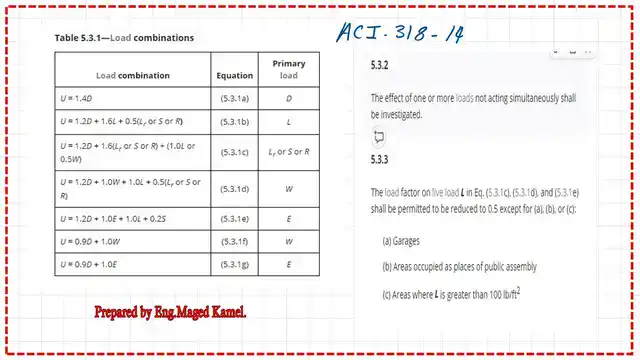
The first combination is 1.4D, where D is the dead load, dead moment, or dead reaction. In that first case, the Dead load is the primary load, with no other loads.
The second combination is 1.2D+1.6 L+0.50(Lr or S or R), where L is the live loads, live moments, or live load reactions. In that second case, the live load is the primary load with Dead loads, roof loads denoted by Lr, S snow, or R rain loads.
The L factor, 1.60, is higher than the other factors. The third combination is 1.2D+1.6 (Lr or S or R)+(0.50L or 0.5W), where W is the wind loads, wind moments, or wind reactions.
The third combination (Lr or S or R) is the primary load.
The fourth combination is 1.2D+1.0W+0.50 (Lr, S, or R)+f1L. f1 can be considered 1.0 or 0.50. It is taken as 1.00 for live loads that exceed 100 pounds per square foot, garages, and public assembly.
Otherwise, it is taken as 0.50 if the live load does not exceed 100 PSF. In that fourth case, the wind W is the primary load. We will move to the next slide, which contains combinations from 5 to 7.
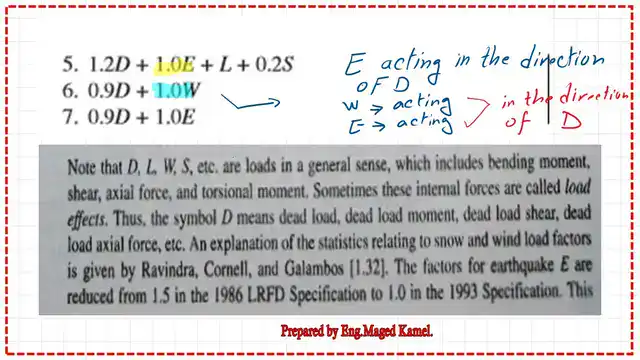
The fifth combination is 1.2D+1.0E+L+0.20S; f1 can be 1.0 or 0.50, similar to the fourth combination. It is taken as 1.00 for live loads that exceed 100 pounds per square foot, garages, and public assembly.
Otherwise, it is taken as 0.50 if the live load does not exceed 100 PSF. In that fifth case, the earthquake load E is the primary load. The sixth combination is 0.9D + 1.0 W. No live loads or roof loads, Rain, or snow are considered.
The sixth combination is 0.9D+1.0 W. The wind load W is the primary load.
The seventh combination is 0.9D+1.0 E. In that seventh case, the earthquake load E is the primary load.
AISC and ASCE load combination.
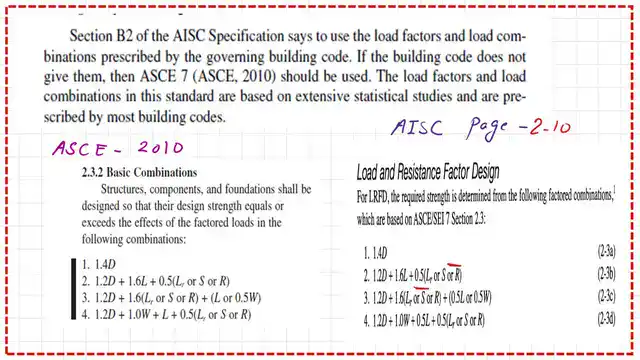
The corresponding AISC combinations are listed side by side and compared with ASCE 2010. For the combinations from 1 to 4.
The corresponding AISC combinations are listed side by side and compared with ASCE 2010. For the combinations from 5 to 7. The symbols used in the combinations are written.
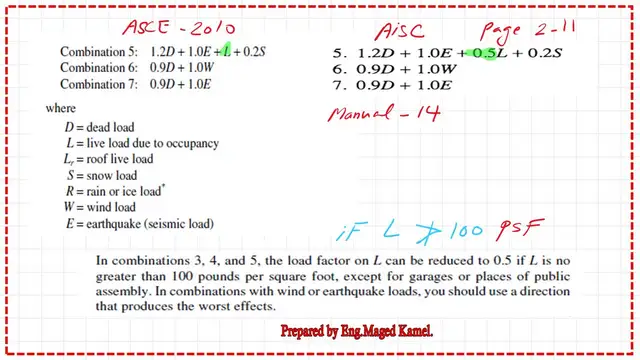
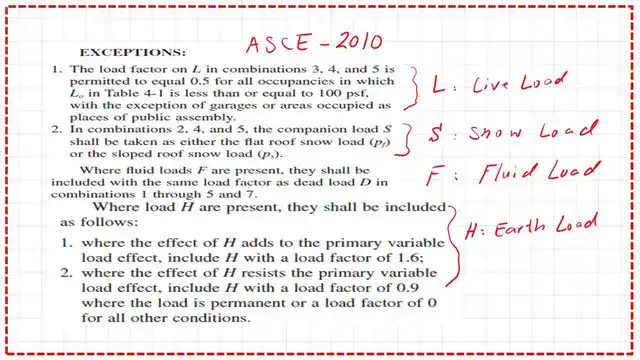
Exceptions in ASCE-2010 For LRFD.
All the exceptions in ASCE-7-2010 are written for live loads, Snow loads, fluid loads, and earth loads.
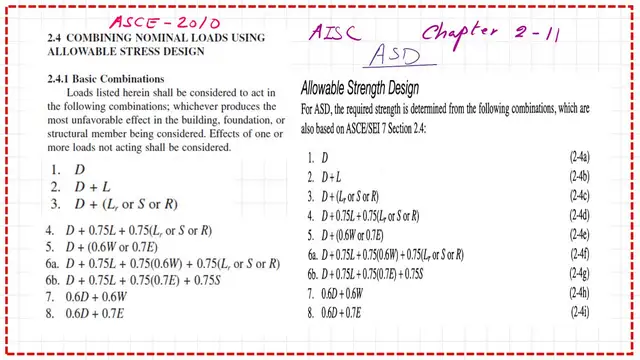
Load combination in ASD.
We continue with the load combination for Nominal loads using allowable stress design (ASD). I put the corresponding load combinations for AISC for ASD from combinations 1 to 8.
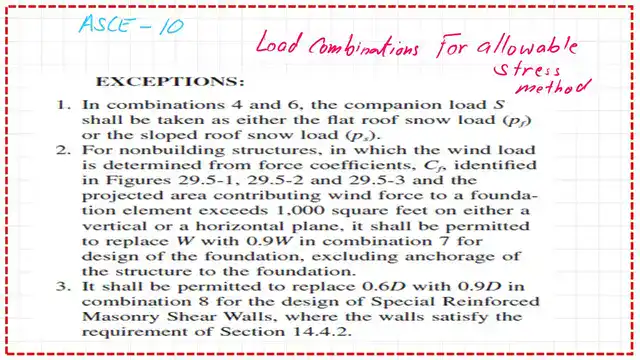
Exceptions in ASCE-2010 For ASD.
All the exceptions expressed in the ASCE 2010 are written for Snow loads, wind loads, and specially reinforced masonry walls.
A Solved problem for Load combination-LRFD-part 1.
A column in the upper story of a building is subjected to the following loads:
Dead load: 109 kips compression. Floor live load: 46 kips compression. Roof live load: 19 kips compression. Snow load: 20 kips compression. It is required to determine the LRFD combination and the corresponding factored loads.
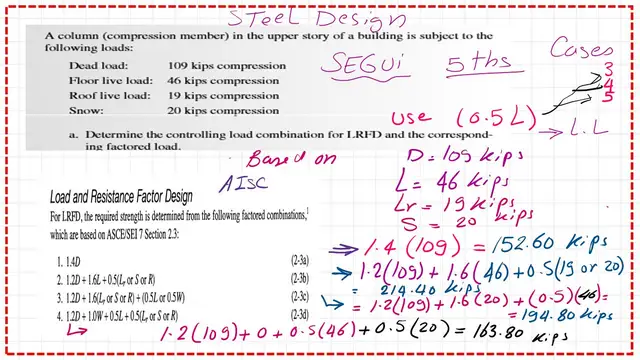
I have written the symbols D for dead load, L for live load, Lr for roof load, and S or snow load. If there is no public area or garages, or the load value is < 100 psf, the reduction factor of 0.50 will be used for combinations 3, 4, and 5.
The corresponding combination for cases 1-4 is shown on the slide. We note that for combinations 2, 3, and 4, since the S value (20 kips) is larger than the lr value (19 kips), the S value will be used in those combinations.
The first combination is 1.40D = 1.4 × 109 = 152.6 kips.
The second combination is 1.2D+1.6 L+0.50(Lr or S or R) = 1.2*109 + 1.6*46 + 0.50*20 = 214.40 kips.
The third combination is 1.2D+1.6 (Lr or S or R)+(0.50L or 0.5W)=1.20*109+1.6*20+0.50*46= 194.8kips. L is bigger than W.
The fourth combination is 1.2D+1.0W+0.50 (Lr or S or R)+f1L =1.20*109+1.00*0+0.50(20)+0.50*46=1.2*190+33=163.80 kips.
A solved problem for Load combination-LRFD-part 2.
The corresponding combination for cases 5-7 is shown on the slide.
The fifth combination is 1.2D+1.0 E+f1L+0.20 S
The last combination=1.2*109+0+0.546+0.20*20=157.80 kips.
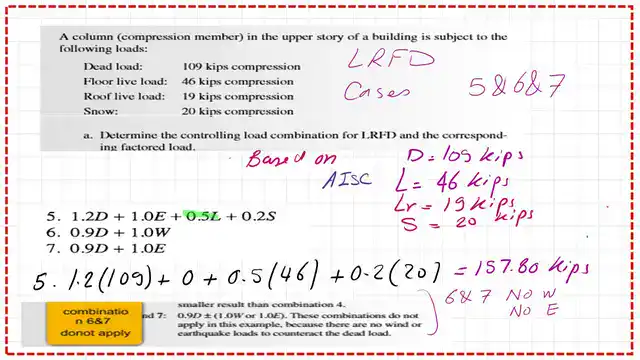
The sixth and seventh combinations do not apply, since no E and W loads counteract the effect of the D load.
for part c the controlling load combination factor is for combination Number 2 which will give the highest value. The maximum value =214.40 kips.
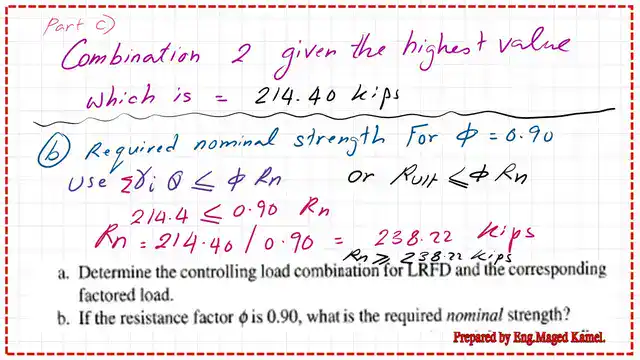
For the second requirement, if the resistance factor Φ=0.90. What is the required nominal strength? We will adjust the term Φ*Rn and let it be Rn = Ru = 214.40/0.90 = 238.22 kips.
The same solved problem for Load combination-ASD.
The corresponding combination for all cases 1-8 is shown on the slide based on ASD.
The first combination is D=109 kips. The second combination is D+L = 109 + 46 = 155 kips. The third combination is D+(Lr or S or R)=109+20= 129 kips. The fourth combination is D+0.75L+0.75 (Lr or S or R)=109+0.75*46+0.75*20=109+0.75*66=158.50 kips
The fifth combination is D+(0.60w or 0.70E)=109.0 kips. The sixth 6a combination is D+0.75*L+0.75(0.60w) +0.75(Lr or S or R)=109+0.75*46+0+0.75*20=158.50 kips.
The sixth and seventh load combinations are not applicable since there are no W or E loads.
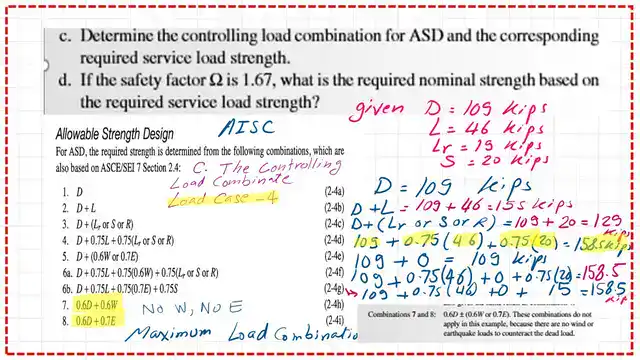
We note that for combinations 3& 4, the S value of 20 kips is larger than the LR value of 19 kips.
The S value will be used in those combinations. There are no values for wind, earthquake load, or rain. The maximum value of R will be greater than or equal to 158.80 kips.
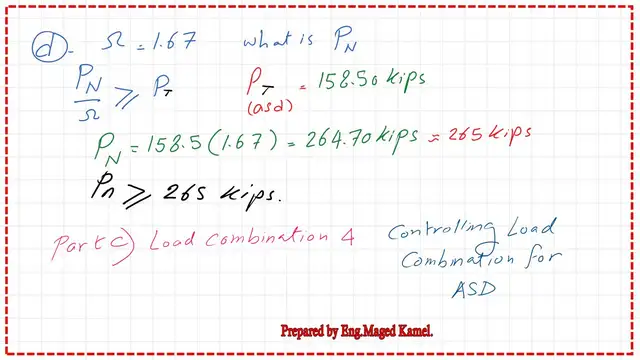
The last requirement if the safety factor Ω =1.67. What is the required service load strength? We will adjust the term (1/Ω)Rn and let it be R = 158.80167 = 264.70 kips.
An extract from ACI 318 on LRFD load combination cases matches ASCE 7.
The PDF for this post can be reviewed or downloaded from the following documents.
If you want to see the major changes between Cm#14 and CM#15 regarding the different grades of steel and their uses for steel elements and bars, please refer to post 1A.
This is a link to a very good reference, Chapter 1 – Introduction–An Overview of the AISC Steel Construction Manual, 14th Edition
This is a link to a very good reference, Chapter 1 – Introduction–An Overview of the AISC Steel Construction Manual, 15th Edition
This is a link to a very good reference, Chapter 1 – Introduction–An Overview of the AISC Steel Construction Manual, 16th Edition.