Last Updated on October 14, 2026 by Maged kamel
Matrix Operations-part-2.
In this new Post, I will introduce Matrix operations—part 2, which covers Matrix powers. Please refer to the next slide image.
The data are quoted from Prof. Kuldeep Singh’s handbook, which discusses the properties of addition through a solved Problem.
Powers of a Matrix.
The following property of Matrix operations, part 2, is Matrix powers. For instance, Matrix A with dimension (2×2) consists of 4 elements (1 2, 0 1).
A raised to the power of 2, or A^2, is found by multiplying Matrix A by itself.
If Matrix A has a dimension of (2×2), the final Matrix will also have a dimension of (2×2).
Let us perform the multiplication. It is easy to treat the first Row as a column vector and multiply it by the first column of Matrix A. For (AB)11, we have (1*1 + 2*0) = 1 + 0 = 1. I use the letter B to indicate the second Matrix.
For (AB)12, we multiply the first Row of A by the second column of B; after placing it as a vertical column, we get (1*2 + 2*-1) = 2 + (-2) = 0.
For (AB)21, we multiply the second Row by the first column of Matrix A, and we get (0*2 + (-1)*0) = 0 + 0 = 0.

For (AB)22, we multiply the second Row by the second column of Matrix A, and we get (0*2 +- 1*-1) = 0 + 1 = 1. We cannot square each element of Matrix A and consider the resulting Matrix to be A^2.

Multiplication of 3×3 matrices.
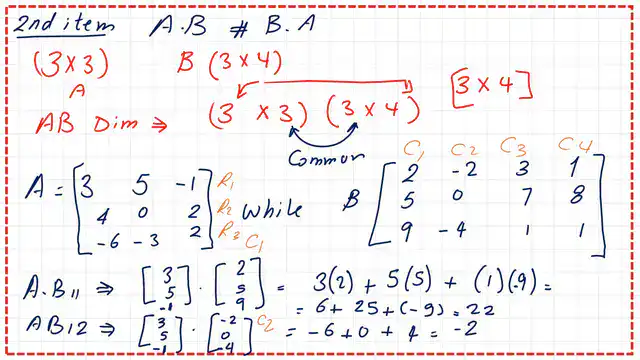
Matrix operations part: multiplying two matrices A × B. Matrix A is 3×3, while Matrix B is 3×4. Since both matrices share the dimension 3 (the columns of A and the rows of B), the resulting Product AB will have the dimension 3×4.
Elements AB11, AB12.
Consider the first Row as a vertical column and multiply it by the first column of Matrix B. For (AB)11, we have (3*2+5*5+-1*9)=22.
For (AB)12, we multiply the first Row of A by the second column of B:(3*-2 + 5*0 + 1*-41 * -4) = -2.
Elements AB13, AB14.
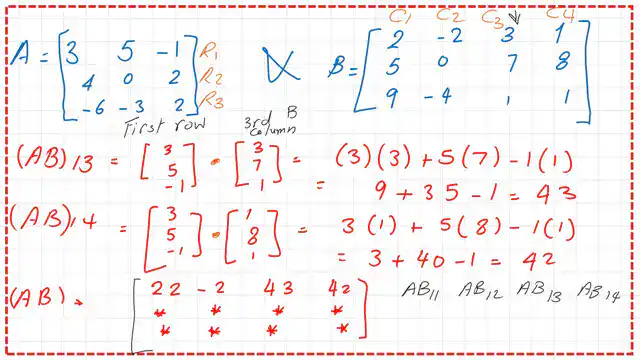
For (AB)13, we multiply the first Row by the third column of Matrix B:(3*3 + 5*7 + (-1)*1) = 43.
For (AB)14, we multiply the first Row by the fourth column of Matrix B: (3*1 + 5*8 + (-1)* 1) = 42.
Now we can write the first Row of the Product of Matrix A and Matrix B.
Elements AB21, AB22 & AB23.
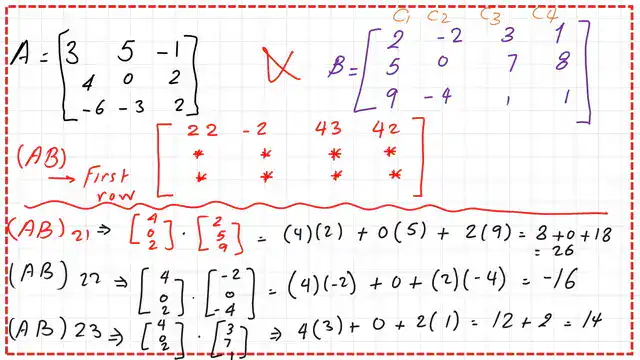
For (AB)21, we multiply the second Row by the first column of Matrix B: (4*2 + 0*5 + 2*9) = 8 + 18 = 26.
For (AB)22, we multiply the second Row, and after placing it as a vertical column, by the second column of Matrix B; we have (4*-2+0*0+2*-4)=-8-8=-16.
For (AB)23, we multiply the second Row by the third column of Matrix B, and after placing the result in a vertical column, we get (4*3 + 0*7 + 2*1) = 12 + 2 = 14.
Element AB24.
For (AB)24, we multiply the second Row by the fourth column of Matrix B, and we get (4*1 + 0*8 + 2*1) = 6.
Now, we can write down the first & second rows of the Product of matrices A and B.
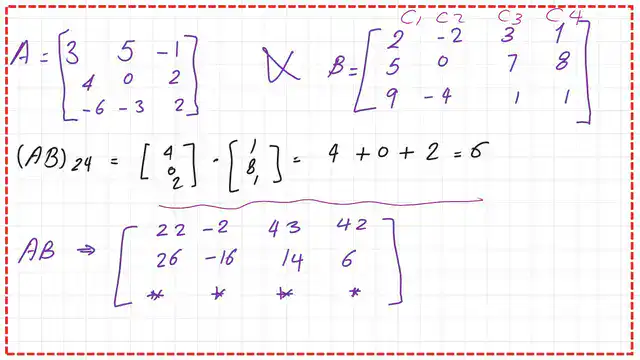
Elements AB31, AB32& AB33 and AB34.
For (AB)31, we multiply the third Row by the first column of Matrix B: (-6*2+-3*5+2*9)=-12-15+18=-9.
For (AB)32, we multiply the third Row, and after placing it as a vertical column, by the second column of Matrix B; we have (-6*-2+-3*0+2*-4)=+12-0-8=4.
For (AB)33, we multiply the third Row by the third column of Matrix B: (-6*3+-3*7+2*1)=-18-21+2=-37.
For (AB)34, we multiply the third Row by the fourth column of Matrix B: (-6*1+-3*8+2*1)=-6-24+2=-28.
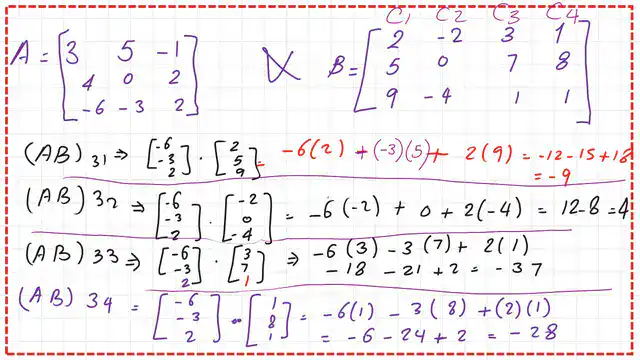
The Product of A by B is shown in the next slide image. We cannot compute the Product of B by A because Matrix B has 4 columns, while Matrix A has only 3 rows. An online Matrix calculator verifies the Product of Matrix A by Matrix B.

You can view or download the PDF data for this Post and the next one in the document below.
This is the next Post, 5-Solved Problem for Matrix operations.
For a useful external Link, Math is Fun for the Matrix part.