
Last Updated on September 24, 2026 by Maged kamel
Quadratic interpolation.
Quadratic interpolation uses a second-order polynomial to interpolate a function.
Unlike linear interpolation, which we discussed in the previous Post, quadratic interpolation requires three points.
The first point of the three points has a coordinate of(x0,y0 ), the second point has a coordinate of(x1,y1 ), and the last point has a coordinate of(x2,y2 )

What is the Vandermonde Matrix?
After substituting the polynomial Matrix with the x and y values of the three given points, we get a set of quadratic equations with three unknowns: a0, a1, and a2. These equations can be written in Matrix form. Use the form V*X=Y, where V is the Vandermonde Matrix, X is the column vector of the coefficients a0, a1, and a2, and Y is the column vector of the y-values for the three points.

How do we derive the Expression for the Vandermonde elements?
The Vandermonde Matrix, in the case of quadratic polynomials, is a(3 x 3) Matrix, it can be written in the form of Vi,j =xi-1^j-1, where i is the Row number and j is the column number, for instance,, V23=x2-1^j(3-1)=x1^2, V23 is the element in the second Row and the third column, will be equal to the second power of x1.
I have written the Vandermonde Matrix in that form for quadratic interpolation.
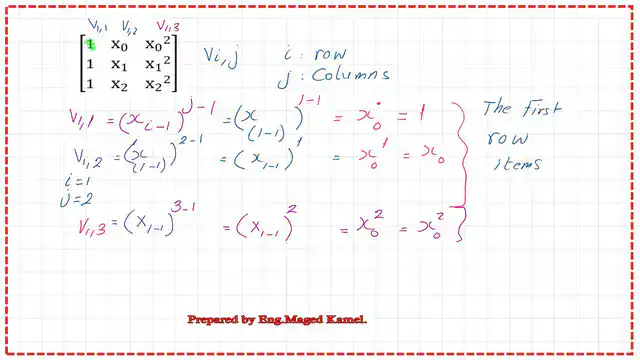
How do we find the determinant Value of the Vandermonde Matrix?
To find theMatrixx’s determinant, we set x0=0 by multiplying the second column by x0, subtracting the result from the third column, and placing it in the third column.
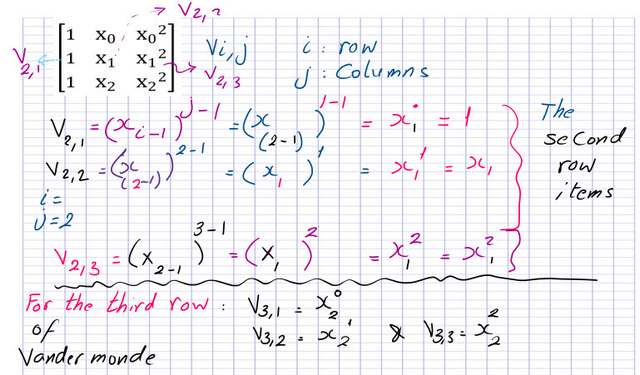
This continues the calculations.
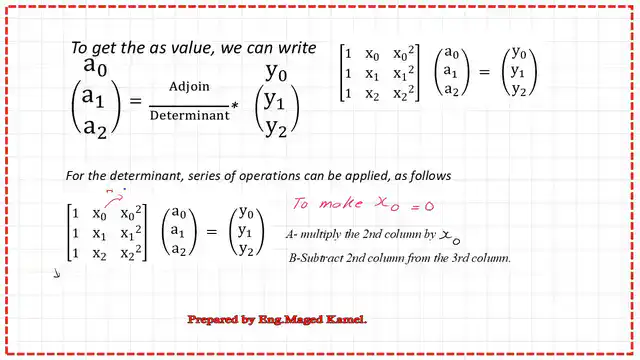
To compute the determinant of the Matrix, we let x0=0, multiply the second column by x0, then subtract the result from the third column and place it there.
Repeat the process with the first column and x0; then subtract the result from the second column and place it there.
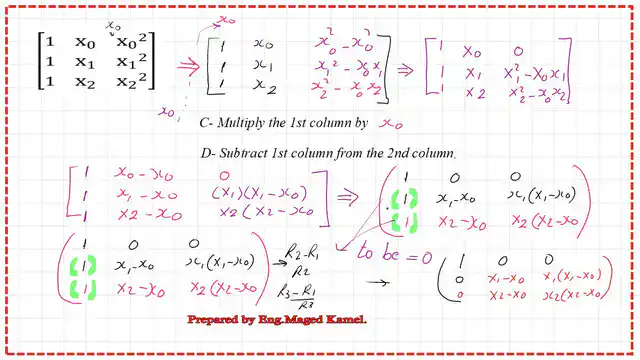
The first Row will have two zeros in the second and third columns, while the second Row will have a Value in the first column.
Finally, the first column will have a Value in the third Row.
The final Value of the determinant of the Vandermonde Matrix can be found as (x2-x0)*(x1-x0)*(x2-x1).

The process to get the inverse of the Vandermonde Matrix.
We find the inverse of the Vandermonde Matrix using cofactors and the adjugate.

We will start by estimating the minors of Matrix V. The next images will show the estimation process for the minors of the first, second, and third rows.
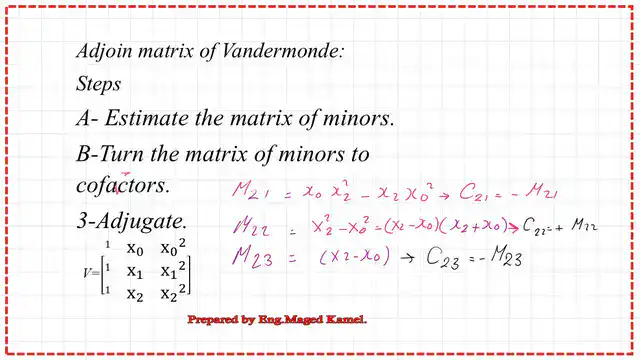
These are the minor values for the second Row of the Matrix. The minor values are for the third Row of the Matrix.
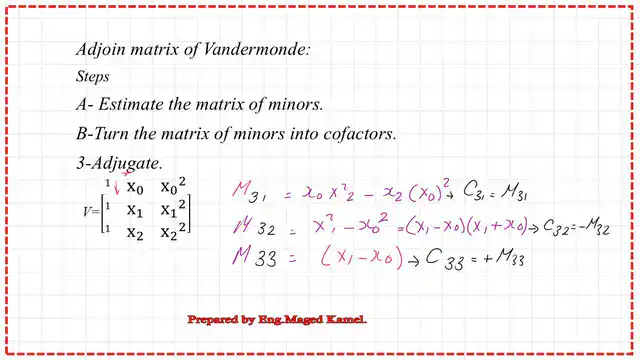
The next slide shows the step-by-step procedure.
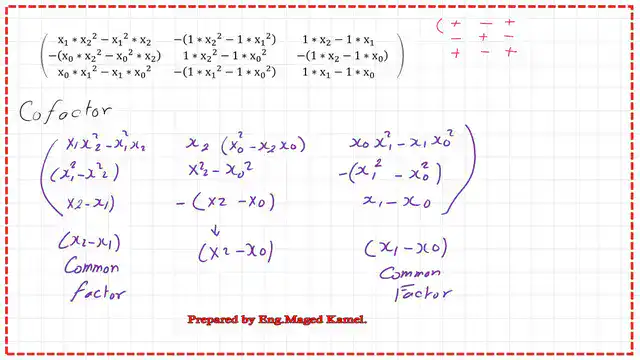
We can form the cofactor Matrix and factor (x2-x1) for the first column & (x2-x0) for the second column, and (x2-x1) for the last column.
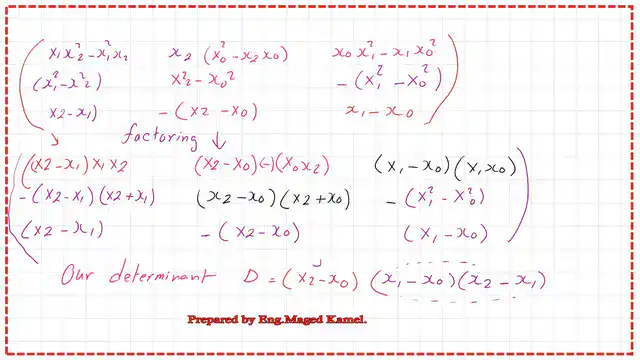
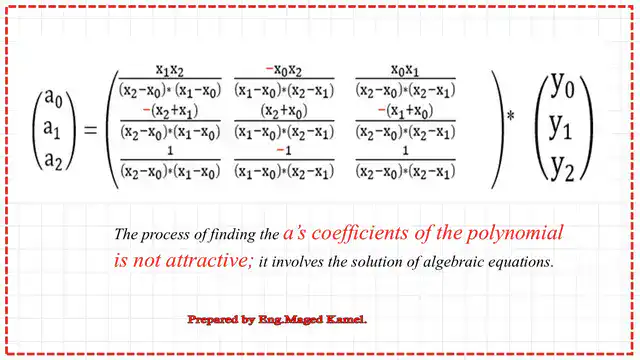
To find the inverse of the V Matrix, we divide the cofactor Matrix by the determinant we estimated earlier.
That division cancels the common factor, and we can find the inverse Matrix.

The final Value of the coefficient Matrix.
The last step is to multiply the inverse Matrix V-1 by the X-X Matrix to find the factor column vector.
In the end, we obtained these values, as shown in the last slide image.
You can view or download the PDF containing this Post’s content from the following Link.
This is an external Useful site: Mathonline.
The next Post: Solved problems for quadratic interpolation.