Last Updated on March 11, 2026 by Maged kamel
Modification to alignment Chart for the Braced Frame.
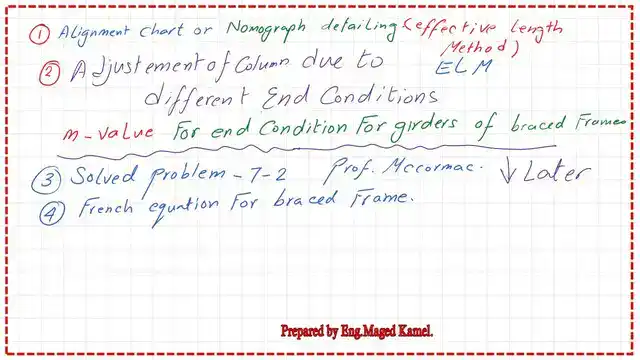
We will start a new subject for the braced frame. The first point to consider is the Alignment chart or the Nomograph detailing.
This subject we are going to review quickly, the second point to consider is the adjustment of columns of different end conditions and how to get the- m value for end conditions for girders of braced frames.
The third point is the solved example of 7-2, from Prof. McCormac’s handbook, which includes both braced and unbraced frames.
The fourth point is the French equation for the braced frame, which gives the k value for braced frames, which is approximately Close to the k value by the Nomograph.
The points that were taken into consideration while developing the Nomograph are that the columns must be in the elastic region, which follows the Euler equation, where Pcr=π^2 EI/(KL)^2, when the(kl/r) >4.71*sqrt(E/fy), as was explained earlier.
Point 2: All members have a constant cross-sectional area.
Point 3: All joints are rigid, for point 4.
For columns, inside-sway inhibited frames (i.e braced frames), rotations, and rotations at opposite ends of the restraint beams or girders are equal in magnitude and opposite in direction.
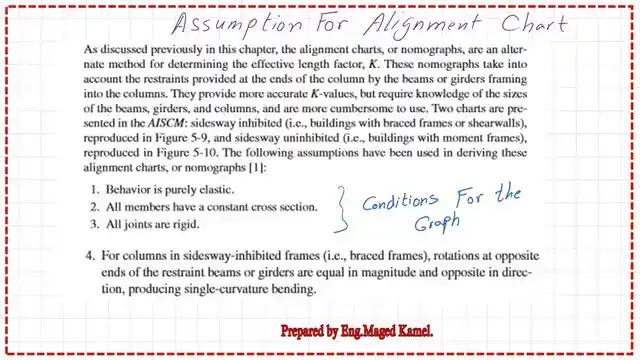
The moments are equal but in opposite directions, producing single curvature bending. The bending moment is supposed to be equal and opposite in direction.
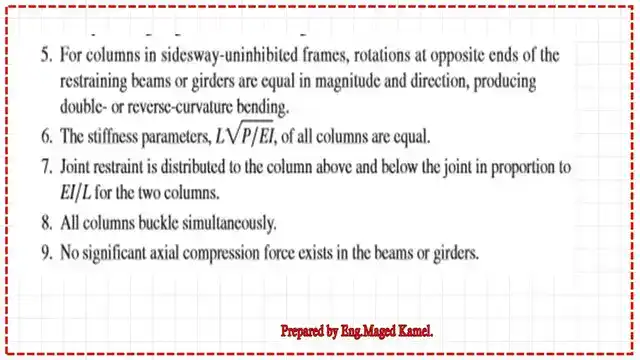
Point 5- This point is for the uninhibited frame, which we have included in our previous videos. the stiffness parameters L*sqrt(P/EI) of all columns are equal.
For point 6- All stiffness parameters L, P, E, and I of all columns are equal.
For point 7, joint restraints are distributed to the columns above and below the joint in proportion to EI/L for the two columns. EI/L for the two columns, because we use summation for the columns above and below the joints.
Therefore, the proportion is determined by the dimensions and properties.
For point 8- All columns buckle simultaneously, and buckling for each column is separate from the other columns.
For point 9- No significant axial compression force exists in the beams or girders, which means girders have no axial force.
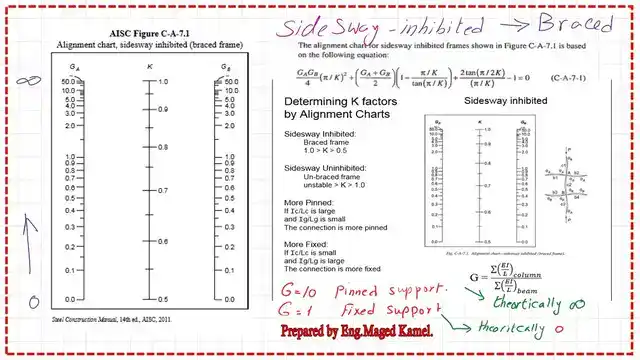
Side sway inhibited frame chart.
This is the alignment chart for sideways inhibited bracing, with k-values ranging from 0.5 to 1.
The equation is rather difficult to memorize. This is curvature due to bracing, which is a single curvature, the same as a wave rotating in that direction.
As for girders, the same as a wave, the unbraced behavior is double curvature, as if we have a joint in the middle that covers the moment sign from positive to negative. The G value for pinned Support =10, and the G value for fixed Support =1.
I have written the link for the Alignment charts from the same site. The site contains valuable lectures for compression members and other subjects.
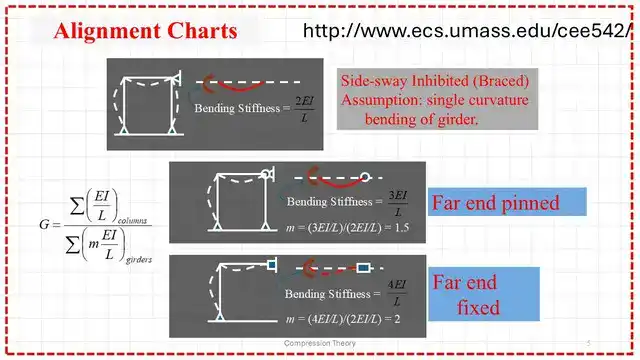
For the alignment chart modification, the first case is the ideal condition. The far joint has an equal moment and opposite sign. If it is considered positive at the near end, then it is also positive at the far end.
Case no. 1 in the alignment chart corresponds to m = 1. G, as estimated at the joint, will be equal to the sum (EI/L) for columns/sum (m*EI/L).
For girders at the same joint, whether on the right or left of the joint, or, in the case of single-girder framing, to the joint, the modification m is based on the end condition.
The value of m=1 is for an ideal condition, but if we have a hinge at the far end, then the moment at the far end=0, unlike the first case when we have at the far end the moment= moment at the near end, and a moment at the near end, but the moment=0 at the far end.
We will consider case No. 1 for single-curvature bending. We have two bending moments, one at the left joint and the other at the right joint. One moment is in the clockwise direction, and the other is in the anticlockwise direction.
For the slope value at joint A, which is the joint connecting the column with the girder, near the end, the area of the moment, which is a rectangular area, is ML divided by EI. Take direction downwards, based on the technique we use when the moment loads act down. Half the value for the left joint, then we have a slope of ML/2EI.
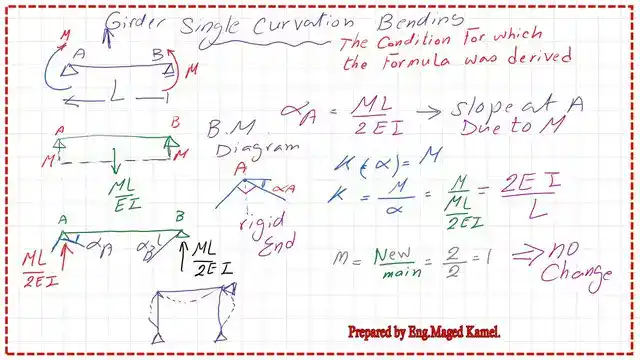
This is the angle of rotation and then this is the rotation of the column as shown in the sketch and back to the hinge, the formula for coefficient, for stiffness K, M=K*α, α at A =ML/2EL at the near joint, then k=M/α goes with m, 2EI will be at the top K=2EI/L.m= new situation/ ideal case, m=2/2 =1 since this is the perfect case.
Modification to the alignment chart for a side-sway-inhibited frame with the far end pinned.
We continue to discuss the modification to the alignment chart for the braced frame; next is case number#2. For case no.2, we have introduced a pin at the far-end joint. Then, at joint A, the moment M; the area of the moment diagram is EI = 1/2 ML/EI; the slope at A = 2/3 of the area; A is near the CG of the load, at a distance L/3; slope = ML/3 EI.
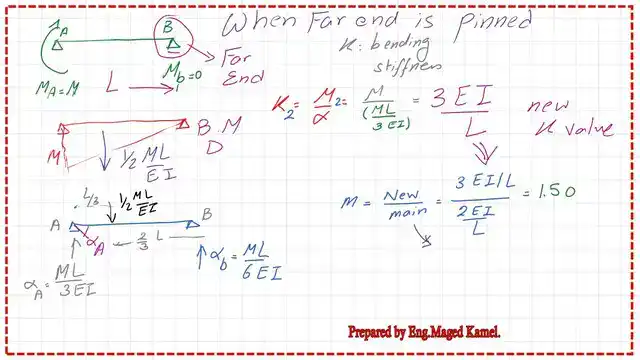
The slope we use to get the value for the bending stiffness k coefficient, k2=M/α, α=ML/3EI, then at the end =3EI/L. m = new situation value/the ideal case= 3/2=1.5.
Modification to the alignment chart: The case of the side-sway-inhibited frame with the far end fixed.
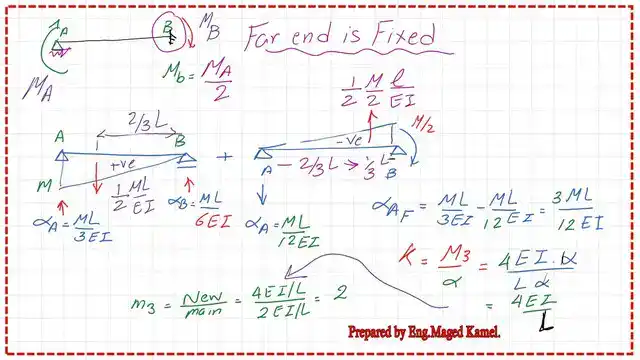
The last modification to the alignment chart is the fixation at the far-end joint. We have a bending moment M due to fixation. We have a moment at the far end of the fixed joint; the slope is 0, and for positive M at the near end, there will be M/2 in negative value at the fixed support.
We have a superposition. We have a triangle with M at the left and at the far joint M=0. The slope here for joint (2/3)*(ML/2EI)at the other triangle is negative. We have a negative M/2 moment. The area is represented by an upward force that produces a downward reaction. The CG distance at A=2/3L, and the area of the triangle = (1/4)*ML*M/EI.
The slope at B (2/3)*ML/4EI, the slope at α b ML/6EI, while the slope at A=1/3 ML/4EI, αA=ML/12EI, the final α at A=ML/3EI-(ML/12 EI), making the denominator 12 EI, (4-1)ML=3ML/12. EI=1/4 ML/EI. Divide M/ α to get the bending stiffness, k=4 EI/L, m3 value=4/2=2, and the multiplication m= 2.
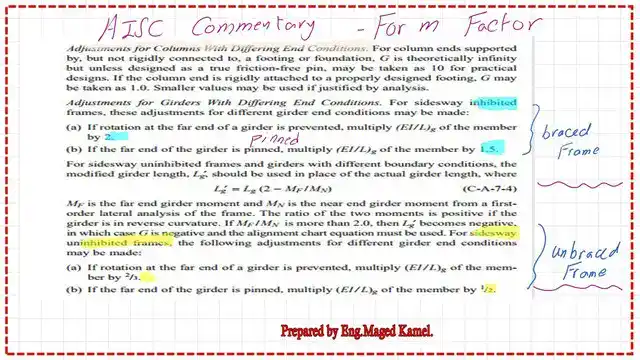
of AISC regarding side-sway inhibited and uninhibited frames.
Let us refer to the AISC commentary. Adjustment of the column with different end conditions for alignment charts.
First, the adjustment for girders with different end conditions, if rotation at the far end of the girder is prevented, is multiplied by 2; this is the case of our final case, fixation at the far end multiplied by 2.
b—If the far end of the girder is pinned, then multiply the girder’s (EI/L) by 1.5, which is case no.2, where m=1.5, for side-sway uninhabited the figures as shown at the end of our subject.
The PDF file used for the illustration of this post can be viewed or downloaded from the following document.
The Core Teaching Aids for Structural Steel Design Courses use full data, which can be downloaded from the AISC link. Check the folder for compression members.
This is the next post, solved problem, 7-2 for k value for frame 1/2.
For a good A Beginner’s Guide to the Steel Construction Manual, 14th ed. Chapter 7 – Concentrically Loaded Compression Members.
For a good A Beginner’s Guide to the Steel Construction Manual, 15th ed. Chapter 7 – Concentrically Loaded Compression Members.
For a good A Beginner’s Guide to the Steel Construction Manual, 16th ed. Chapter 7 – Concentrically Loaded Compression Members.