Last Updated on September 9, 2026 by Maged kamel
Solved problems for net Area estimation.
How do we estimate the net Area for plates?
A solved Problem 3-1.
In solved problem 3-1, we have a plate 3/8 inch thick and 8 inches wide.
Determine the net Area of the 3/8-inch x 8-inch plate, which is connected at its end with two lines of 3/4-inch bolts.
This is the original plate, 8 inches by 3/8 inch, connected with two thin plates. Each is exactly 8 inches wide and 1/4 inch thick.
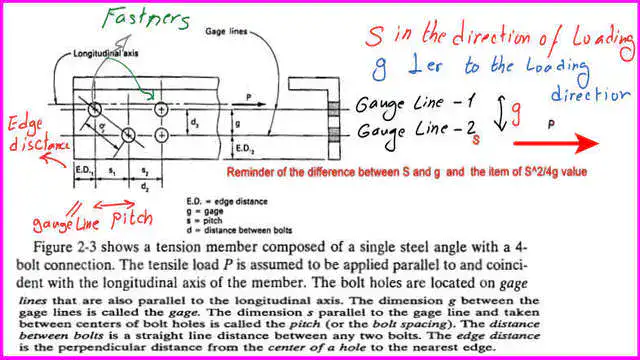
This is the first gauge line in the direction of the longitudinal tension, which is in the direction of the applied force, and this is the second gauge line.
As discussed earlier, the distance between the two center lines in the longitudinal direction represents the gage distance, while the perpendicular distance is the pitch.
We don’t have a zigzag line, so we’ll handle the vertical section, as shown in the next slide image. The next image shows the difference between the s and g distances for the bolted connection.
The Area, while selecting a vertical line AB= Ag – the Area of the bolts.
1-The bolt diameter as given =3/4 inch. We will refer to Prof. McCormac’s remark when considering the diameter of the bolts by adding 1/8 inch to the given bolt diameter.
During drilling, material damage will increase the diameter by 1/16 inch, so that the total increase will be 1/8 inch.
2-After drawing sections A and B, the width is 8 inches, the thickness is 3/8 inches, and there are two bolts.
We estimate the final diameter of the bolt as (3/4+1/8)=7/8″ inch. There are two bolts.
3-The A gross=3/88=3.00 inch2, Ag, = 3/8 × 8 = 3.00 in^2. For the net Area Anet, we deduct the Area of the two holes; then Anet=Ag-sum(d)t=3.00-2(3/8)(7/8) = 2.34 in^2. for U=1, then A eff=1*2.34=2.34 inch2.

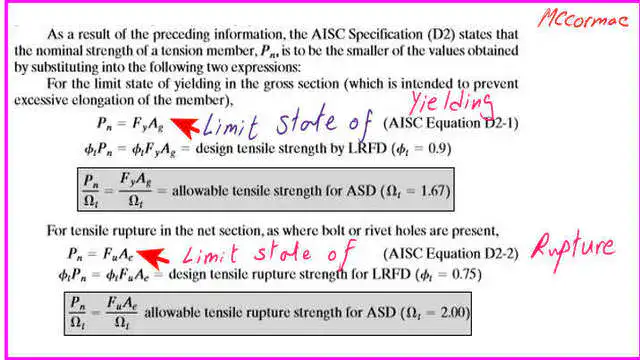
This is a list of the equations used to estimate the limit state of Yielding and the limit state of Yielding fracture for tension members.
Problem 3-2: Determine the critical net Area for a plate.
This is Problem, -2. It requires estimating the critical net Area of a 1/2-inch-thick plate for bolts with a 3/4-inch diameter.
We have two paths to failure. The first path is ABCD. On this path, we remove two holes, and there is no zigzag line.
1-The Area gross Ag=111/2=5.50 inch2, for Anet=Ag-sum(d)t=5.50-2(1/2)(3/4+1/8)
=5.5-(7/8)=4.63 inch2.

For the second path, which is a staggered line path ABEF, in this path, we are going to deduct two holes and also consider the zigzag line BE, for which S=3″ and g=6″.
2a-The area gross Ag=11*1/2=5.50 inch2.
2b- For the net Area for the staggered line ABEF, Anet = Ag- sum (d)t+tplS^2/4g=5.50-2(1/2)(3/4+1/8)+1/2(3^2)/(46)=5.5-1/2*(7/8) + 0.1875 = 4.81 in^2.
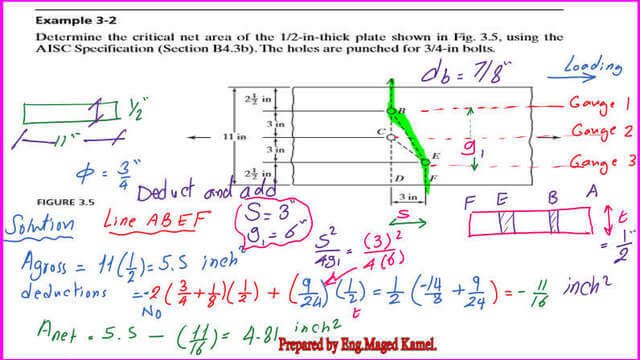
For the third path, ABCEF, we deduct three holes and consider the zigzag line CF, for which S = 3″ and g = 3″.
3a-the area gross Ag=11*1/2=5.50 inch2.
3b- for Anet=Ag-sum(d)*t+tpl*S^2/4g=5.50-3*(1/2)*(3/4+1/8)+1/2*(3^2)/(4*3)=5.5-1.3125+0.375=4.56 inch2. Finally, the least net Area is 4.56 in^2; the final route selected is ABEF.
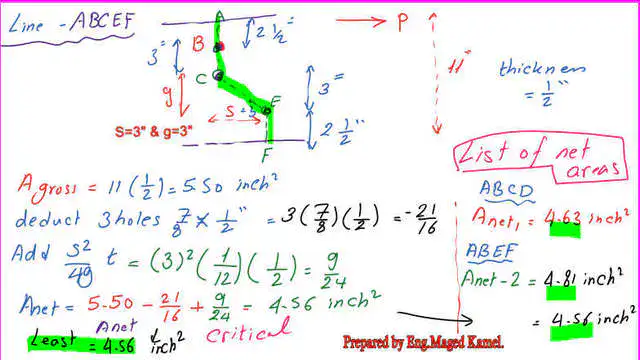
That is the end of problem 3-2. Thank you all.
You can view or download the PDF for this post from the following link.
For the next post, please refer to this link: A solved problem 3-1 for the nominal strength.
For a more detailed illustration of block shear, there is a very useful external link to Chapter 3, Tension Members—a Beginner’s Guide to the Steel Construction Manual, 14th ed.
Chapter 3 – Tension Members —A Beginner’s Guide to Structural Engineering is a great external resource—a Beginner’s Guide to the Steel Construction Manual, 15th ed.
A useful external link: Tensile Yielding and Tensile Rupture. Beginner’s Guide to the Steel Construction Manual, 16th ed.