Last Updated on July 9, 2026 by Maged kamel
- Practice problem 5-6-1M: What is the available strength for W310x97?
- Introduction to practice problem 5-6-1M.
- Convert 1 KSi to N/mm2.
- Check the local buckling parameters for W310x97.
- Find the values for Mpx and 0.7*Fy*Sx for W310x97.
- Practice problem-5-6-1M- What is the available strength for W310x97 based on local buckling?
- What are the non-compact W sections for Fy = 50 ksi (345 MPa)?
- Estimate Lp and lr for W310x97 for lateral torsional buckling.
Practice problem 5-6-1M: What is the available strength for W310x97?
Introduction to practice problem 5-6-1M.
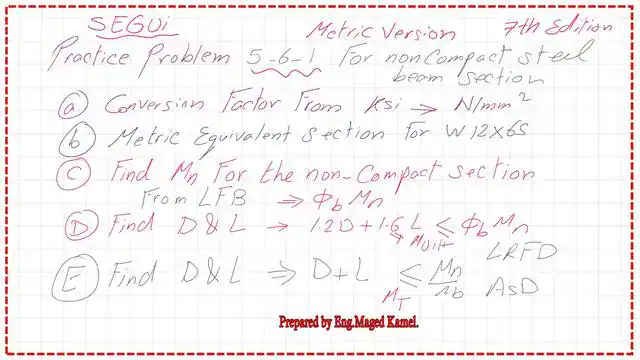
We are going to discuss practice problem 5-6-1, the metric version for a non-compact steel beam section, from The Steel Design Book, 7th Edition, by Professor Segui.
But we will discuss the following items. How can we derive the conversion factor for KSI to newtons per square millimeter? Second, what is the metric equivalent of W12 by 65? Third, find the nominal moment for the non-compact section W12 by 65.
We are going to equate the ultimate moment to the nominal moment by φb. The Ultimate load is estimated as 1.2 dead plus 1.6 live. Because we have dead and live loads, for ASD we use W total = dead + live. From that figure, the total moment should be less than the nominal moment over the Omega Ωp.
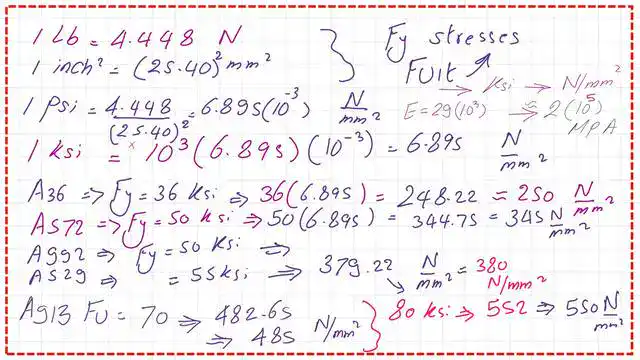
Convert 1 KSi to N/mm2.
We’ll move to the next slide. In the next slide, how to derive the conversion factor from KSI to newtons per square. We have 1 pound equals 4.448 newtons, and 1 inch equals 25.4 millimeters.1 inch square equals 25.4^2 mm2.
One PSI is nothing but one pound per square inch. We are going to divide 4.448 by 2.25.4 raised to the power of two. We will get 6.895 × 10^-3 newtons per square millimeter.
For 1 KSI, which is (1000 psi) . We are going to multiply 1000 by 6.895, all multiplied by 10 to the power of 3. We can derive that 1 KSI equals 6,895 newtons per square millimeter.
For instance, for the modulus of elasticity E, which is 29,000, multiplying by 6.895 gives approximately 2 × 10^5 newtons per square millimeter, which we call megapascal.
For other types of steel, we can find that steel is 36 with a field equal to 36 KSI. When we multiply by the conversion factor 6.895, we get 248.22 MPa, which can be approximated to 250 MPA.
For other types of steel, such as A572 and A992.Both these two types have a field of 50 KSI. When we multiply by the same conversion factor, we get 345 N/mm². Below, we can see other types of steel and their corresponding values in newtons per square millimeter.
We will move to the next slides for the second item.
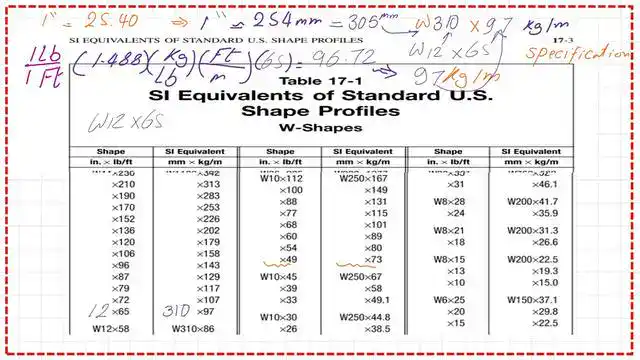
If we have a W12 by 65 cross-section and want to find the corresponding w in kilonewtons per meter, the W12 designation means the nominal depth is 12 inches. If we multiply 12 inches by 2.54, we get 305, but in reality, they select 310.
For the weight, we will use Table 17-1, which includes the corresponding inch-per-pound-per-foot w section; we find that w is 12 by 65. The SI equivalent of millimeter multiplied by kilogram by meter is 310 by 97.
If you would like to review that value, we know that 1 pound per foot is 1.488. When we multiply the weight per linear foot by 65, we get 96.72. That can be approximated to 97.
W12 by 65, the corresponding millimeters by kilograms per meter will be W310 by 97.
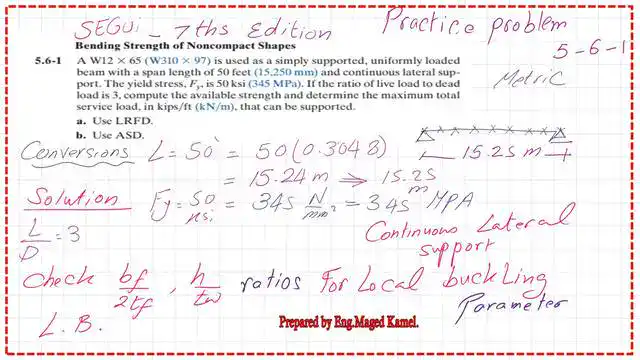
Our beam, which is W310x97, is used as a simply supported, uniformly loaded beam. The span of the beam is 50 ft. When we multiply it by 0.3048, we convert it into meters. Because 30.48 centimeters is 0.3048 meters, 50 × 0.3048 gives 15.25m. After approximating the yield stress, we set it equal to 345 Newtons per square millimeter, or 345 megapascals.
If the ratio of the live load to dead load is 3, L/D equals 3. Compute the available strength and determine the maximum total surface load in kips per foot or kilonewtons per meter that can be supported. Use the LRFD and ASD.
Check the local buckling parameters for W310x97.
For the given W310x97 section with Fy = 345 MPa and continuous lateral support, we need to determine the local buckling parameters bf/2tf and h/tw to confirm whether the section is compact or non-compact.
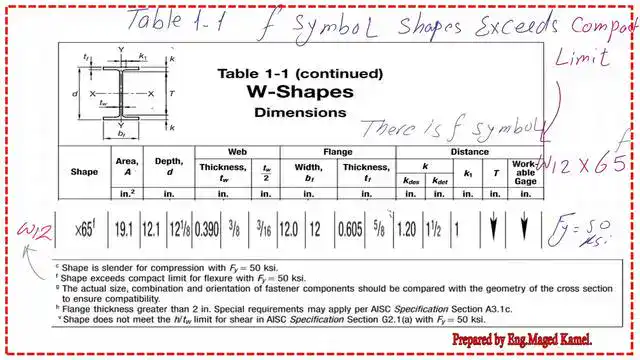
From Table1-1 for our section w12 x 65, we’ll find that it has a symbol f, which means that the shape exceeds the compact limit for flexure, with f yield equal to 50 ksi, so it means that the corresponding metric version will also be a non-compact section.
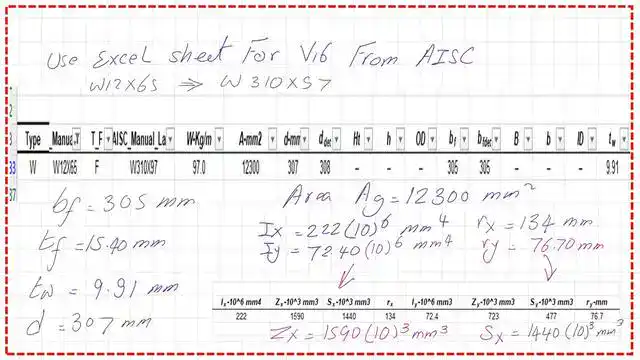
On the next slide, we will use an Excel sheet for AISC version 16. We have concluded that W12x65 is W310x97. Using that Excel sheet, we need to identify the key items that will help us obtain the local buckling values. We will find that the flange width is 305. The flange thickness is 15.4 mm, the web thickness is 9.91 mm, and the overall depth is 307 mm.
In the second part of the Excel sheet, we’ll find that Ix and Iy are 222 and 72.40, but we have to be careful to multiply them by 10^6 to get them in mm4.
The elastic radius of gyration about the x-axis, rx, is equal to 134mm and
The elastic radius of gyration about the y-axis, ry, is 76.70 mm.
The gross area is 12300 mm2, as in part one.
For the plastic section of inertia about the X-axis, Zx, it is 1590, which should also be multiplied by 10^3 to get the value in mm^3, while the elastic section of inertia, Sx, is 1440, which should also be multiplied by 10^3 to get it in mm^3.
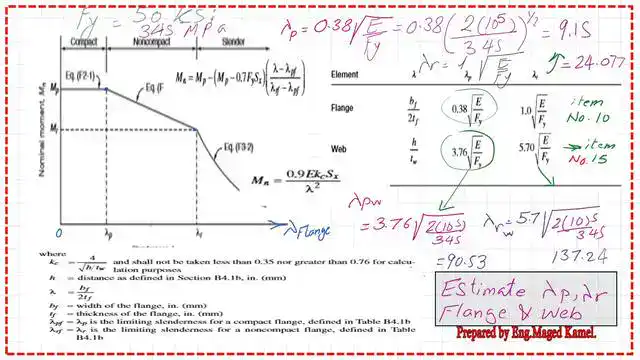
We’ll move to the next slide. This is the graph of local buckling, whether for the flange or the web. What are the parameters for the flange? Bf/2tf, λpf = 0.38 multiplied by the square root of E/Fy. λrf for the flange equals 1 multiplied by the square root of e over Fy.
For estimation, we are now going to use the metric version of lambda, λpf = 0.38 multiplied by the square root of E/Fy: 0.38*sqrt(2*10^5/345) = 9.15. While for λrf, it will be equal to 1.0*sqrt(2*10^5/345) = 24.077. For the web, the two parameters will be λpw and λrw. The λpw equals 3.76* sqrt (2* 10 ^5/345) = 90.53.
The λrw equals 5.70* sqrt (2* 10 ^5/345) = 137.24.
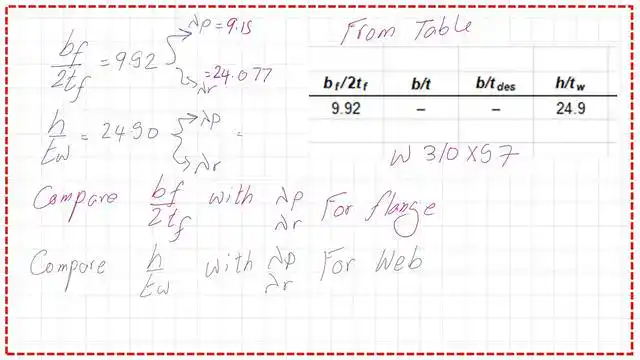
On the next slide, from the table, we have bf/2tf = 9.92 and h/tw = 24.90. λpf = 9.15, and λrf = 24.077. We’ll find that bf/2tf exceeds λpf, since 9.92 is greater than 9.15, which means the section is non-compact due to the flange. For the parameter h/tw, the value is 24.90, which is less than the values of λpw and λrw for the web.
Find the values for Mpx and 0.7*Fy*Sx for W310x97.
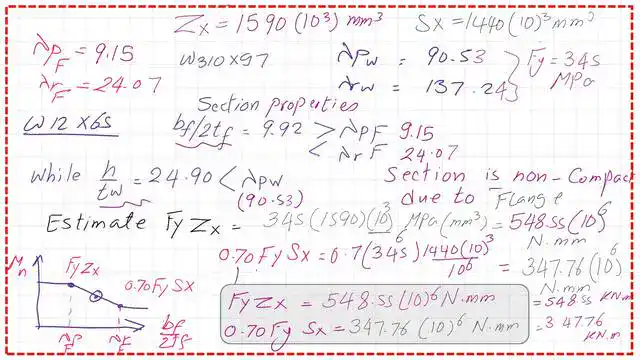
We utilize the properties from the Excel sheet: ZX is 1590*10^3 mm4 and Sx= 1440*10^3 mm4. Fy=345 MPa; we have concluded that the section is non-compact due to the flange.
We are going to calculate the nominal moment: Mp = Mn = Fy*Zx = 1590*10^3*345/10^6 = 548.55*10^6 N · mm.
For 0.7*Fy*Sx = 0.7*1440*10^3/10^6 = 347.76 *10^6 N. mm. We can convert these two values to kN · m by dividing by 10^6. Mn=548.55 KN.m corresponds to λpf, while 0.70 Fy*Sx=347.76 KN.m corresponds to λrf
The W section property for the flange bf/2tf lies between these two values, so we will estimate the nominal strength for the non-compact section using bf/2tf = 9.92.
Practice problem-5-6-1M- What is the available strength for W310x97 based on local buckling?
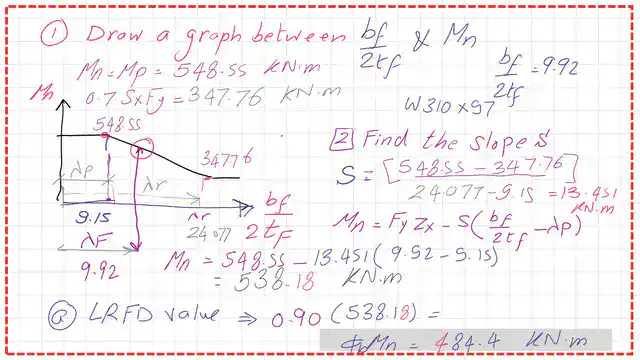
We drew a graph of bf/2tf versus the nominal moment, and for λpf = 9.15, the nominal strength is 548.55 kN·m. For λrF = 24.077, the nominal strength is 347.76 kN·m. We have an inclined line, and our lambda flange is equal to 9.92. The slope equals the change in y divided by the change in lambda. The difference in y is (548.55 – 347.70)/(24.077 – 9.15) = 13.451 kN · m.
We have an inclined line, and our lambda flange is equal to 9.92. The slope equals the change in y divided by the change in x. The difference in y is (548.55-347.70)/(24.077-9.15)=13.451 KN.m
In order to get the nominal moment for the section W310x97, we can write the equation that Mn=Fy*Zx-(slope)*(bf/2tf-λp)=548.55-13.455*(9.92-9.15)=538.18 KN.m.
For the LRFD value, it is 0.90 × 538.18 = 484.4 kN · m.
What are the non-compact W sections for Fy = 50 ksi (345 MPa)?
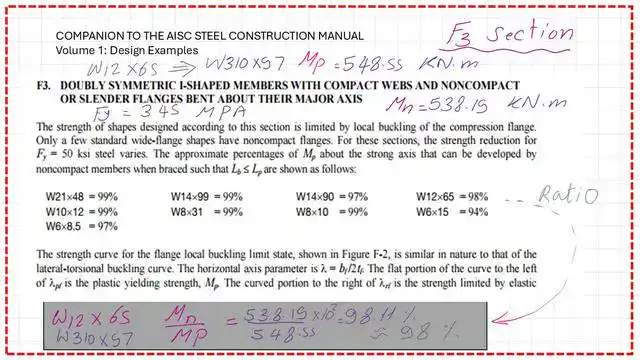
The following slide, from the companion to The AISC Steel Construction Manual, Volume 1- Design Examples, lists nine non-compact W sections, starting with W21x48 and ending with W6x8.50. The % percentage reduction of the nominal moment is included for each W section.
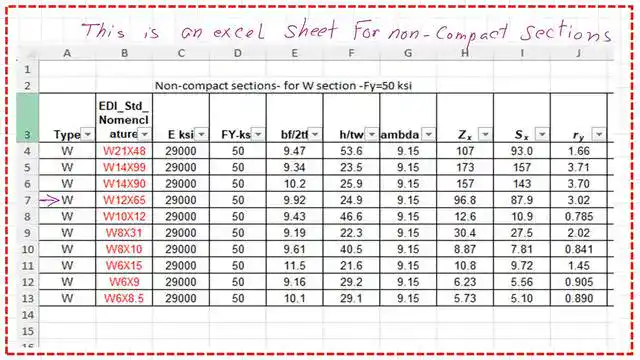
Create an Excel sheet for non-compact W sections with Fy = 50 ksi (345 MPa).
In the Excel sheet for non-compact W sections based on Fy=50 ksi, I have sorted the W sections with bf/2tf> 9.15 using an Excel sheet quoted from AISC W sections V15; the result is 10 W sections. Please refer to the next slide for more details.
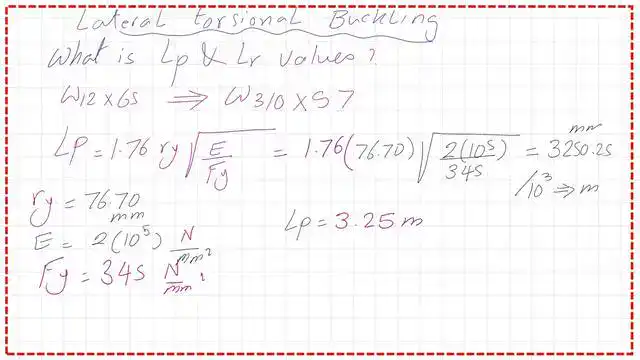
Estimate Lp and lr for W310x97 for lateral torsional buckling.
Since we are dealing with metric sizes, there is no table to get Lp and Lr values. We need to estimate both. We will check the lateral torsional buckling. What are the Lp and lr? The section is continuously braced, but for more data, if we need to confirm, we would like to adjust the actual value of Lp’.
The value of Lp=1.76ry*sqrt(E/Fy=1.76*76.7*sqrt(2*10^5/345)=32540.25 mm; we divide by 1000 to convert to meters = 3.25 m.
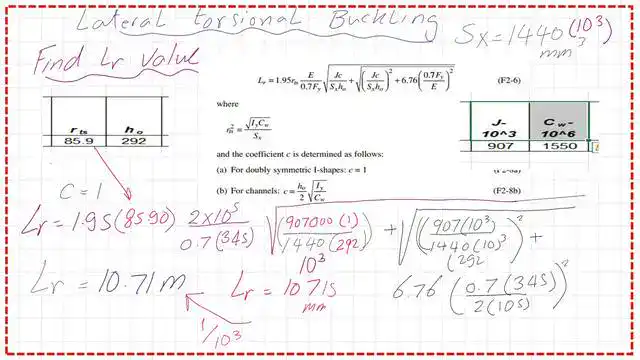
We move to the next slide for the evaluation of lr. We have a very large equation that includes rts, C, ry, Sx, ho, E, Fy, cw, and J.
The lr = 10715 mm, which is 10.72 m. The detailed estimate is shown in the next slide.
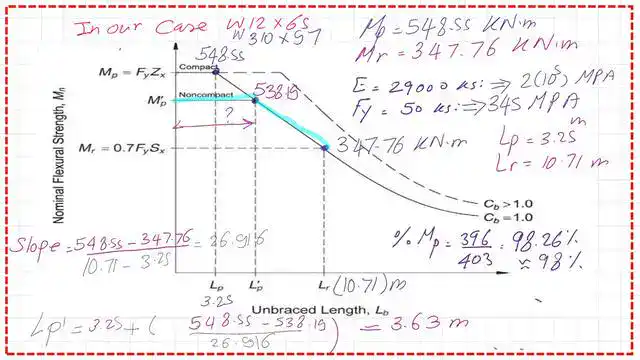
Adjustment in the Lp distance based on Mn.
The bracing Length Lp, which equals 3.25m, corresponds to Mpx = Fy*Zx = 548.55 KN.m, and the Bracing length lr, 10.715 m, corresponds to 0.7*Fy*Sx = 347.76 KN.m. But our W310x97 has an Mn of only 538.19 KN.m, an extra length to add to lp. The slope or B.F equals 26.916 kN.
This distance equals the difference between (548.55-53980.19)/B.F value. The final L’p = 3.63 m.
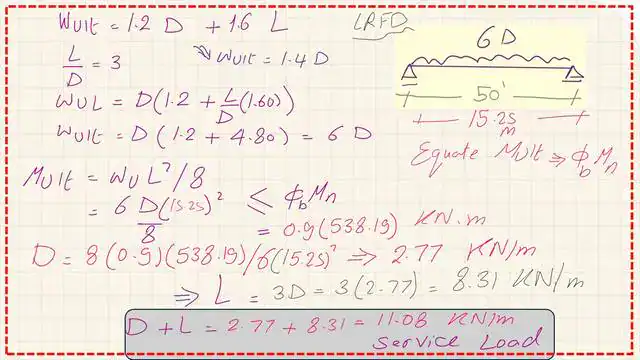
Check the maximum Total service load for LRFD design.
For Practice problem 5-6-1M, what is the available strength for W310x97? We will equate Mult to φ*Mn. We have l/D=3, the uniform ultimate Load Wul=1.2*D+1.6*3D=6D, the Mu=6D*(50)^2/8=0.9*538.19, then D=2.77 KN/m, the value of L=3*D=3*2.77=8.31 KN/m. The Total service load equals 11.08 KN/m
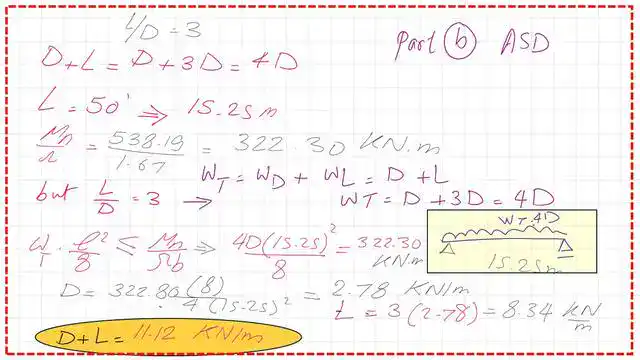
Check the maximum Total service load value for ASD design.
For Practice problem 5-6-1M, what is the available strength for W310x97? We will equate MT to 1/Ω*Mn. We have l/D=3, the uniform total Load Wt=D+3D=4D, the Mt=4D*(15.25)^2/8=322.30, then D=2.77 KN/m, the value of L=3*D=3*2.78=8.32 KN/m. The Total service load equals 11.09 KN/m. Thanks a lot.
The PDF used to solve this problem can be viewed or downloaded from the following link.
Please refer to post 41 for the imperial unit for the same practice problem.
Here is the link to Chapter 8 – Bending Members, section A Beginner’s Guide to the Steel Construction Manual, 14th ed.
Here is the link to Chapter 8 – Bending Members, section, A Beginner’s Guide to the Steel Construction Manual, 15th ed.
Here is the link to Chapter 8 – Bending Members, section, A Beginner’s Guide to the Steel Construction Manual, 16th ed.
For more information about LP and Lr, please see the post: Step-by-step guide to Lateral-torsional buckling.