
Last Updated on September 20, 2026 by Maged kamel
Two solved problems for estimating the effective net Area.
This is the lecture content.
How do we estimate the U-value for different shapes?
Refer to shapes as per Figure 3.10 from Prof. Segui’s handbook. He gives examples of different shapes and their u-values, such as single- or double-angle configurations with two or more fasteners.
We will use different Shear lag factors, derived from the Table for single- or double-angle connections to a plate. We have two different U values: if we have three or more fasteners in each line, then U = 0.80.
But if there are two or three fasteners, then U = 0.60. Please refer to item #8.
The first figure is for two or three fasteners. The next shape is for four fasteners and has U> 0.80. He gave different sections for the W sections.
For example, in W10x19, the W section is bolted at both the upper and lower flanges with four bolts, then U = 0.85; if we refer to the Table for W sections and write the breadth of Flange bf = 4.02 in and overall depth = 10.2 in and overall depth = 10.2 in.
Estimate the bf/d, If bf/d>2/3, then U=0.90, but if bf/d<2/3, then U=0.85, for the case of w10x19, we have bf/d is =0.394 <2/3 then U=0.85 this rule is from the Table. Please refer to item #7.
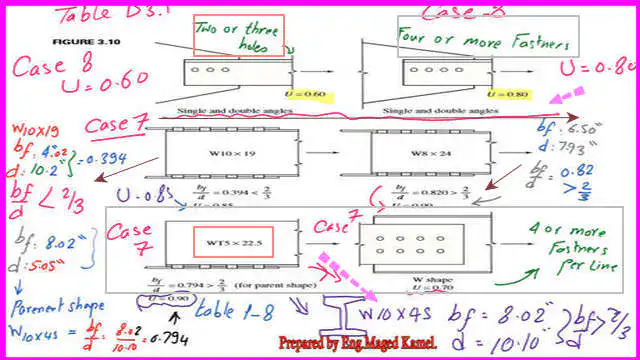
For W, M, S, or Hp shapes with bolts at the top and bottom flanges and three or more fasteners, the rule is: if bf > 2/3*d, or bf/d = 2/3, then U = 0.90; if bf < 2/3*d, then U = 0.85.
For the w section, if for W10x 19 the upper fFlangehas four bolts at the top and bottom, bf/d=0.394< 2/3, then U=0.85; for the other case with w8x24, the depth of the Beam is small, the Beam is shallow, d is 7.93 ”, if we divide bf/d we get 0.82> 2/3, then U=0.90, this is the case in the Table for w section.
If we have Wt, which means it is a T-shape cut from a W section, and refer to the properties for Wt5x22.5 in the Table, we have bf = 8.02″ and d = 5″. If we divide by d, we find that the ratio is >1.
What is the parent section? The parent section is W10x45. the depth is twice the Wt section, then bf/d=8.02/10.1=0.794, then the U Value =0.90.
In the last case, if we have a W-shaped Bolt with two lines of two fasteners, with four or more fasteners per line, but these fasteners are at the Web, this is the case shown in the Table; the U Value is 0.70.
The next tables for the U-value are provided for quick reference to match the examples given by Prof. Segui, which are shown in the previous slide image.

The next Table shows case 3 in the specification.

Cases 6a and 6b: a rectangular HSS welded to a gusset plate in the middle.
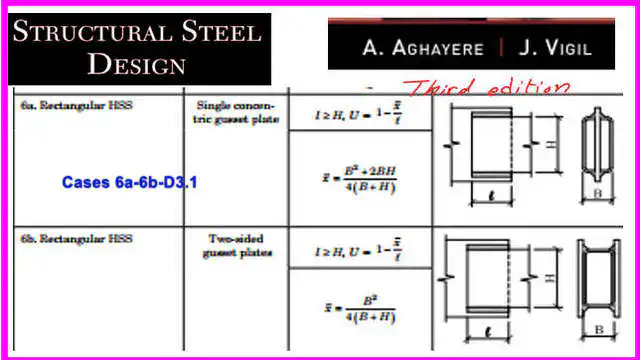
The Table shows the two cases (7 and 8) for tension members.

The first solved problem is 3-4.
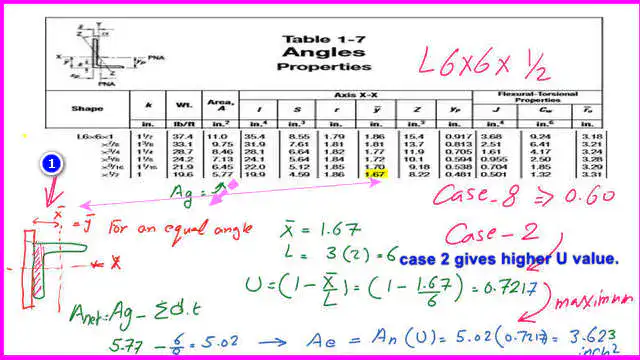
In the first solved problem, 3- 4, determine the effective net Area for the tension member in Figure 3-12; the given angle is 6×6 x1/2″, and I put the corresponding u Value for the angle with fasteners.
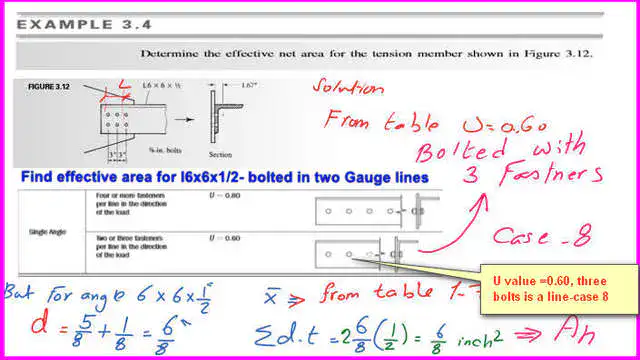
If we refer to Table 1-7 for the 6x6x1/2″ angle, for solved problem 3-4 we get y̅ = 1.67″, which is considered x̅, the vertical distance to the connection line, or the force line. We must estimate the net Area and U factor, then multiply them to get the effective net Area.
We have two lines of bolts, and each line has 3 bolts; each Bolt dia is 5/8″; we add 1/8″, then the diameter of the Hole d hole=6/8″. For the net Area determination, sum d*t, where t is the leg thickness, which is 1/2. Then Area net = 2*(6/8)*(1/2) = 6/8 in², which is the deduction Value from the gross Area.
In the next step, the U Value will be estimated from case 2: U = (1-x̅/L). L is the length for x̅ we obtained from the Table, while the L Value is from the first fastener, Bolt, to the last, which is=3*2=6″. Then U= (1-(1.67/6)) =0.7217. This Value exceeds the U estimated from Case 8, which equals 0.60.
Our gross Area Value is 5.77 inch2; we will deduct (6/8) inch2, then the net Area equals 5.02 inch2.
To get the effective Area, we multiply the net Area by the Shear lag factor U, which equals 0.7217.
The A-ffective=5.03*0.7217=3.623 inch2.
The second problem is 3-5 of the two solved problems.
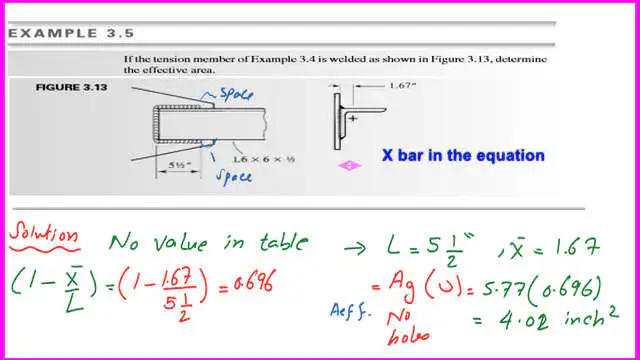
Referring to solved problems 3-5, if the tension member-single angle of problem 3-4 is welded as shown in fig 3-13, determine the effective Area, as before. The effective Area was 3.623 in^2.
The same equation for the U Value is used with the same x̅, but this length, the average length of welds, is 1/2(5.5+5.5)=5.5 “, U=1-(1.67/5.5)=0.696. Since there is no deduction for bolts, the effective Area, Aeff, is given by Aeff = U*Anet = U*A-gross.
The Value of the effective Area, Aeff = 5.77*0.696 = 4.02 in^2. The rupture tensile Value, in this case, will be higher than for bolts since A is larger.
There is a Post for a connected section by transverse weld, which is case 3; please refer to post-9A-Practice problem-transverse weld of a WT section.
You can view or download the PDF for this Post from the following Link.
The next Post introduces block Shear.
For a more detailed illustration of block Shear, there is a very useful external Link to Chapter 3, Tension Members—a Beginner’s Guide to the Steel Construction Manual, 14th ed.
Chapter 3 – Tension Members —A Beginner’s Guide to Structural Engineering is a great external resource: A Beginner’s Guide to the Steel Construction Manual, 15th ed.
A useful external Link: Tensile Yielding and tensile rupture. A Beginner’s Guide to the Steel Construction Manual, 16th ed.