Last Updated on September 10, 2026 by Maged kamel
Area and Cg of a triangle.
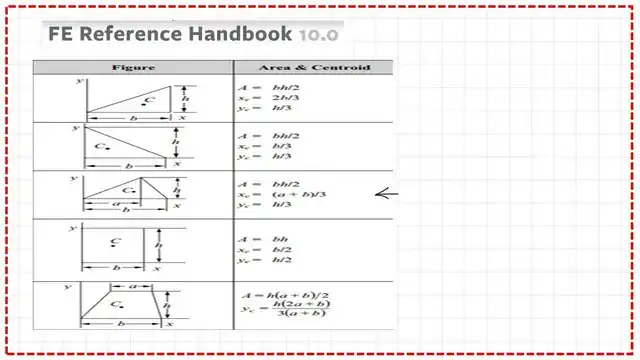
Reference handbook 10.00 values for areas and Cg.
To find the Area and Cg of a triangle, we will divide it into two right-angle triangles; we need the same data as in the FE reference handbook, as shown in the image on the next slide. The triangle case is the third case in the table.
Area and Cg of a triangle-x bar estimation.
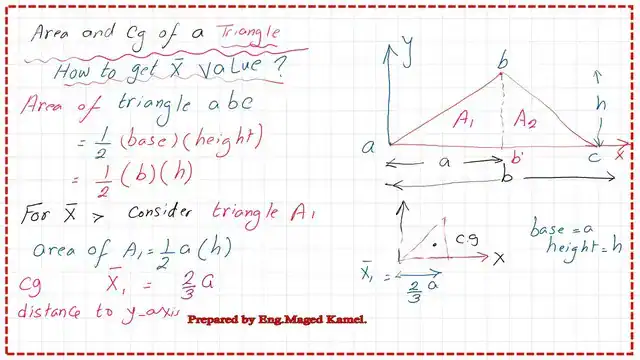
We divide the triangle into two triangles, A1 and A2. The Area of the first triangle is 0.50*base*height; the base length equals a, and the common height of the triangle equals h. The Area A1 = 0.50*a*h. As for the second triangle.
X-bar for a triangle.
The x-bar for the triangle of Area A1 can be found to be (2/3) a, from the y-axis passing through point a on the left side of the triangle.
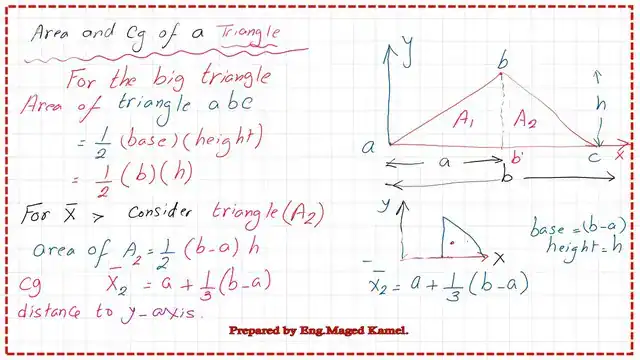
The second Area is A2; its base is (b-a), and its height is h, so A2 = 0.50 (b-a)*h. While the cg distance for Area A2 to the y-axis is termed x-bar2, it will be =a+(1/3)*(b-a).
The final value for the X- bar for the triangle can be obtained by summing the Product of A*x and equating the value to the Product of the total area*x-bar of the triangle.
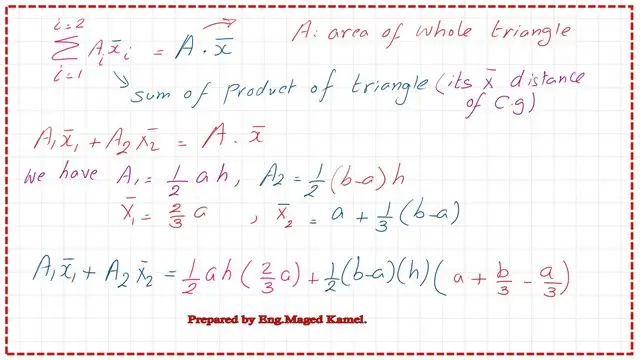
The sum of the Product of area1*x-bar1 plus the sum of Area2*x-bar2 is shown in the previous slide image.
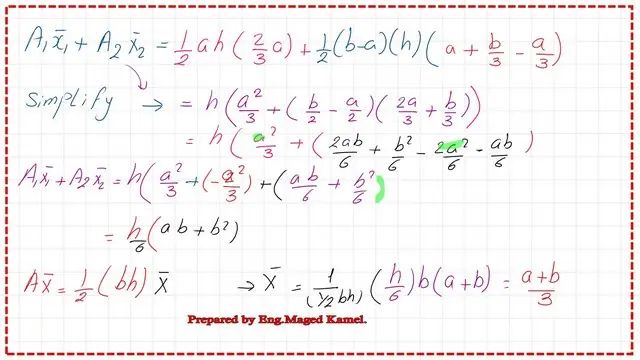
After simplifying the multiplication terms, the final first Moment of Area for the whole triangle equals (h/6*(ab+b^2)).
The final x-bar for the triangle, or the distance between the Cg of the triangle and the y-axis, can be found to be equal to (1/3)*(a+b) and matches the Reference Handbook-10 value of the Area and Cg of a triangle.
Area and Cg of a triangle-y bar for a triangle.
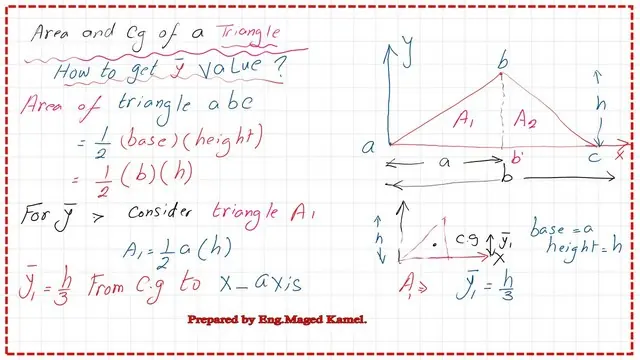
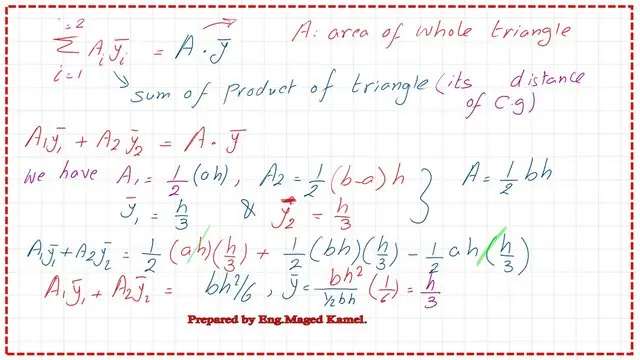
To find the triangle y-bar, we will divide the triangle into two triangles, A1 and A2, and calculate the y-bar for each. The first triangle Area can be found as =0.50*base* height, where the base length of the whole triangle =a, while a is the distance from point a to point b’—the common height of the triangle=h.
The AreaA1 = 0.50*a*h. Y1 bar, which is the Cg vertical distance to the x-axis, can be found to be=h/3, as for the second triangle. We find the y-bar for the triangle of Area A2; it is (1/3) h from the x-axis, passing through point a on the left side of the triangle.
The second Area is A2; its base is (b-a), and its height is h. The dimension b is the base of the whole triangle ABC. We can divide the Product of A2*y-bar2 by the Area A2. The Area is A2 = 0.50 (b-a)*h. while the cg distance to x- axis y- bar-2=h/3.
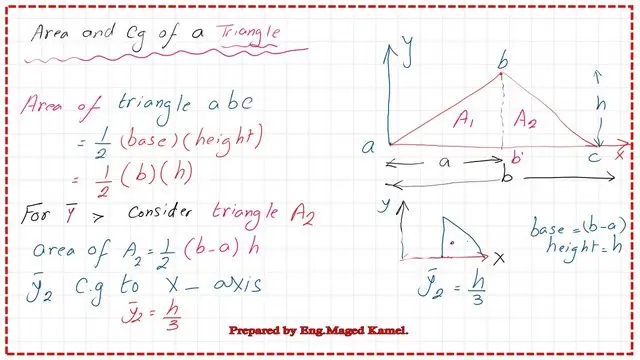
The final value for the Y-bar for the triangle can be obtained by summing the Product of A*y for Areas A1 and A2, and equating the value to the Product of the total area*y-bar of the triangle. We find that (A1*y1 bar + A2*y2 bar) = b*h^2/6.
Y-bar for a triangle.
The final y bar, or the distance between the Cg of the triangle and the x-axis, can be found as=h/3. This value matches the Reference Handbook-10 value for the Area and CC of a triangle.
You can view or download the PDF for this post via Area and CG for a Triangle.
For a good external reference, see Centroid of an Area by Integration.
This is the link to the next post, which will be Area and Cg for a Rectangle.