Last Updated on November 24, 2026 by Maged kamel
- AISC Metric Conversion Guide: How to Convert Imperial Steel Sections to SI Units
- Quick conversions for units.
- Stress estimation after converting to metric units.
- Pound per linear foot conversion to N/m.
- Where can you obtain data for metric sections?
- What is the Second source from which you can obtain the sections?
- Table CA 3.2. Minimum tensile properties for HSS sections
- Table 2.4-CM#15 for the three parts.
AISC Metric Conversion Guide: How to Convert Imperial Steel Sections to SI Units
In structural steel Design, engineers frequently work across both U.S. Customary (Imperial) units and the International System of Units (SI). Whether you are adapting AISC 360 specifications for an international project or solving textbook problems in metric units, understanding how to perform accurate soft conversions (metrification) is essential.
In this Post, we will discuss conversions from the U.S. Customary (pound-and-inch) system to the metric SI unit system for structural steel Design. You can follow along using the downloadable PDF of the presentation slides.
If we review the AISC 360 specifications (Chapter 17, Table 17-18), we find a summary of the SI conversion factors—often referred to as metrification.
For example, an inch—that is, any number expressed in inches—becomes 25.40 when converted to millimeters. Ten inches times 25.40 equals 254. To convert feet to meters, you multiply by 0.3048; that is, ten feet equals 10 × 0.3048, giving you 3.048 m, approximately a little less than three and a quarter. A pound-mass equals 0.4536 kg.
The pound-force is the force that acts on a pound-mass and produces an acceleration of 32.502 ft/Second^2. One pound-force equals 4.448 Nm. KSI is an important unit for yield stress, ultimate stress, and Bolt stress; to convert to megapascals (newtons per square millimeter), multiply by 6.895. Foot-pound-force is a unit of Moment; to convert it to joules, multiply by 1.356.
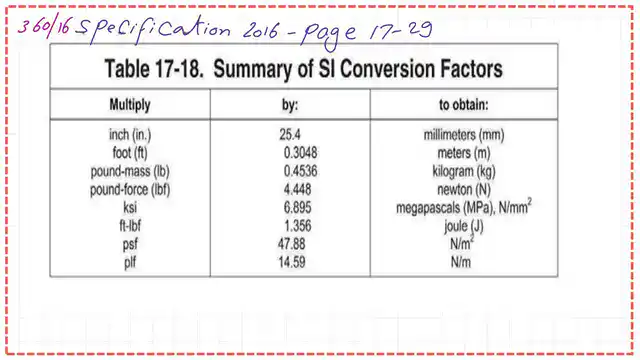
PSF, or pounds per square foot, is converted to newtons per square meter by multiplying by 47.888.888.808.808. To convert pound-foot to newtons per meter, multiply by 14.59.
Quick conversions for units.
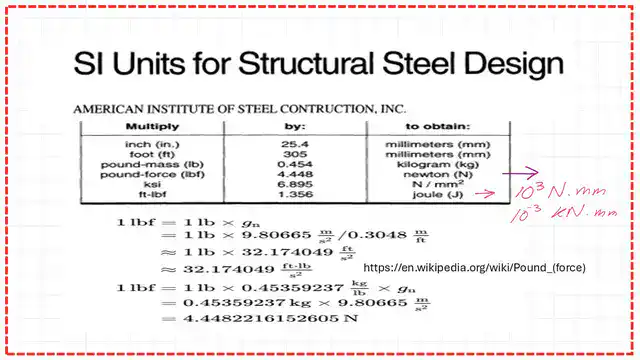
We move to the Second imperial slide. It shows that pound-foot is the force acting on one pound with the acceleration of gravity; thus, one pound-foot corresponds to a gravitational acceleration of 9.80665 meters per Second squared.
You divide again because you divide pound-foot by 0.3048 to convert from the standard gravitational acceleration of 9.80665 to the corresponding gravitational acceleration in pound units. If you divide 9.80665 by 0.3048 to convert meters to feet, the gravitational acceleration in ft/s² is 32.1740949.
Therefore, if you convert pound-force to ft · lb/s, we multiply by 32.174.
The pound-force acts on a one-pound mass under gravitational acceleration.
Suppose we want to convert to newtons and use gravitational acceleration in lb: 1 lb multiplied by 0.4536 kg/lb. The lbs cancel, and we multiply by g = 9.80665. The final result is that 1 lb-force equals 4.44822 N, or approximately 4.448 N.
Stress estimation after converting to metric units.
The corresponding AISC combinations are listed side by side and compared with ASCE 2010. or the combinations from 1 to 4.
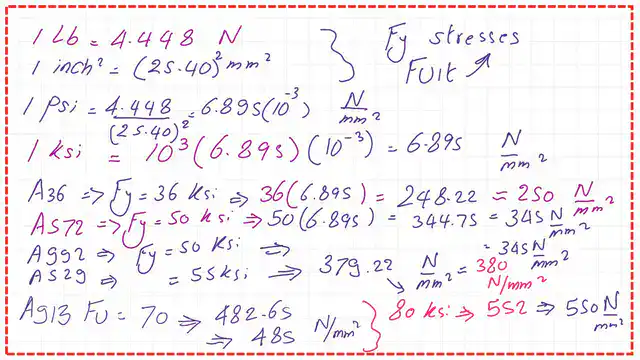
Let us look at the Third slide: 1 lb equals 4.448 N, and 1 inch equals 0.0254 m. To calculate stress, you divide the force by the Area, whether you are calculating yield stress, ultimate stress, or Bolt stress; 1 lb equals 4.448 N, and 1 square inch equals 645.16 square millimeters. Since we will divide the force by the Area, we will divide 4.448 by 25.4 square millimeters.
We will call this 1 psi = 4.448/(25.4) ^2 = 6.895x 10^-3 N/mm2. The unit of 1 ksi = 10^3 multiplied by 6.895x 10^-3 = 6.895. The letter K means ten to the third power, as in multiplying Psi by ten to the third power. I will write it as 6.895 × 10^3.
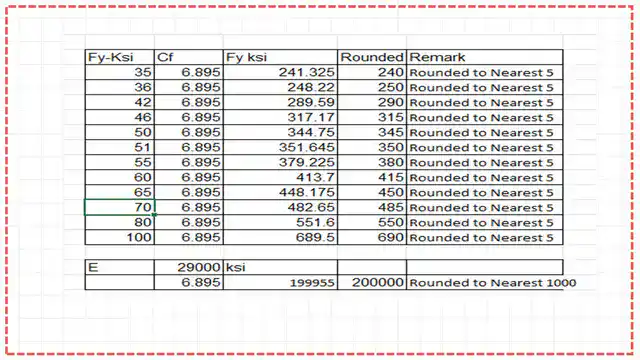
One Psi is equal to 6.895 × 10^-3 N/mm². For 1 ksi × 10^3, (6.895)^-3=.1 Ksi is equal to 6.895 N/mm². We will review the common stresses for steel and for different steel grades. For ASTM A36 with Fy of 36 ksi, 36 × 6.895 = 248.22, which rounds to 250 N/mm².
ASTM A572—yield stress 50 ksi; multiply 50 by 6.895 = 344.75 N/mm²; this rounds to 345 N/mm². Similarly, ASTM A992 is used for W sections; it has Fy = 50 ksi, which gives a yield stress of 345 N/mm2. We have ASTM A529 with Fy = 55 ksi, rounded to Fy = 380 N/mm². For A 913, Fult is 70 ksi. Multiplying by 6.895 gives 482.65 kips, rounded to 485 kips.
For 80 ksi, it will be rounded to 552 kips, then converted to 550 N/mm2.
The following slide contains a Table I created in Excel summarizing the different stress values, rounded to the nearest 5 MPa. In contrast, the Modulus of elasticity is rounded to the nearest thousand.
Pound per linear foot conversion to N/m.
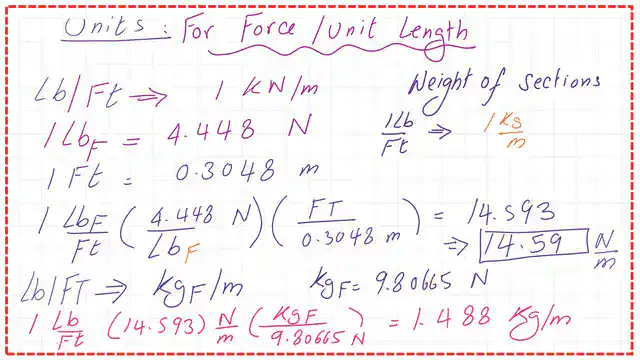
We want to convert from pounds per foot to kilonewtons per meter. One pound-foot is Equivalent to 4.448 newtons. And we want to see that one foot equals 30.48 centimeters, meaning 0.3048 meters. Divide 1 lb force by one Ft.
Because the Beam weight is Pbf × 4.448 / 0.3048, you can work in the physics system with Pbf; you want to convert to newtons per meter. Enter newtons in the denominator to cancel out pounds per foot; then enter newtons again to cancel out the foot, so you obtain 1 foot. To convert to meters, use 0.3048 m. Foot-pound with foot-pound and pound-foot with pound-foot, so you are left with newtons per meter; but you will divide 4.448 by 0.3048= 14.59.
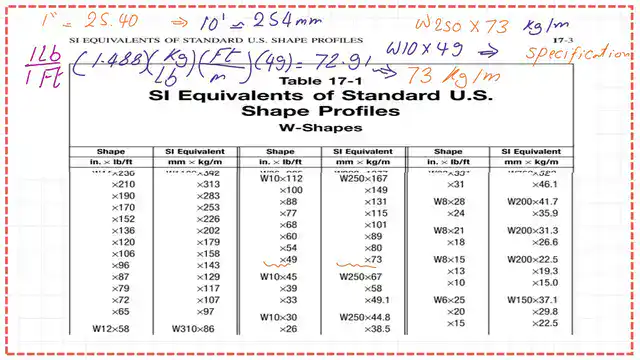
Let us check it with the Table in the Second slide; it has the same Value as we estimated: 14.59. One pound per ft converts to kgf/m. Or, kilogram-force equals 9.80665 newtons, so kilogram-force has the Value 9.806656 newtons. We have the relationship 14.59 Nm; if you want newtons, you obtain kilogram-force 9.80665 Nm. Finally, you are left with kilogram-meters: 14.593 M × 9.80665 1.488.
Where can you obtain data for metric sections?
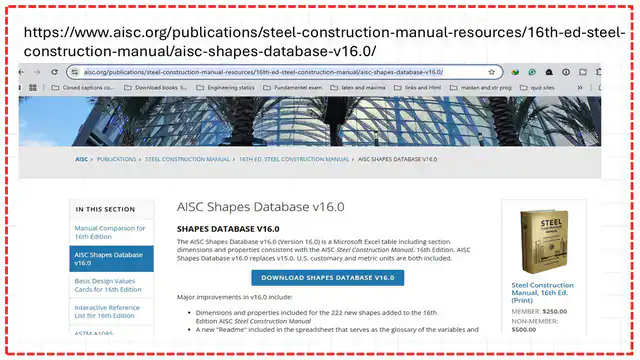
Finally, let us look at the two primary sources for obtaining metric steel section properties: Source 1: AISC Shapes Database v16.0 (Excel).On the AISC website, you can download Excel sections for the latest Shapes Database (version 16). The important thing is that it downloads the sections as an Excel sheet (version 16). If you open the Excel sheet, you will find a partial List.
Scroll to the left section, which I abbreviated as A, B, and C. The segments will appear in the linear section of the pound with a cone shape. Starting with the first C.G. and proceeding onward, the corresponding section will appear. For the number shown in Excel, an adjustment is required.
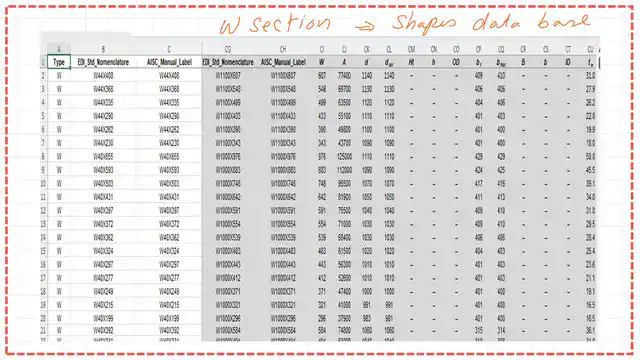
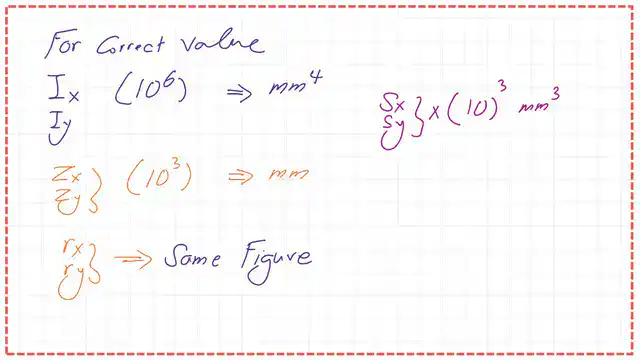
The number in Excel must be multiplied by the displacement Ix or Iy; it must be multiplied by 10⁶. The milli-newton Value is 4. Sx and Sy must be multiplied by 10³. Please review the following slide for more details.
What is the Second source from which you can obtain the sections?
Some mechanics and Matrix books that you can find in the back appendices. For example, you can refer back to Ferdinand Beer’s book, edition 7, SI units. A18.
For example, he gives something like W920x449; he gives the Area in mm2 and the depth in mm.
Also, the width and depth of the Flange and Web thickness. For Ix, the author multiplied by 10^6, while for Sx he multiplied by 10^3. For rx, no change: 391 mm.
The major axis is X-X, while the minor axis is Y-Y. For Iy, the figure is multiplied by 10^6; Sx is multiplied by 10^3; ry is left unchanged.
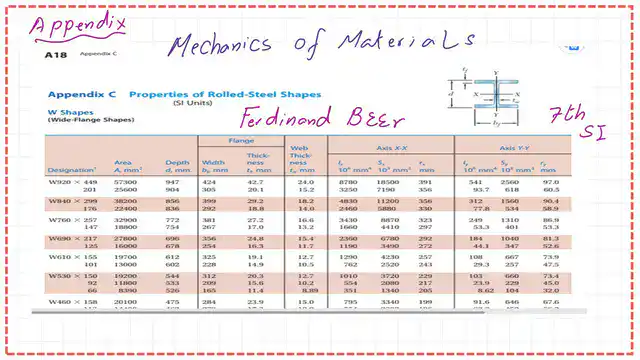
Table CA 3.2. Minimum tensile properties for HSS sections
The next slide contains Table CA 3.2. Minimum tensile properties for HSS sections, including a List of yield stresses based on List of ASTM standards starting from A53/ASTM A53M: Fy = 35 ksi (240 MPa) and Fu = 60 ksi (415 MPa), ending with ASTMA1065/A1065M.Please refer to the following slide.
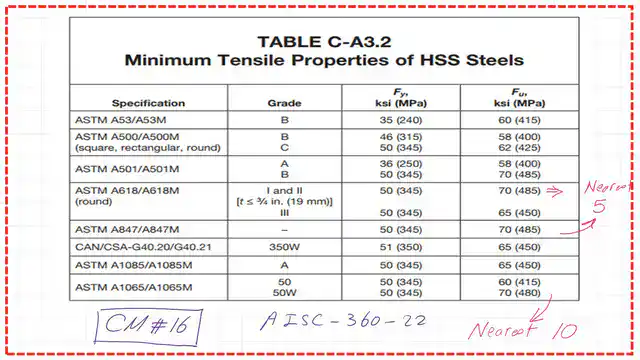
Table 2.4-CM#15 for the three parts.
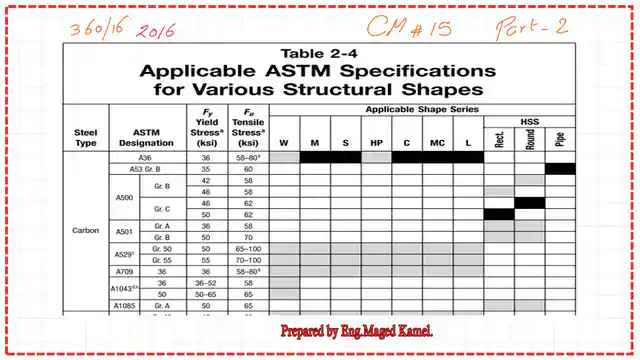
Note that in AISC 16th Edition (Table 2-4), the shading convention (dark gray, light gray, and white cells indicating preferred and available material specifications for each shape type) is updated compared to the 15th Edition.
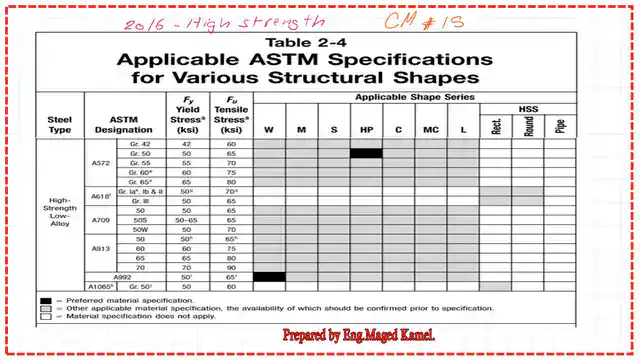
An extract from ACI 318 on LRFD Load combination cases matches ASCE 7.
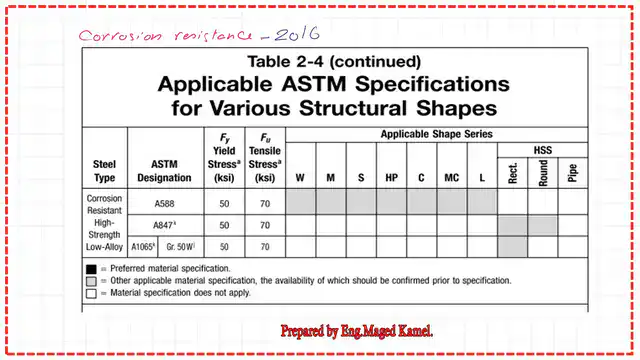
The following slide shows an example of the corresponding metric section for W10x49, using the Table.
The PDF for this Post can be reviewed or downloaded from the following documents.
This is a Link to a very good reference: Chapter 1 – Introduction–An Overview of the AISC Steel Construction Manual, 14th Edition.
This is a Link to a very good reference: Chapter 1 – Introduction: An Overview of the AISC Steel Construction Manual, 15th Edition.
This is a Link to a very good reference: Chapter 1 –Introduction: An Overview of the AISC Steel Construction Manual, 16th Edition.