Last Updated on September 20, 2026 by Maged kamel
Solved problem 4- 6: block Shear for a C-Channel-1/2.
Topics included in our discussion are shown in the next slides.
Solved problem 4-6 is the same as solved problem 4-4, which we covered in the previous Post, but it requires including block Shear.
Solved problem 4-6 is from Prof. Abi O. Aghayere’s handbook, 3rd edition.
We need to determine whether the channel and gusset plate are adequate for the applied ultimate tension Load, but we also have to consider the block Shear.
Consider block Shear: the plate’s breadth must be such that block Shear, combined with the failure plane depicted in Figure 4-12, governs the plate’s Design.
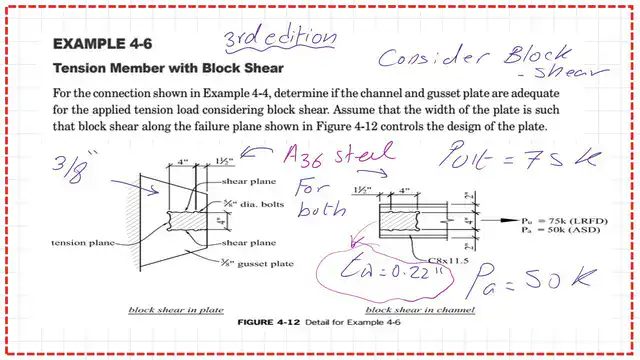
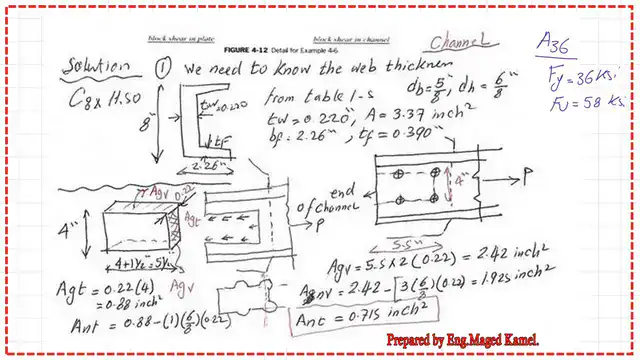
If we look closely at the C-channel after it has been split, we can see that the hatched shape is torn from the original shape; there are four bolts, and a route has been created for the separated component. The hatched Area is 5.50″ long and 4″ high.
The calculation for Agv, Anv, and Ant is for the channel.
We will perform the necessary calculations for the C channel to check the Block Shear Strength.
1- We have one plane acted upon by a tension force, for which Agt is the gross Area for tension, and the Area Ant is the net Area for tension. The section is perpendicular to the applied force. the height of this section=4″ and theWebb thickness =0.22″.
The channel’s gross Area is 3.37 inches2. The gross Area under tension is estimated as Agt = 4* 0.22 = 0.88 in^2.
For Ant, which is the net Area under tension, deduct two halves, which is one diameter of (5/8″+1/8″)=6/8″, and then multiply by the Web thickness. The net Area for the C-channel is the sum of holes * t-web = 0.88 – ((0.22*1)*(6/8)) = 0.715 in2.
Please refer to the next two slides for details of these calculations; they show the number of Hole diameters for both tension and Shear.
2—The Shear force component acts upon two planes, for which Agv is the gross Area for Shear, and Anv is the net Area for Shear. For Agv,we e(2* 5.50* 0.22) = 2.42 in^2; for the net Area in tension, Ant deducts the Area of 3 diameters: 3* (6/8) * (0.22) = 2.42 – (54/64) = 1.925 in^2.
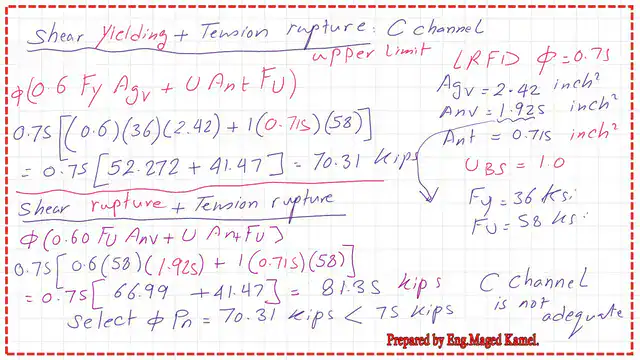
Block Shear calculation for the channel.
We will List all the values of Agv, Anv, and Ant that we estimated earlier. The steel is A36, with Fy = 36 ksi and ultimate stress, Fu = 58 ksi.
Based on the LRFD Design, φ equals 0.75 for Shear Yielding and tension rupture. Multiply φ by (0.60*Fuy*Agv)+UBS*Ant*Ful.
Based on the LRFD Design, we have φ = 0.75 for Shear Yielding and tension rupture. Multiply φ by (0.60*Fy*Agv)+UBS*Ant*Ful. We will substitute the Design nominal block Shear Value of 70.31 kips, as shown in the next slide.
Based on the LRFD Design, we have φ = 0.75 for Shear and tension rupture. Multiply φ by (0.60*Fu*Anv) + (UBS*Ant*Ful). We will substitute the Design nominal block Shear Value of 81.35 kips into the equation.
Select the minimum Value of 70.31 kips and check it against Pu. We find that the Design block Shear Strength is less than the Ultimate Load, so the C-channel is inadequate to carry the ultimate Load.
In the next Post, we will continue to solve problems 4-6.
The Post will include all the necessary data to estimate the block Shear for the Gusset plate and verify its adequacy under both LRFD and ASD. We will also continue checking the adequacy of the C-channel for the total Load.
You can view or download the PDF files for this Post and the next Post from the following Link.
The next Post is a solved problem: 4-6-block Shear for a C-Channel-2/2.
There is a very useful external Link: Block Shear Rupture–A Beginner’s Guide to the Steel Construction Manual, 14th ed.
There is a very useful external Link: Block Shear Rupture–A Beginner’s Guide to the Steel Construction Manual, 15th ed.
There is a very useful external Link: Block Shear Rupture–A Beginner’s Guide to the Steel Construction Manual, 16th ed.